
Havana’s Galería 23 y 12 has reasserted itself as an avant-garde space despite the conflicts that arose from its position in the city’s network of commercial galleries. The gallery has attempted to solve the old “avant-garde versus market” dilemma in exhibitions that engage cultural and social issues specific to this situation. The show titled Loop, with work by Osvaldo Yero and Ibrahim Miranda (on view in February and March) explored local and global connections by fostering a perspective that emerged from the artists’ own origins and evolution as well their respective fates as relocated individuals.
For those who are not familiar with the conditions of art discourse, the way that these artists translate experiences and trajectories that are dissimilar—yet convergent and tending toward interaction and flux—into images may be difficult to understand. Their strategy is framed by the creation of concentric spheres of personal experience that become public, or rather social. Yero and Miranda were educated at Havana’s Instituto Superior de Arte, among the 1980s and 1990s artistic cohorts. Their first works were inserted into the public sphere, where the most cherished expressions of the personal were transformed and acquired a new meaning. One should recall Miranda’s earliest printmaking period: those works seemed to retrieve an ancestral, ecumenical wisdom as they parodied the styles and functions of ancient bestiaries and medieval manuscripts, imposing themselves as code and universal experience—even if they were derived from the artist’s most personal perceptions. Later experiences, however, took Miranda to the Proyecto Cubrecamas (1997–1998), which broke the contours of the autonomous work, with the use of quilts, blankets, carpets, and tablecloths made in the popular patchwork technique. It offered the lived experience of involving the artist’s friends in the work of art, an event that in turn appeared as a game that implied contexts for circulation such as the home and the public space. In the same way, Yero, with his 1990s installations, appropriated the prototypes of Cuba’s traditional plasterwork and vernacular kitsch in works that salvaged the Cuban repertoire and cultural memory from different sources. At the same time, they were encompassing and trans-cultural in their quotations and references (such as the works Sueño de una noche de Verano, I love New York, El obrero y la kolhosiana, and El corazón sangrante de Jesús).
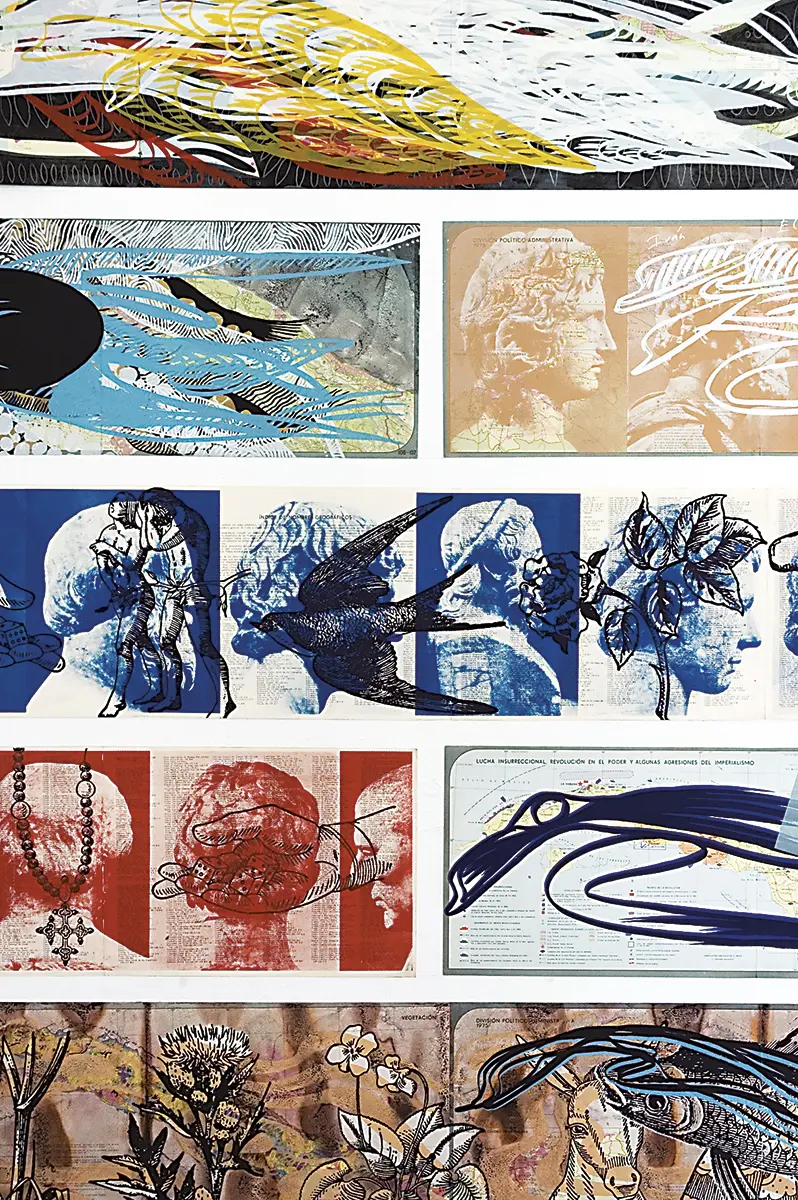
For the recent exhibition, and with paintings and prints that became installations, Miranda recycled imaginary maps; for a while, the artist’s work has described a nomadic contemporary culture and the body as the anchor between the private and the public, between here and there. In the work, monster islands moved toward insularity. Journeys to the geologic, biologic, and historical infinity of an island were in perpetual transformation. New cartographies of islands became cities, and cities became maps, always exploring the space of mutability, obsessed with the flow from the past to the present and back. Miranda’s maps could have been constellations seen from any vantage point, like the Nazca man or like the new idea of a global world. They were dressed with the trappings of different cultures, such as Asia, appearing international and speaking of superficial and limited knowledge of the world, of a complex and partial “worldization”—but returning, in a way, to the individual.
In 1997, Osvaldo Yero settled in Canada. The vernacular conceptualism of his early work was distilled through techniques and materials that allowed for better finishes and a rigorous relationship between image and title. Some alluded to phenomena like sea-borne migration (in the work Landmark) or displacement (in Transplant). In Landmark, 750 tear-shaped porcelain hands in various shades of blue created an undulating sea on the wall. In Transplant, the artist used vases (vital organs with seeded plants) that referred to the substitution of an old organ with a new one and the imminent change implied in any displacement. But Yero also returned to images of Cuba that have become universal and that synthesize the life-death-resurrection cycle through the figure of the hero, in this case, Korda’s famous photographs of a dead Che Guevara in Bolivia, digitally superimposed in an installation.
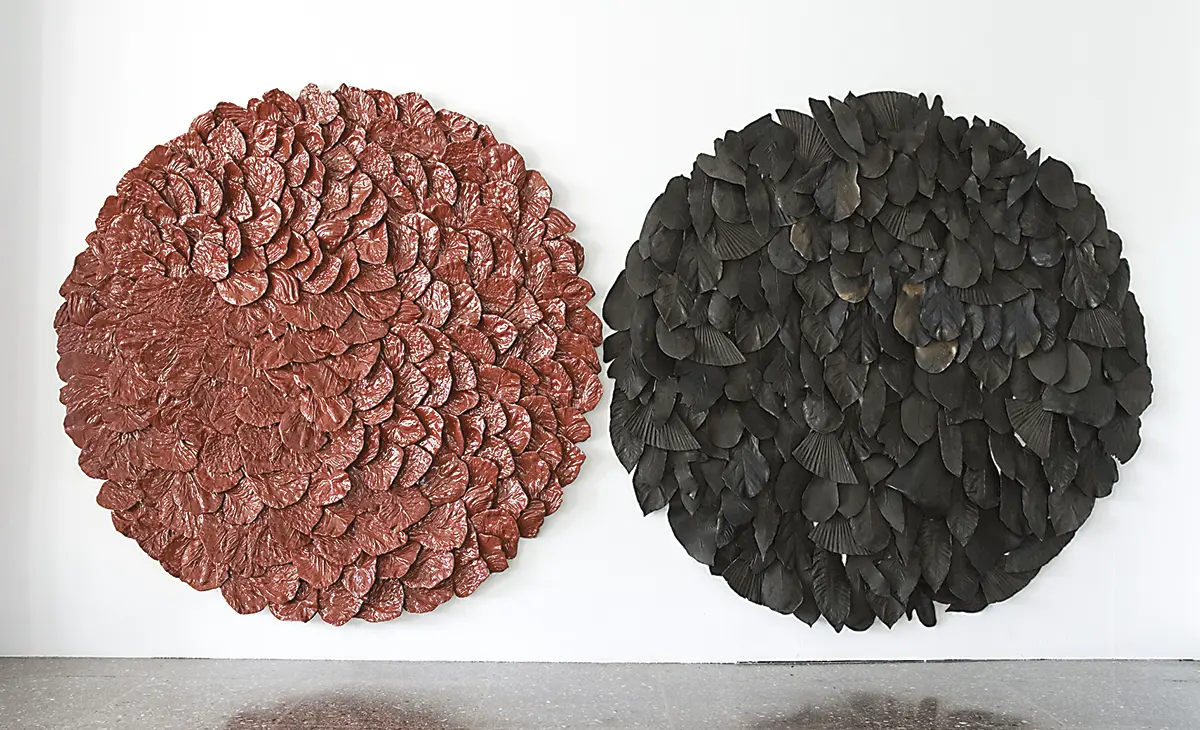
Yero returned to Havana and exhibited his work Loop (2008), which gave the recent show its title. But the installation favored Miranda. Two circles, one red and one black rubbed each other like opposites and equals. Composed of ceramic leaves with drawings that moved between the vegetal and the human, one related to life and the other to decaying organic matter, they created a kind of dual mandala connected to the continual processes—the complements of Life and Death as cycles that begin and end, that reject or attract each other in the permanent sacrifice that is existence.
DANNYS MONTES DE OCA MOREDA