
Sandra Cinto has placed an installation at the very center of the gallery exhibition space that lured the visitor to examine it at close range, but once there is also highlighted her other works around it, and made the whole room seem like one the single, unified project, even though all the pieces were not part of the installation. The piece refers to the title of the exhibition itself: The Journey after Gericault and features several prints of the famous painting by Gericault, now at the main hall of the Louvre, The Raft of the Medusa. There are seven prints hanging on a wall that actually stands for the traditional “seven seas” of ancient narratives. The artist has installed a a large number of paper boats coming onto the floor, as if they had somehow navigated their way into the gallery, falling from the wall, which holds the prints of the famous Gericault painting, onto the floor’s space. The feeling of displacement, endangered travel, and the fragility of migration have been given a truly poetic representation here.
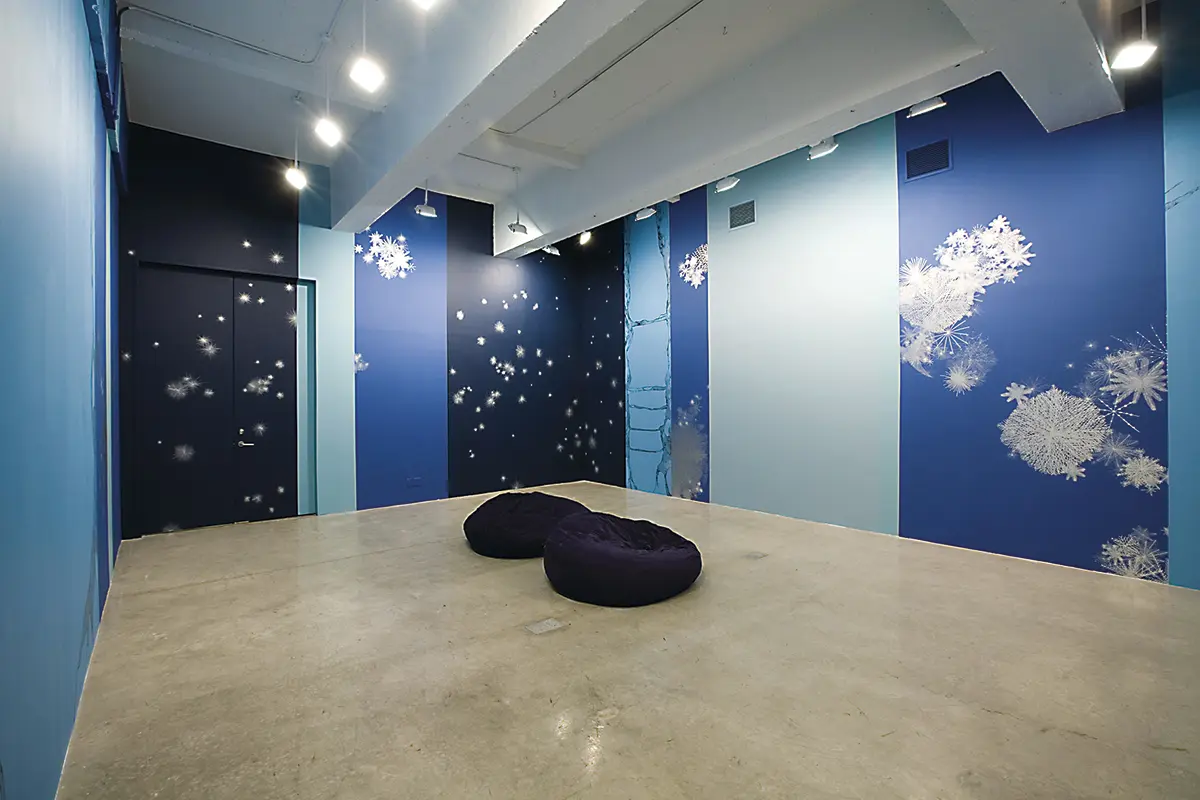
On another wall the artist has placed three seascapes piled into a triangle formation. The sea representation is done in a manner that strongly suggests the stylization of the Great wave at Kanagawa by Hokusai; here stylized waves assume the strength of the sea in motion in a detailed and monumental stance. The two paintings to the sides support the intended illusion of a water pyramid, which looked menacing and oppressive from the viewpoint of the small, fragile paper boats were strewn before it, although the paintings themselves were not part of the installation, the fact that they are all viewed in unison by the visitor, established a dialectic that may not have been intentional, but was certainly effective in reinforcing the theme of travel by sea. Here we must note that the hue of the blue used by the artist in the seascapes is a preamble to the blue room at the end of this exhibit, where the entire walls will be dedicated to a deep, celestial blue that is very much a part of the color vocabulary in the sea paintings.
Sandra’s commentary on immigration and displacement is both subtle and aesthetic. It introduces disturbing thoughts into an otherwise beautiful environment that resonates with the very appealing shades of blue and the virtuosity of her brushstrokes. It is precise because the presence of these beautifying effects that the presence of the paper boats is rendered more poignant, it was a most fortunate addition to the boats’ installation to be surrounded by pictures depicting the high seas. It also had the special quality of making the viewer have the illusion of walking into a dream, a space outside the exhausting reality of cosmopolitan contemporary life, which had disturbing overtones, yet was nevertheless very attractive.
The second room of the exhibit was covered with wall paintings, very delicate plant-like forms creeping through the walls, also in dark shades of blue, but here the sensation was one of meditative peace and tranquility as if she were creating a chapel for respite from the sensations from the other viewing area. It is the ability to convey serenity and peace that I would say is the most attractive characteristic of Sandra’s work; it invites the viewer to a journey of reflection, re-thinking, and inner contemplation. It certainly is heaven from the thoughts that the first room sustained on the fragility of travel and the uncertainty of the sea, and it made one want to stay longer and savor the experience.
ALBERTO BARRAL