
What did this show comprise? From the outside, the gallery’s portal—even when closed—confronted passers-by and interested visitors with an image of an ephemeral painting on the wall, broken and whole painted skateboards, a ramp, skateboard bags, and a video.
The video, titled The Bowl, with an approximate length of four minutes, fit well into the exhibition with its dual character of artist’s video and documentary. In it, the artist and other skaters clean and retouch an abandoned swimming pool in a forested area in Puerto Rico, transforming it into a bowl for skateboarding, which connected the scene inside the gallery to the open-air space in the video, and to the viewer who just passed by or peeked through the window. Juxtaposing the video’s virtual volumes were the mural and the objects: skateboards and bags.
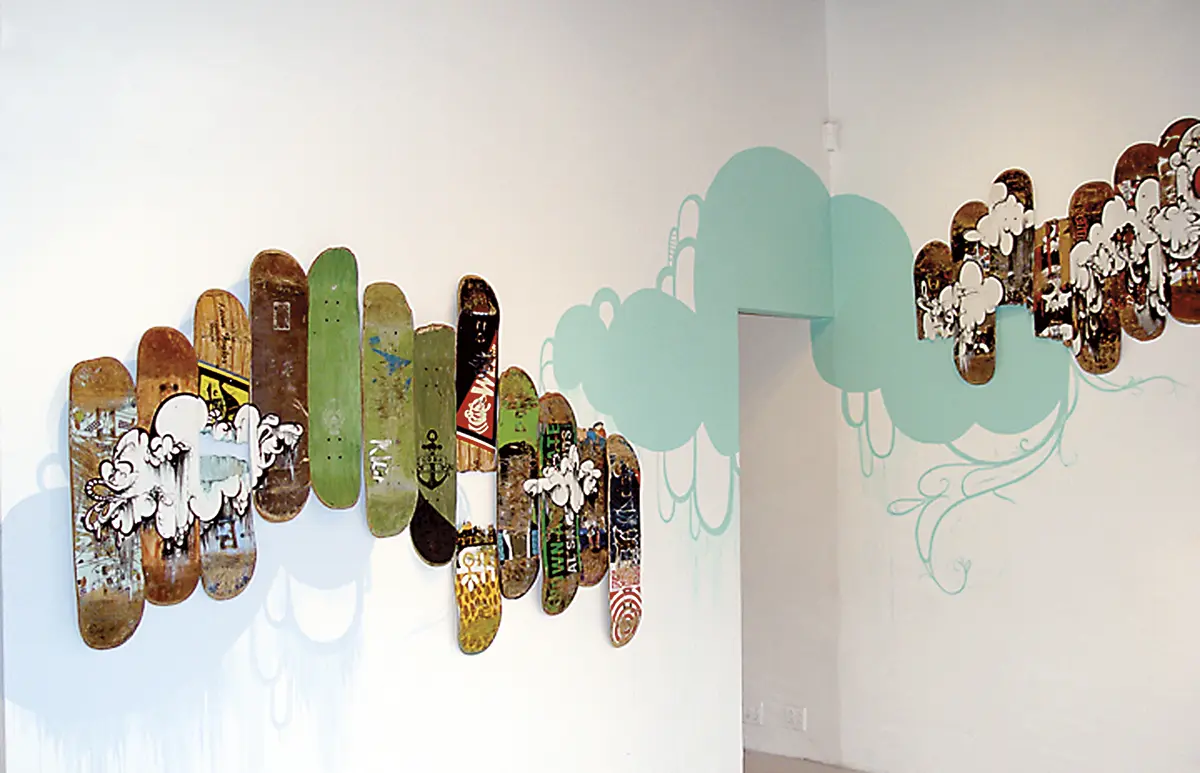
This three-dimensional scene of contemporary life, of the culture of urban public spaces, took place inside a New York gallery under the title La tormenta tropical (Tropical Storm). This was the first solo show in New York by the Puerto Rican artist Sofía Maldonado (born 1984). Maldonado incorporated skateboarding, graffiti, and punk rock to this presentation composed of installation, video, and objects. The concept of site-specific art operated through the opposite extremes of the flat painting and the enormous central volume of the ramp (five feet tall, twenty feet long, four feet wide) that occupied almost the entire gallery.
In the show’s title, the young artist cited a natural phenomenon that is significant despite being common. The tragic water-related events seen in recent years throughout the world were implied. The title allowed for a wide range of readings, connected specifically to storms, and was a reference to a specific moment in history that marked all coastal areas in relation to the tsunami.
At the same time, the concept of the tropical storm allowed other readings, such as an allusion to the duality of life/death: the activity, the game, the varied colors, and tones, and the movement of people on skateboards represented living in the face of implicit risk. The show also expressed the life/death duality through the broken skateboards, the actions are frozen in time, and the cleaning action, which not only can prepare a space for use but also can occur after a traumatic event, as in the case of a flood.
For those who don’t remember, the storms of recent years destroyed many things, erasing human lives and leveling entire geographical areas. Unlike water skiing, skateboards are used in the city, on asphalt, on specially built platforms; they require appropriate spaces, horizontal embankments, and launching and landing locations. On the other hand, the painting was a dynamic, animated, and even violent representation. Through the use of color and the application of matter, Maldonado manifested the storm. Although the skateboards were attached to the wall, the sensation of movement and speed was intense.
The storm also symbolized certain aggressive postures. With the jaunty skateboard bags, the artist confronted the chauvinistic postures of male skateboarders who brandish their boards in their hands or under their arms. The bags created by Maldonado responded to the practical sense of a woman who uses her skateboard only for the pleasure of the “sport,” or as a means of transportation in the city, and afterward keeps them inside the youthful bags.
Conceptually, the exhibition expanded into other areas, such as the unusual practical sense of a visual artist, and in that way, Maldonado and the gallery entered the respectable domain of the applied arts. This topic is as old as the world and many labels have been applied, among them the mistaken title of “minor art.” In the twentieth century, with the counterculture that persists, important artisanal work—both in terms of techniques and materials and in certain characteristics of the image—was integrated with author-driven work. Depending on who does it, how and where it is presented, and how authorial it is, countercultural work that reaches levels of applied art rubs elbows with design and is the freshest denizen of the twenty-first century. This could be perceived at Magnan Emrich. With the gallery’s interest in occasionally assuming this stance, Sofía Maldonado’s exhibition found an adequate context, one that extends from the visual artist to somebody who understands, inhabits, and maintains her generation’s culture.
GRACIELA KARTOFEL