
At 36 years of age, Aby Ruiz has not only become one of the best and most respected painters of his generation, but he is also, without a doubt, one of the foremost representatives of the New Figurative Painting in Puerto Rico. This generation includes excellent artists such as Rabindranat Díaz, Camilo Carrión, Eliezer Pagan (SKE), Carlos Santiago, and Fernando Villanueva. Ruiz is also well known – through his ingenious snapshots – as an honest, powerful, and thoughtful interpreter/creator/poet of our realities – specifically of the marked prevailing inequalities – that divide and continue to destroy our society.
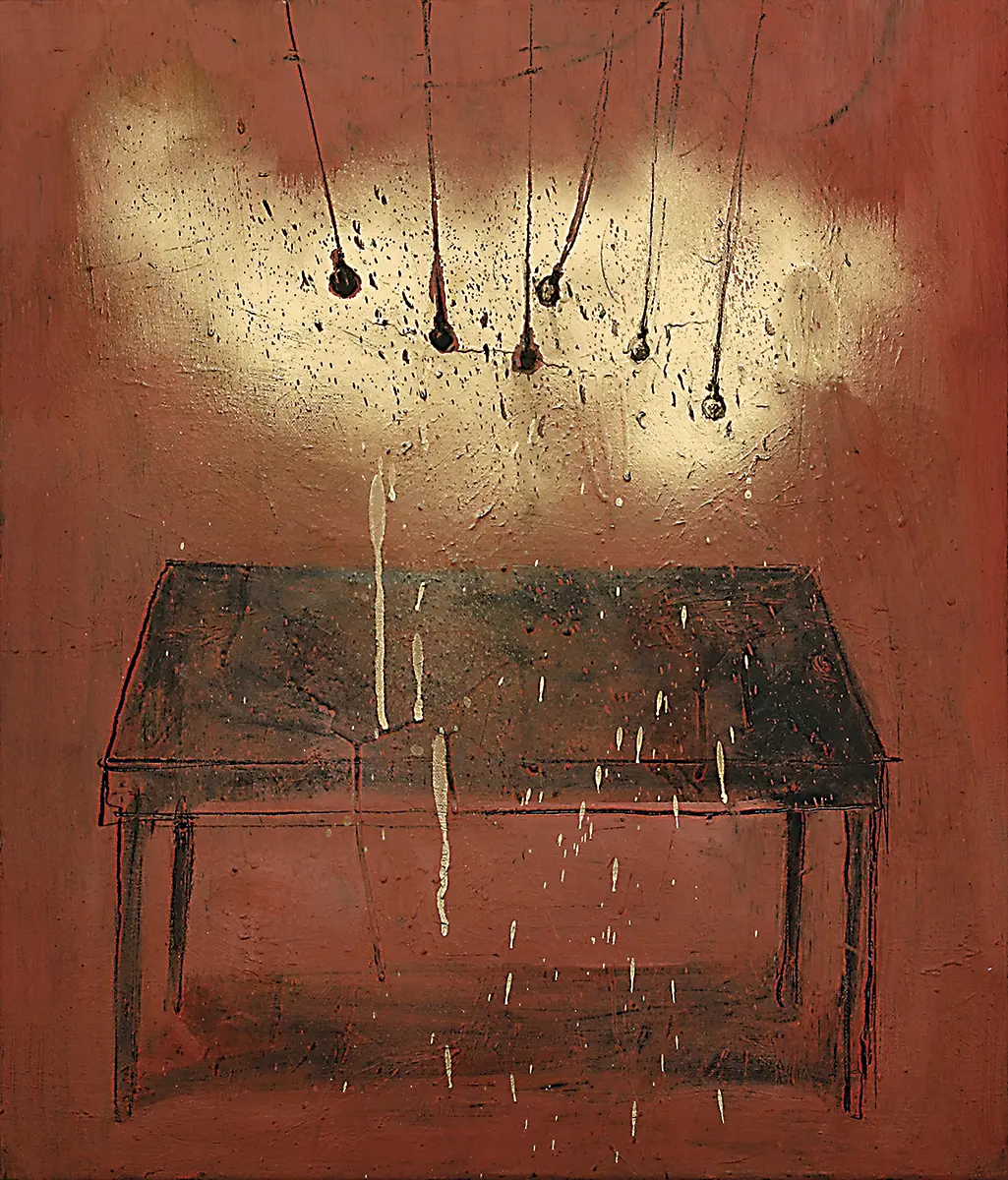
Although Ruiz’s work is immensely diverse [those of us following his career through his exhibits and studies have observed how each of his paintings, drawings/paintings on paper, every single one of his labyrinths composed with tens of his extraordinary retazos (remnants) that become whole in the end: couples, light bulbs illuminating desolated spaces or inhabited by desperation – in the manner of Picasso’s Guernica – flies, live beings already “carrying their own skeletons”, “playful” pink elephants, faces hungry for everything, men on the verge of committing suicide], we know that each of his subjects and objects are intense/sharp aesthetic and ethic “radiographies” of our existential period. The persistent struggle between the haves and the have nots is always present in his work; those having fun amid emptiness – the wasteful ones – while “the others” live in brutal poverty, solitude, and desperation (are they us?); loneliness and hope, oscillating between those forced to surrender and others who still believe in humanity and life.
In this current show at the 356 Gallery, we note a different Aby Ruiz (Arecibo, Puerto Rico, 1971) than the other known for his masterful architectonic/existential spaces of desperation; for celebrating life and representing men and women as they travel on the roller-coaster that is life. In this exhibit, a new dimension of Ruiz’s enormous dramatic and poetic creative powers is evidenced as he captures/recreates/translates both hopeless depths of suffering, crushing loneliness, and heart-rending desperation, as well as colorful moments of euphoria during which we delve into ephemeral explosions of pleasure and false happiness.
The contrasts in Ruiz’s work here are more marked than ever before. In this exhibit, we see masterful paintings such as La Vida que Sigue (The Life that Follows), in which the artist narrates the suffering and death of his friend, painter Henry Ortiz, who died alone when he was just over 40 years of age; Hazme un Chiste (Tell Me a Joke), a painting in which Death takes the artist away, and he in turn leaves his multiple hearts behind; Carga su Carne (He Carries His Flesh), which deals with true sacrifices, and Oro Negro (Black Gold), a very eloquent critique of capitalism. These works powerfully underscore the devastating injustices that the artists see, because they also – as in an installation – present characters (Puerto Rican, Latin-American, characters from Third World Countries – some of these a result of the impact on the artist by the movie Motorcycle Diaries, of 2004, on Che Guevara’s travels through Latin America) painted on aluminum plates in which the natural shine of the metal bestows a halo of sanctity (‘Blessed are the poor in spirit, for theirs is the kingdom of heaven’). And on the other hand, the artist contrasts these images with other colorful ones depicting characters living grotesque lives in Monkey See, Monkey Do and El sanwish (The Sandwich), in which people unknowingly find themselves very close to the most ignorant interpretations of Maquiavelo, Hobbes, Darwin, Nietzsche, and Freud. The duality of life is crystal clear in Ruiz’s work: the hungry vs. the well-fed, the winners vs. the losers.
Ruiz’s characters – always portraying us during restless or dreamlike moments that are far removed from our “secured” lives – and his fantastic spaces also very distant from every day is mysteriously bound as they prompt us to become part of the story that the author presents in one of his compositions, regardless of the dimensions of the work.
For the past twenty years, several variations of New Figurative Painting have been developing in Puerto Rico and around the world. They are all surprising for their originality and strengths. Nevertheless, several authors can be seen as standing out, and Aby Ruiz figures among these. He not only presents us with extraordinary visions of light – such as with his sensual female nudes and phenomenal bestiary – but he also dares to exhibit environments of darkness and the things hiding hide under its blanket. The bodies and spaces he creates express secret needs and untold desires that generate in the spectator ambiguous and enigmatic associations; the spectator who always appears as one of the common folk in wartime. Some of Ruiz’s works will remind us of Conrad (The Heart of Darkness), or Camus (The Stranger), among others, and of novel post-modern games and the new avenues of the information technology revolution.
MANUEL ALVAREZ-LEZAMA