
As an accepted form of art, ceramics acquired a new dimension in Puerto Rico when Susana Espinosa and her husband Bernardo Hogan (two Argentineans)—together with Jaime Suarez (a Puerto Rican), Toni Hableton (a Mexican), and Aileen Castaneda (a Cuban)—established one of the most creative and successful art projects the island has witnessed: Casa Candina, a powerhouse for future ceramic sculptors. The now dismantled and sorely missed Casa Candina was a true aesthetic experience that lasted for over two decades. Along with Liga de Arte de San Juan master ceramists John Balossi and Sylvia Blanco, Casa Candina was responsible for the education and development of extraordinary local ceramic sculptors like Christina Cordova, Redo del Olmo, and Adriana Mangual.
Mangual (who is in her early sixties and was born in Mayaguez, Puerto Rico) is one of the most original and provoking ceramic sculptors in Puerto Rico today but unfortunately, for complex reasons, she has never received the recognition she deserves. In fact, I often compare Mangual’s energy and imagination with the late painter Marta Perez Morales, whose insatiable surrealist creativity in the field of naïf painting made her one of Puerto Rico’s most important artists of the second half of the twentieth century.
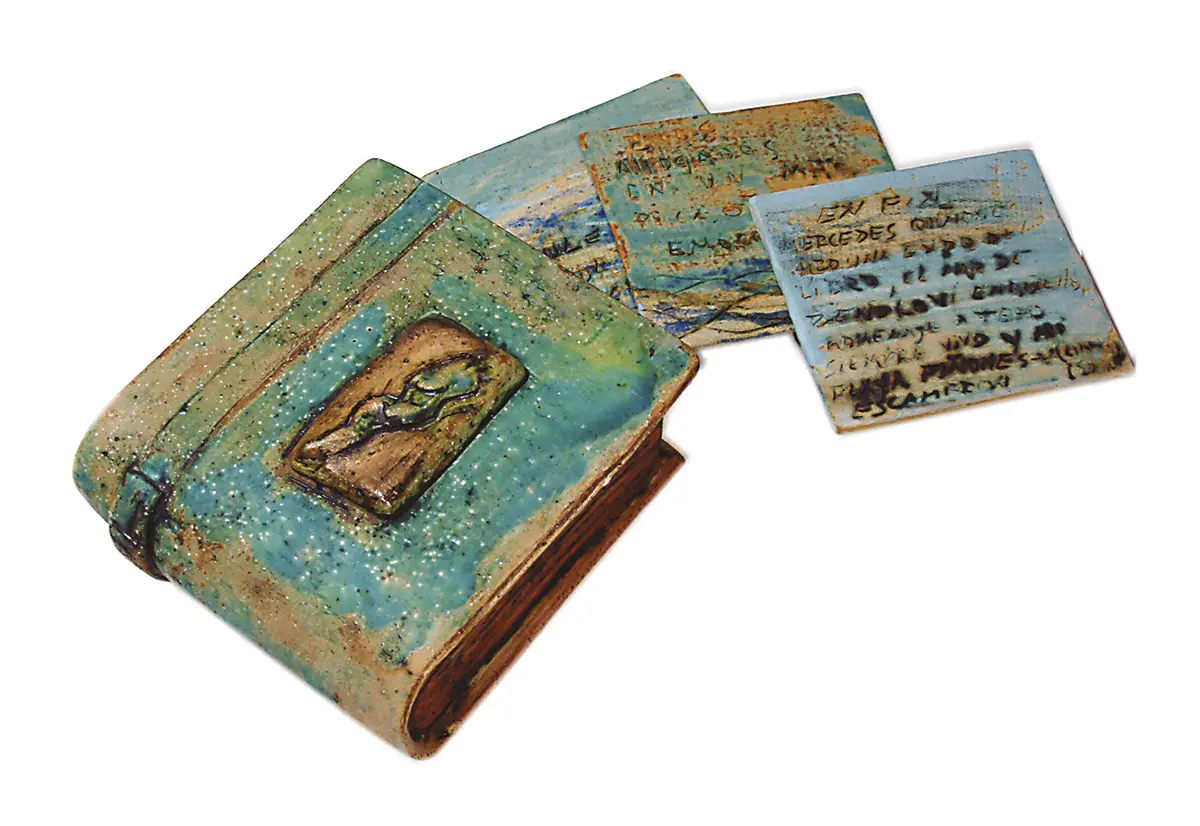
Having studied at Casa Candina and also having taken courses at the School of Plastic Arts of Puerto Rico and in Japan, Mangual has always recognized that her most important local influences are Susana Espinosa and Bernardo Hogan. Nonetheless, she quickly developed her own distinctive discourse, one in which she was able to reinvent herself within the realm of naïve/surrealist art. Those of us who have followed her three-decade-long career has witnessed the transitions from her adorable casitas to her fascinating portraits, from her astonishing bestiaries to her delicate angels and superb, elongated human figures. Each one of her creative periods—including the most formal ones in which cubism and abstraction played important roles in her existentialist manifestations—has been an aesthetic challenge that combines elements from three basic sources: her rich personal experiences, Puerto Rican culture, and the great themes of art throughout history.
Nonetheless, I believe that Mangual’s best work can be best described as the product of various moments of freedom. There are times when her work comes from a “flower child” from the 60s (in which we find her flowers, leaves, stars, hearts, and Taino Indians). Other times it reveals the years she spent studying at a nun’s boarding school in Madrid since the age of ten (in which one sees her confessionals cross, and altars). Then there are the existentialist moments when she produced her phenomenal chairs (exquisite love chairs, patience chairs, dream chairs, poetry chairs, mourning chairs), her astonishing angels (angels with only one wing, angels like common people, old and tired angels, erotic angels), or her extraordinarily poetic, elongated figures that remind art connoisseurs of both El Greco and Giacometti (such as a series of more than thirty magnificent sculptures of men and women which reveal the beauty and fears of being alive).
Mangual has stated, “Clay and our flesh are brothers and therefore can capture every human feeling about our fragile condition, about Mother Nature.” She possesses a privileged imagination that can freely translate images into clay, from folkloric icons (the aforementioned decorative casitas, the humble little wooden houses where the peasants used to live, or the local flowers or mushrooms) to her own interpretations of lo real maravilloso, from all sorts of common personages to truly deep existentialists or mystic experiences embodied in her more spiritual creatures. This tireless creator has conceived many pieces that, in my judgment, are at the same level as the best ones produced by Susana Espinosa or Cristina Cordova, two internationally acclaimed surrealist ceramic sculptors from Puerto Rico.
For the recent group exhibition at Botello Gallery in Old San Juan, titled Four Women Artists: Adriana Mangual, Masaro Torres, Roxana Jordan, and Chezelle Torres, Mangual chose the sea as the unifying element of her sculptures. These works embodied the sea as an aesthetic force, the sea as the primeval source of life, the sea as the beginning of philosophy (Thales of Miletus), and the sea, in Mangual’s words, “as the great Teacher, who lets us know that even if She is made of drops of water which are different from each other, it is One, a Whole, the essence of Life and Harmonies.”
According to Mangual, her love for the sea (the Atlantic and Caribbean Oceans) guided her “to create simple but deep metaphors about the secrets and magic of this good Friend and awesome Teacher.” In this show, art lovers saw spectacular sirens giving birth to fish, charming fisherwomen, seductive sea guardians, provocative sea books, angels of the seas, sea goddesses, etc., which were all contained within Adriana Mangual’s alluring eclecticism.
MANUEL ÁLVAREZ LEZAMA