
Despite its political and historical importance, natural beauty, and technological interest, the Panama Canal has inspired works by only a limited number of artists. The recent landscapes by the renowned Panamanian painter Amalia Tapia represent one of those few exceptions in her country’s pictorial tradition. They are landscapes that depict multiple views of the profuse natural environment surrounding the Canal, interpretations of the locks’ mechanisms, and views of the human activity that have all made the Panama Canal worthy of being called one of the wonders of the world.
Notwithstanding their documentary value, Amalia Tapia’s landscapes differ dramatically from being simple registers of a geographical, technological, and maritime reality. Her canvases make an impression in terms of their atmospheric quality, the handling of contrasting colors, and the interpretation of natural light at different times of day. They are reminiscent of the landscapes of great Impressionist painters, a tradition to which they are bound by their focus on the effects of light, their small brush strokes, and the artist’s desire to interpret the natural world and underscore the accomplishments of contemporary man. Impressionism not only celebrated light but also modern reality, human activity, and new machinery. In the same way that Monet demonstrated a fascination for steam engines in works such as Gare St. Lazare and mechanical structures like the Pont d’Argenteuil, Tapia celebrates, through her paintings, this path between two oceans carved by man.
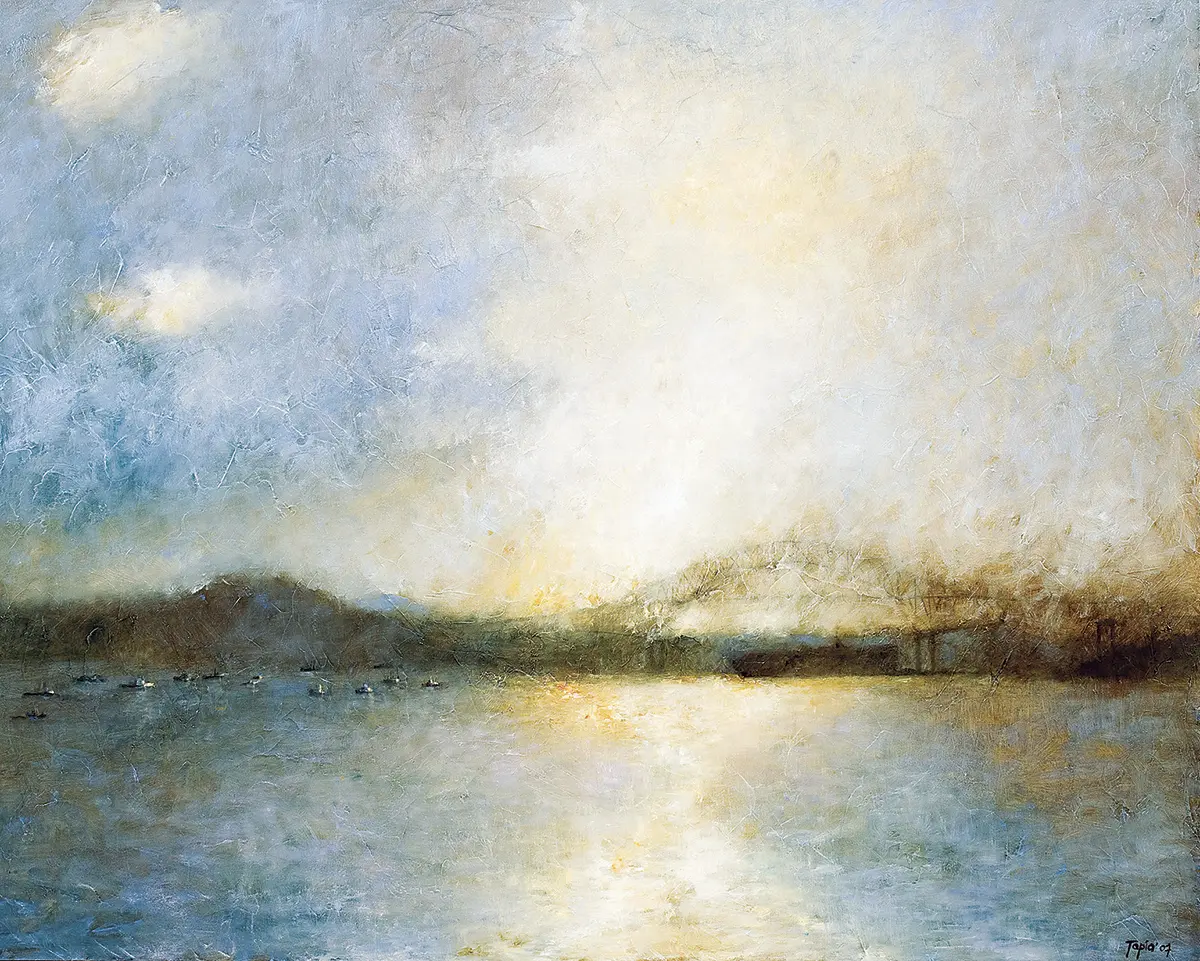
The painter has focused on the Panama Canal at a moment of special historical importance, a point in time when this portion of land and this great waterway have finally passed, in fulfillment of the Torrijos-Carter Treaties, to Panamanian hands. If throughout the history of art, landscapes have been the favored images for the exaltation of nationalism and patriotic fervor, this focus by Tapia serves as a reflection—granted, a romantic one—of a new national reality. The implementation of these treaties represents the third independence for Panama (after its separations from Spain and later Colombia), and the Canal is the perfect symbol of this transformation. In a subtle manner, with a poetic vision of the landscape and the machinery, Amalia Tapia represents a new political reality and a sense of hope for a prosperous future.
Tapia’s esthetic achievements are also noteworthy, the consequence of years of dedication to research and the constant exercise of the painting process. There is nothing casual about her choice of colors or the structure of her compositions. It is impressive to see how Tapia, who for decades has expressed herself through intimate subjects such as still-lifes and the representation of objects with personal and sentimental value, has managed a transition to painting great exteriors. There is a grandiose quality to her landscapes, even in the smaller formats, as they describe the sublime and overpowering character of natural tropical environments and of the breach that man dug through the isthmus. We observe great ships minimized by the sheer size of the canal, cascades that explode over calmer waters, and the elegant bridges that connect one side of the country with the other, North America with South America. In these oil paintings, even the gates of the locks—those great mechanical doors— shine gloriously in all their texture, their wear, their history.
Within the grandiloquent landscape, a man appears as a small, yet important figure. Tapia paints engineers and workers, but also the participants of the famous cayuco races who, once a year during the summer months, row through the canal from the Atlantic to the Pacific. These races, formerly an activity mainly for Americans living in the Canal Zone, are now organized by Panamanians who enjoy this unique event in which men and women approach the grandeur of the waterway in the humblest of ways, aboard indigenous canoes with wooden oars. Nowhere do they look as small as when Tapia paints them inside the locks, which are just wide enough for the Panamax ships, but that represent enormous chambers of cement and metal for the tiny canoes—a brilliant metaphor for the relationship between man and the monumentality of this technological project.
This new series by Amalia Tapia neither defies conventions nor treads new paths in avant-garde art. Rather, her sense of drawings, composition, color, and content, reminds us of the importance of traditional values in painting. A century after Impressionism, Tapia reinterprets the lessons of this movement and adapts them to a theme not only of great importance but also of great beauty. Her paintings succeed in imbuing these local landscapes with a universal quality.
MÓNICA KUPFER