
After appearing before the city’s audience in several group exhibitions, Ángel Marcano presents his first personal show at Sala Mendoza’s new facilities. The show is comprised of six medium- and large-format works created between 2005 and 2008, in a technique that narrows the gap between drawing and installation. Under the title of Molduras y soportes, this young artist develops a proposal that transcends the borders of two-dimensionality in order to explore the three-dimensional, through the incorporation of space as an expressive medium; a reinterpretation, from a contemporary-art standpoint, of the “paperless drawing” developed by Gego decades ago.
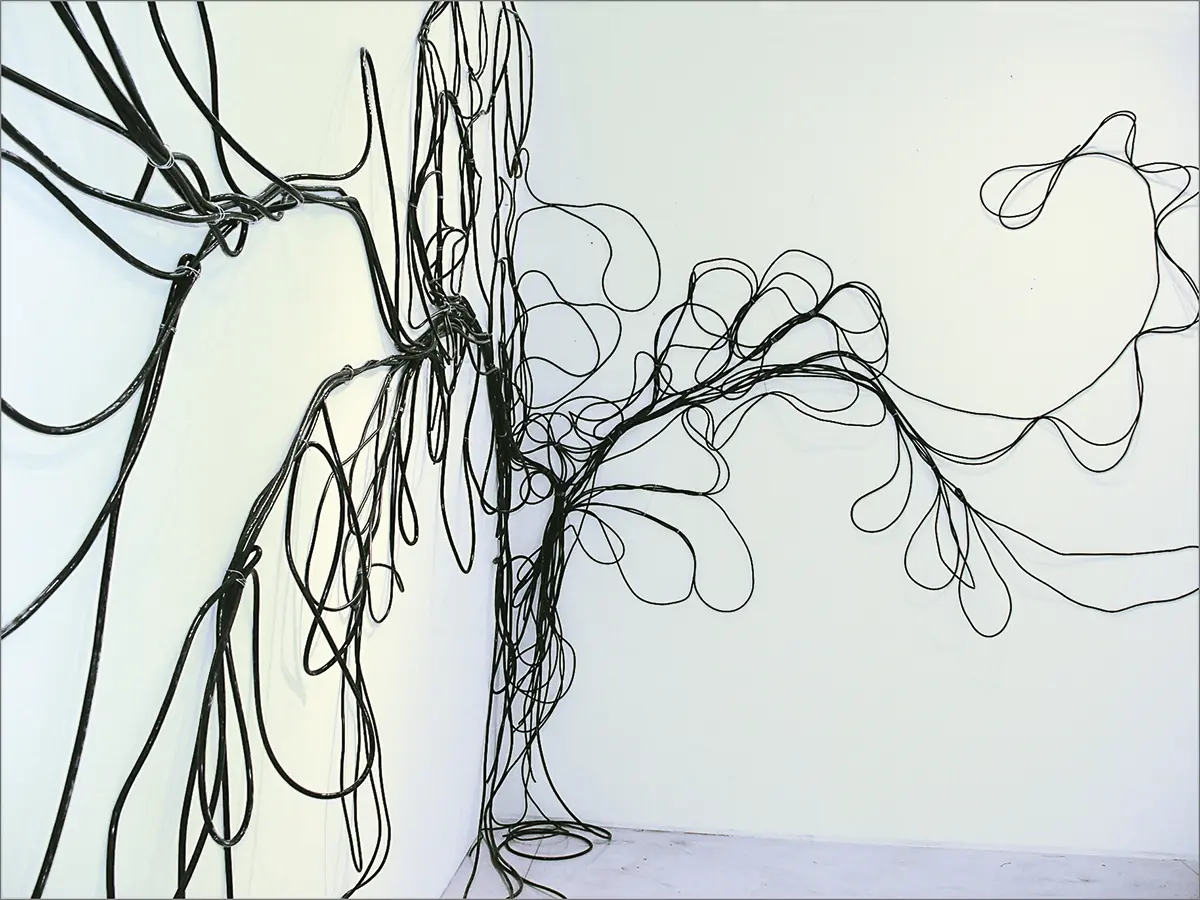
In recent years, Marcano’s work has assumed a variety of references that enrich and consolidate his initial proposal. In 2004 he experimented with metal wires tied into small sketches affixed to a wall, suggestive of features of the human figure —eyes, mouths, fingers—, as can be seen in 170 ojos, which won for its author First Prize in the VII Salón CANTV Jóvenes con FIA. From those fragmented forms, atomized against their base on a wall, he moved on to a continuous weaving of organic lines, sinuosities he achieves through the pliability of the copper wire he uses to design a kind of embroidery, ornaments, and structures that favor a dual reading. On the one hand, a relationship is established with hand weaving, and on the other, there is a connection to architectural elements. Thus the use of terms such as “moldings” and “supports” in naming his compositions. In this way, Marcano alludes to protruding or inlaid forms, the kind of artful add-ons, purely decorative in character, that are made to cabinetry, furniture, or buildings. Configurations that are repeated obsessively in search of chaos within order, or order within chaos. These elements constitute the central theme of Marcano’s discourse. They refer us to the spires, volutes, rosettes, or frontispieces characteristic of the European models that have become part of the West’s tradition.
In the series Redes, 2007, for example, the modular scheme is repeated, trying to mimic the geometric shape in a succession of reticules that seem to expand beyond the work itself. Rosas, 2008, in turn, is a jumble of small metallic agglutinations that come down like a waterfall attracted by the force of gravity. Contrary to what its name indicates, Soporte (La Alhambra) 2005-2008, is a 12-piece installation in a galvanized wire. As a whole the composition wants to emulate one section of the famous Granada building, well known for its many columns. Marcano evokes these constructions through his use of a metallic filigree of delicate wire twists to outline the contours of 12 columns whose ethereal bodies rise, weightless, in the middle of the gallery. For this series, he took photographs that allowed him to emphasize architecturally details. In other compositions, however, he uses memory and imagination: “I simply see the image,” the artist says, “copy it in my memory, and never turn to see the building again, granting myself a license to make a free drawing of what I have seen…” Hence the element of irregularity seen in his works, which approach the artisanal, a form of freedom Marcano introduces to give his art the pulsation of the unfinished, pointing out an action in progress, a shape that is never completely defined or built, so that their organicity is an expression of the living. In other compositions, like Escayola negra, 2008, made of thick cables, he seeks to return to the density of the line, to the density of the form, a forceful demonstration of a creative process that goes from one extreme to the other, from the immaterial to the material, from the virtual to the real, from emptiness to fullness. Marcano’s proposal moves from an interior vision that explores the labyrinths of memory to an external one that establishes relationships with its environment. The interior reflection arises by making concrete those fleeting, volatile images that emerge from the recollection of the visual experience. In their material concretion, the fragility of the elements and the lightness of the composition require, to a degree, of the help of the surrounding space to complement the mise-en-scene. Invisible connections between walls, floors, ceilings, lights, and shadows are indirectly posited, and these elements are added to the original body in order to induce a wider perception, or better yet, to guide us toward a reading of works of art that are open in both form and content.
GLADYS YUNES YUNES