
This past spring, the Chicago Cultural Center presented a show of the work of the Puerto Rican painter Arnaldo Roche Rabell, Brotherhood / Hermandad, which opened April 26 and was on view through June 22, 2008. This was the artist’s second solo show at the Chicago Cultural Center, and the exhibit also traveled to the Museum of Latin American Art in Long Beach, California. Curated by Gregory G. Knight, the exhibition was co-sponsored by the National Museum of Mexican Art and the Puerto Rican Art Alliance, Chicago.
Approximately twenty of Roche’s recent oil paintings were exhibited in the Cultural Center’s fourth-floor Exhibit Hall: a quiet space with soaring ceilings that dramatically showcased Roche’s vivid large-scale canvases. Arranged primarily by color and shade, the show focused on the artist’s production from 2002 through 2007. A graduate of the BFA and MFA programs at the School of the Art Institute of Chicago (SAIC), Roche lived and worked in Chicago in the 1980s and early 90s. Brotherhood / Hermandad was something of a homecoming exhibition for Roche, who has been working in San Juan, Puerto Rico, for fifteen years.
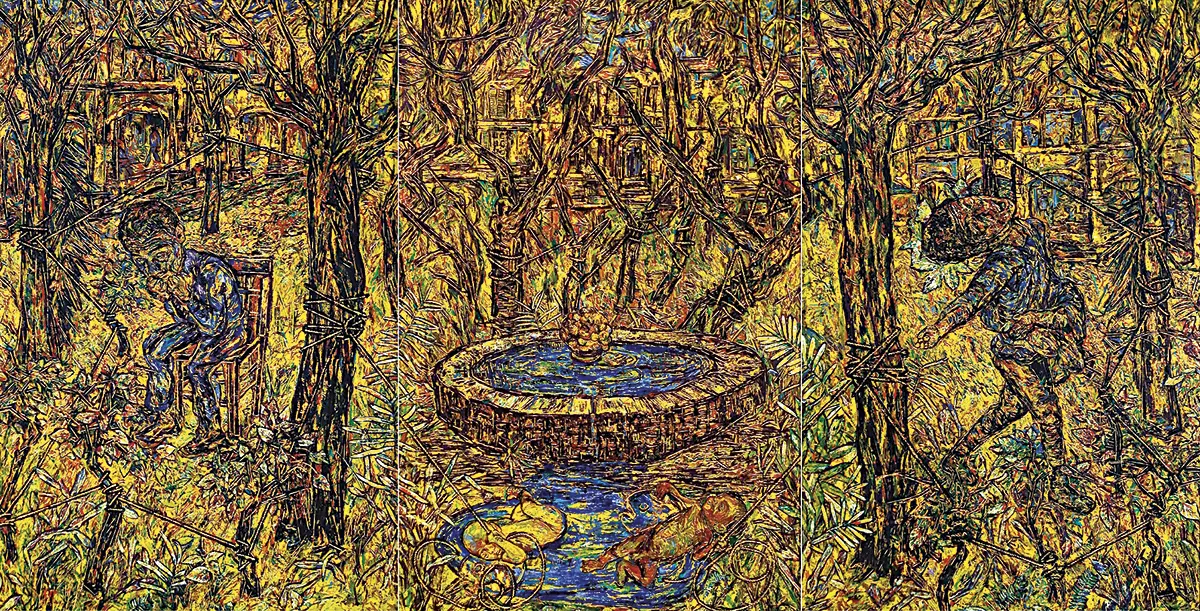
The formal training Roche received as a student of the SAIC, coupled with his own background as a native Puerto Rican, was immediately visible in the works composing this exhibition. Intensely personal and sociologically reliant on recent world events, Roche’s paintings illustrate the personal struggle and trauma through an intensely neo-expressionistic style brought to life by a brilliant and harmonious color palette. A distinct break from his earlier work was present in these paintings, one due to Roche’s preoccupation with the surrounding world’s uncertainty in the wake of calamitous events like the 9/11 attacks and the 2005 tsunami.
Most beguiling was Roche’s fixation on the nineteenth-century artist Vincent van Gogh, whose likeness was replicated in five separate works and whose pioneering expressionistic style was combined with Roche’s practice of rubbing objects on paper to capture texture. The exhibit’s inclusion of van Gogh began with a handful of paintings from 2002, notably the triptych Within These Temples History is Written—We Only Lie When We Paint, a dramatic work spanning twenty-four feet. Roche filled the three canvases with subject matter pieced together from van Gogh’s works, mainly interior settings, a rocking chair, and the well-known sunflowers. A bust of van Gogh was prominently displayed in the central canvas, while a figure—most probably a self-portrait of Roche—peeked from behind a structure in the left panel. Roche purposefully commandeered the golden tones and hazel and royal blue brushstrokes of van Gogh, but Roche’s penchant for dramatic, large-scale canvases filled with emotive personal reflection lent the work a twenty-first-century originality beyond mere pastiche.
Less obviously but nonetheless heavily indebted to van Gogh was Roche’s second triptych from 2002, The Garden of Intolerance: In the End, Like Fathers, Madmen, or Heroes. Inspired by the Dutch master’s own works depicting asylum courtyards, Roche’s Garden showed just that: an architectural structure spanned the background of the painting, while knobby trees punctuated the foreground. The same earthen tones prevailed, but this time van Gogh’s vivid blue was seen in a central fountain, where two infants bathed in the water. Roche inserted a plethora of untamed tropical foliage into the scene, as well as two presumed self-portraits, one on each end panel. While all of this comprised the painting’s subject, a rope beginning from the infants’ arms and continuing to wind around all the trees literally tied the work together. The viewer experienced the presence of disparate emotions, feeling trapped while simultaneously feeling connected.
The later works in the show departed from the heavy hand of van Gogh and traveled one century later in art history, notably to the New Realist artist Yves Klein’s Anthropometries, in which models coated in his signature International Klein Blue (IKB) paint was used in place of brushes to mark the canvas. Roche’s Do You Know Where the Almighty Dwells (2005) operated along similar lines. Roche wrapped paper over a human body and rubbed and painted the form beneath onto the work’s surface. A multitude of entangled human forms composed the work, a twelve-by-twenty-four-feet sheet of white paper colored only by IKB-reminiscent oil paint. This work was hung in a gallery with three other paintings executed with this same, singular blue tone, all of which continued this dialogue with Klein’s practice. Overall, Roche’s work brims with anecdotes from his own life, but reading his paintings within the context of art history is the most enlightening.
BETHANY MARRIER