
The Ascaso gallery (Las Mercedes, Caracas) presented from April 27th through June 1, 2008, the show ZZ Carlos Zerpa, comprising 64 works dated between 2004 and 2008, in a variety of modes and techniques such as drawing, painting, assemblage, installation, performance, and video.
Absent for eight years from the exhibition circuit, Venezuelan artist Carlos Zerpa (born in 1950 in Valencia, state of Carabobo) returns now to reassert not only the versatility of media that characterized his works since his beginnings in the 1970s, but also the width of his iconographic register and the undiminished freshness and validity of a tone that moves between irony and tenderness, violence, and intimacy, unafraid of a visual saturation that is well supported by the show’s museography.
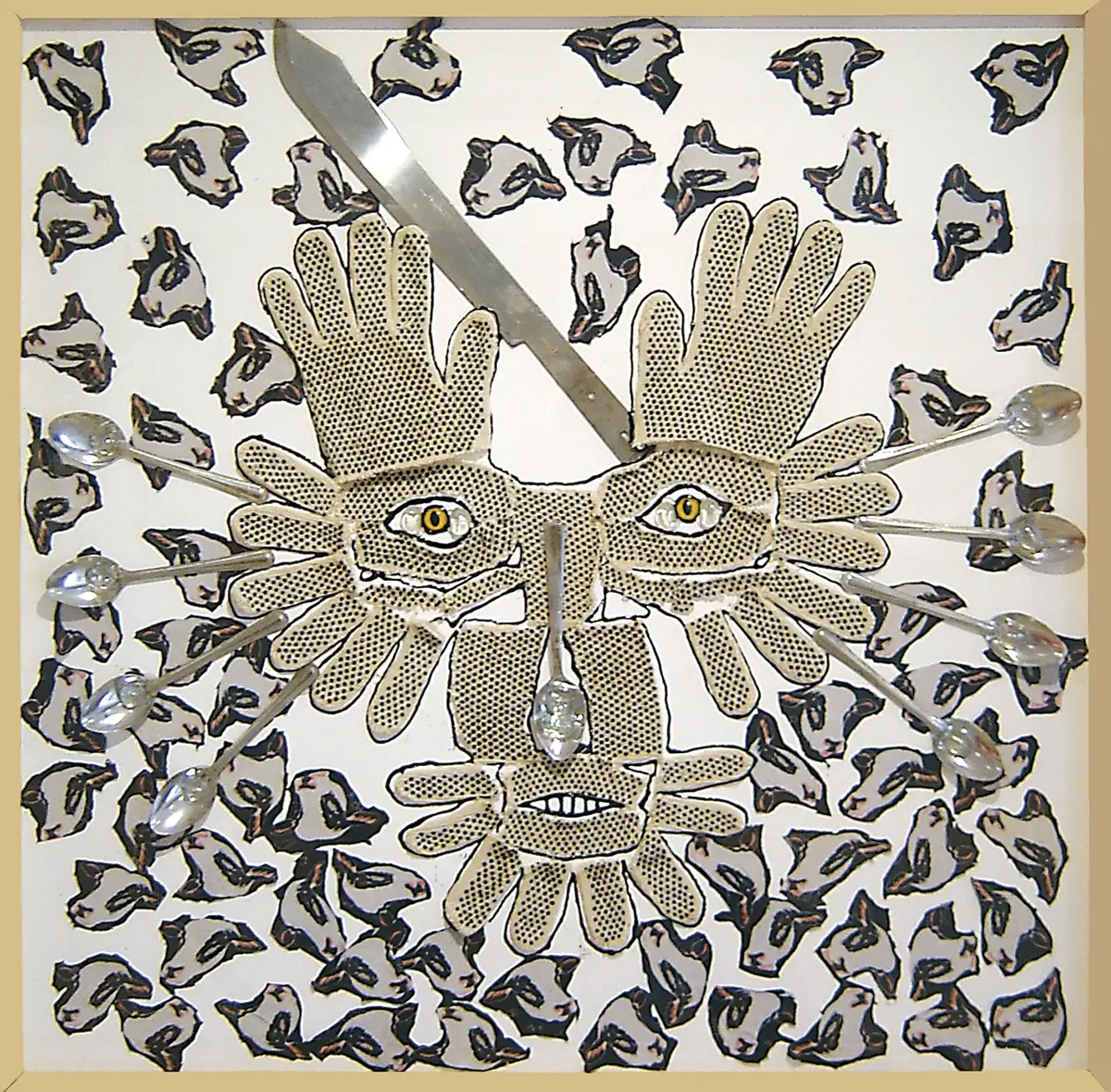
The horror vaccui expressed in the accumulation of objects, in the force of his colors, and in general in an aesthetic founded on the Baroque and on kitsch, becomes the leitmotiv of Zerpa’s aesthetic, although the artist never fully defines it: one must also mention the constant references to high culture (in his recourse to the history of art) and to the popular taste, the presence of religiosity and its corollary of irreverence, the nostalgia for the lost time of childhood, violence as a social ill, intimacy as protection…
A few years back, Carlos Zerpa declared that he had started painting after discovering that movements such as the trans-avant-garde and Bad Painting freed him to do it without technical knowledge, without “mastery” over the medium. This assertion is no longer valid because the set of still lives and animal paintings that opens the exhibition is proof of the dexterity and ability acquired, so much so that the artist can now say “I feel great as a painter. My hands move on their own.”
This is why he doesn’t hesitate to confront one of Western painting’s most traditional themes: the still life with flowers and fruits, the “set table.” There is of course in this choice a will to assume as his own this tradition, while transforming it into a kind of “tropical Pop” (very much distant from the coldness and the nonchalance of an Andy Warhol,) where the European legacy is tinted with autochthonous elements such as the shine of flat colors (used in popular prints) and the magical-realist details added by way of the tiny ladders that lean on the baskets and the fruits that transform into UFOs.
The series devoted to deer evokes, of course, his childhood and his imaginary —they are never apart in Zerpa’s poetry— as well as the popular taste —ditto— for certain kinds of themes. The antlers become vegetation or abstract arabesques. And the Picassian bull, now alleviated of its dramatics, of its “tragic sense,” becomes a Zarpian bull, where humor marks the territory: the artist claims an entire tradition in order to subvert it.
Zerpa’s wrestling heroes, a pillar of his world, could not be left out; they concentrate elements of popular culture, childhood memories, and dress-up games.
This capacity for metamorphosis, for mutations that are more comical than unsettling, already announced in Zerpa’s paintings, is even more evident in his assemblages, presented inside boxes, where the most variegated objects (a full inventory would be unending, would let us point out the piñata toys, costume jewelry, coins, keys, spoon, knives, buttons, dominoes, all kinds of bric-a-brac…) build “portraits” or crosses. Overcoming the initial disorder is the organization imposed by Zerpa, a very personal way of confronting chaos, which offers several levels of reading: first, the attractive shining surfaces, the objects per se; then, the handicraft-like work of assemblage, which crosses here the border between the artisanal and the high-art; next, the combination of objects that give meaning as the image fades, but also reveals its ambiguity: faces or masks, images of images taken from more varied registers where religious icons share space with the punketos.
The show also includes works on paper, which are not drawings in the strictest sense, since the artists use acrylic in them, which reminds us that this technique has always been present in his work and reveals another facet: the speedy stroke as opposed to the patient labor of assemblage.
FEDERICA PALOMERO