
Eugenio Dittborn has been rigorously self-conscious of all aspects of his work since he developed the 1980s Airmail works as an extension of the 1970s Mail Art movement within the Chilean repression when artists were jailed for being artists. Dittborn has recounted many times how airmail helped overcome the isolation of Chilean artists during Pinochet’s dictatorship. Perhaps this strikes the reader as tired news of repressions passed. But it remains a message we should not stop repeating, especially to and for those of us in the U.S.
Latin American art, and its strategies and alternatives, remain advanced because much of it was born in response to extreme problems in social, economic, and individual relations. U.S. artists may even catch up to Latin Americans when they realize that cultural and political production is the same thing.
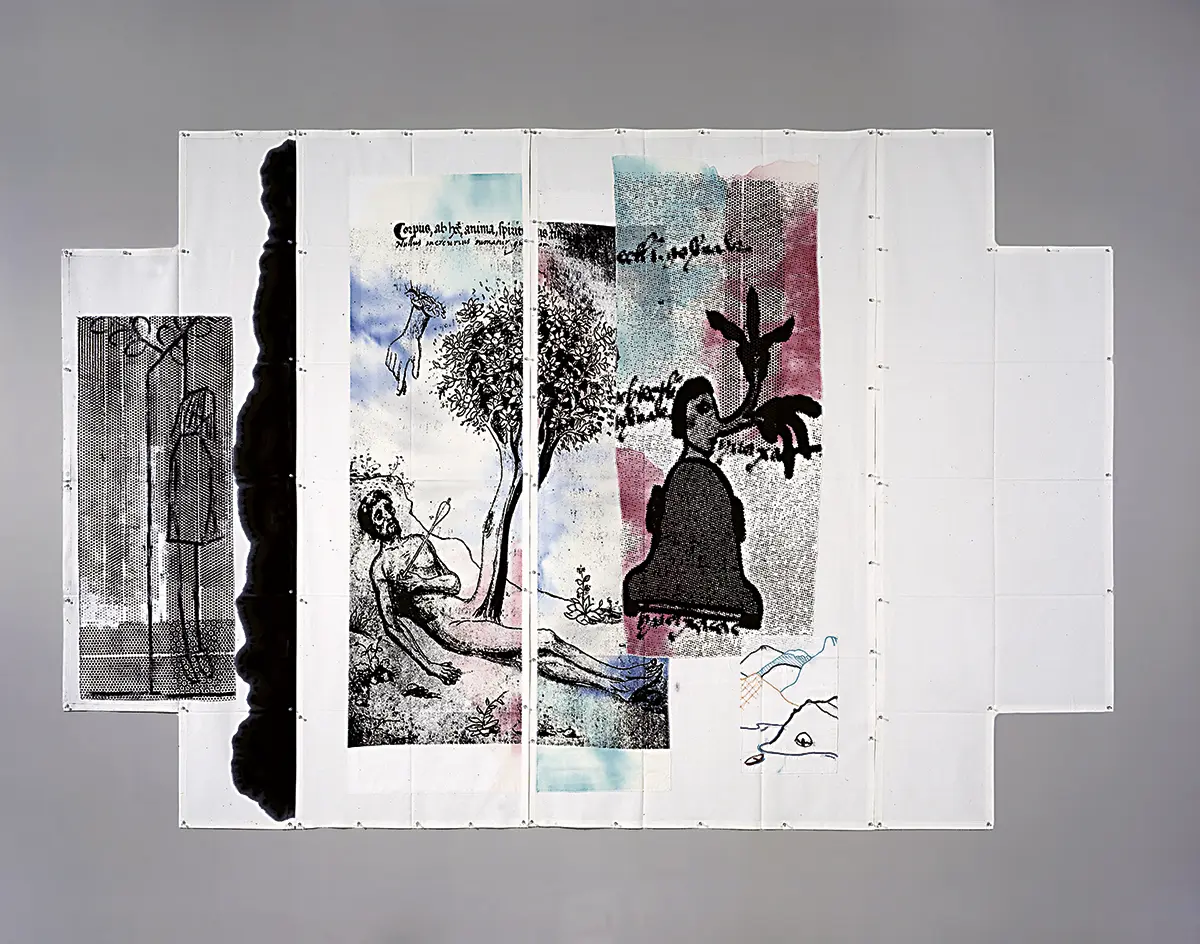
Dittborn’s new works are the first Airmail Paintings to depart from their regimented orthogonal regularity of four right angles and move into irregular shapes and framing. But a significant change in compositional structure is not obvious to the general observer and it seems to have no impact on the meaning of his works. However, one doesn’t go to see his work for aesthetic pleasure. For me, Dittborn struggles constantly, and not always successfully, with the physical aspects of his art because he is concerned with their meaning more than their feeling. How then does Dittborn establish his meaning?
The airmail packets Dittborn designed to fold and send reportedly accrue a recorded history of travel, but in reality, they carry his written commentaries culled from a variety of sources, like his silkscreened images. Many commentators find the writing vague, even poetic. I find them specific as Dittborn repeats and declares his history, intentions, and meanings. But they are generalized meanings with titles and writings that function almost independently of the images. When content and title do align, there is no meaning beyond the generalizations already known to us, such as the repressive history of Latin American colonialism. Even the specifics shuffle into generalities that point toward a direction but leave it to the viewer to form a conclusion—the perfect oscillation between signifying the generalized global and a specific local subject.
The Third Tree: Airmail Painting No. 174 (2007) has three photo-silkscreened images (two with text) and a small piece of embroidery on various sections of stitched, white, duck fabric. In a press release (not available to most visitors), Dittborn explains that the image of the wounded man whose penis is replaced by a large tree comes from a modern picture book collection of old alchemical texts. The remnants of Latin text tell us little. The image of a man with a plant growing from his nose is from the Mexican El Codex Mendoza of 1541–1542 that diagrams Aztec daily life. The combination of a Spanish text, likely by a Catholic priest, and images by Aztec artists makes the text ethnographic and perhaps syncretic, i.e. a product of trans-cultural cooperation.
On the left, of equal size but separated from the other two images by a dark stain or tincture and overlaid by stenciled dots (a possible reference to Roy Lichtenstein’s Ben-day dots) is a child’s stick-figure drawing of a modern woman whose posture could be read as hanging from a tree by her neck or standing and peering into the composition, much the way patrons of the church altarpieces stare into but remain outside of a religious scene. But what then is the third tree?
Dittborn’s airmailer writings quote Walt Disney (“let your imagination fly”) and John Ruskin on the properties inherent to draperies along with Dittborn’s own written claims for his “draperies,” his folded cloth supports. Dittborn not only describes his process of making these but also tells you what to think about them: “textile grafts that discontinue the surface,” which “organize a new field of play.” Yes, they do, but no different from any collage since at least 1912.
The title The Third Tree points us in the general direction of possible meaning but not without the help of some research. A Christian parable tells of a third tree in the Garden of Eden whose seed was to be used later to save humanity from its own accumulation of wickedness. Or the work may be a reference to the third tree in Genesis, the one of immortal life, from which Dittborn’s image of a modern woman—the “now” of the exhibition title “Enteras Partes de Now and Then”—hangs dead. Or does she merely peer in, as Eve? But if so, what of the pre-Columbian Mesoamerican “world tree” whose singular axis mundi has a four-fold nature, not three-fold? Ultimately what do we, or the artist, know about his meaning?
Not much that is specific is known, and yet quite a lot that is important in a specific way is known. Dittborn formulated the perfect vehicle in the early 1980s, a generalized container whose process and form are ideological while the specific images, references, and histories accrue both diachronically and synchronically through the linear record of the airmails and the ahistorical assemblage of images and sources. We learn that Dittborn is an excellent self-promoter. We learn that history is not one narrative but rather a series of disparate collections of narratives that, like Dittborn’s images, may enter dialogues. Or not! And we get a good exercise in specific, albeit fragmentary, histories and imagination. But is it enough?
RICHARD LESLIE