
Exposure to a different culture may have the felicitous result of refining our expectations about it, but an even better outcome is one that defies them. After several years of intense research, Fred Baldwin, Wendy Watriss, and a Chinese team of consultants—Gao Lei, Zhang Li, Wu Hung, Chen Gaungjun, Xu Weiying, Si Sushi, Gu Zheng, Cai Tao, Wang Yan, and Zhuang Wenjun—achieved both effects with Fotofest 2008. Through a plethora of historical and contemporary exhibits, they provided a glimpse not only of the work of Chinese photographers but also of life in China as it once was and as it is now. To be sure, not all of the exhibits this year were about China or by Chinese photographers, but Chinese works were the main course.
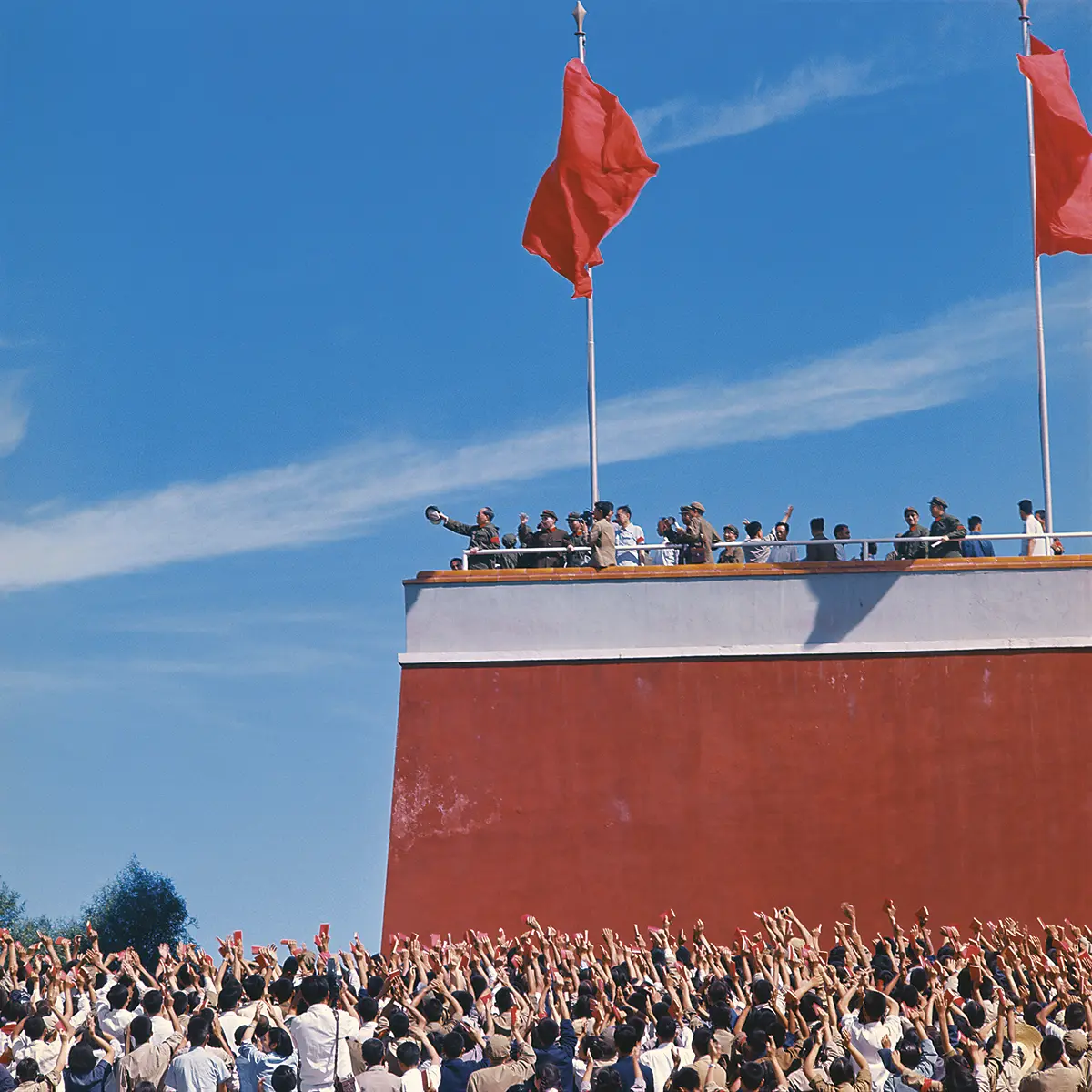
What could possibly be the historical photography of a country that has lived under communist rule for most of the twentieth century? An obvious answer is the propaganda photographs of the triumphs of the Communist Party. The exhibit Red Memory: The Cultural Revolution, 1955–1975, featuring the work of the photographers Weng Naiqiang, Xiao Zhuang, and Wang Shilong, did exactly that. This exhibit was shown at one of the many corporate buildings in downtown Houston. Weng Naiqiang’s photograph Chairman Mao on Tiananmen Square, Beijing (1996) has lost its ideological bite now that China has become the main trade partner of the U.S. In spite of our constitutional commitment to freedom of expression, it would not have been possible to present “Red Memory” in 1966 and only perhaps in 1986. Our local guardians of democracy would have set the prints ablaze just as readily as the Red Guard in Wang Shilong’s People burning old and traditional objects during the Cultural Revolution’s 'Break the Four Olds' movement (1966). But alas, the days of the cold war are over and we now have to contend with new enemies.
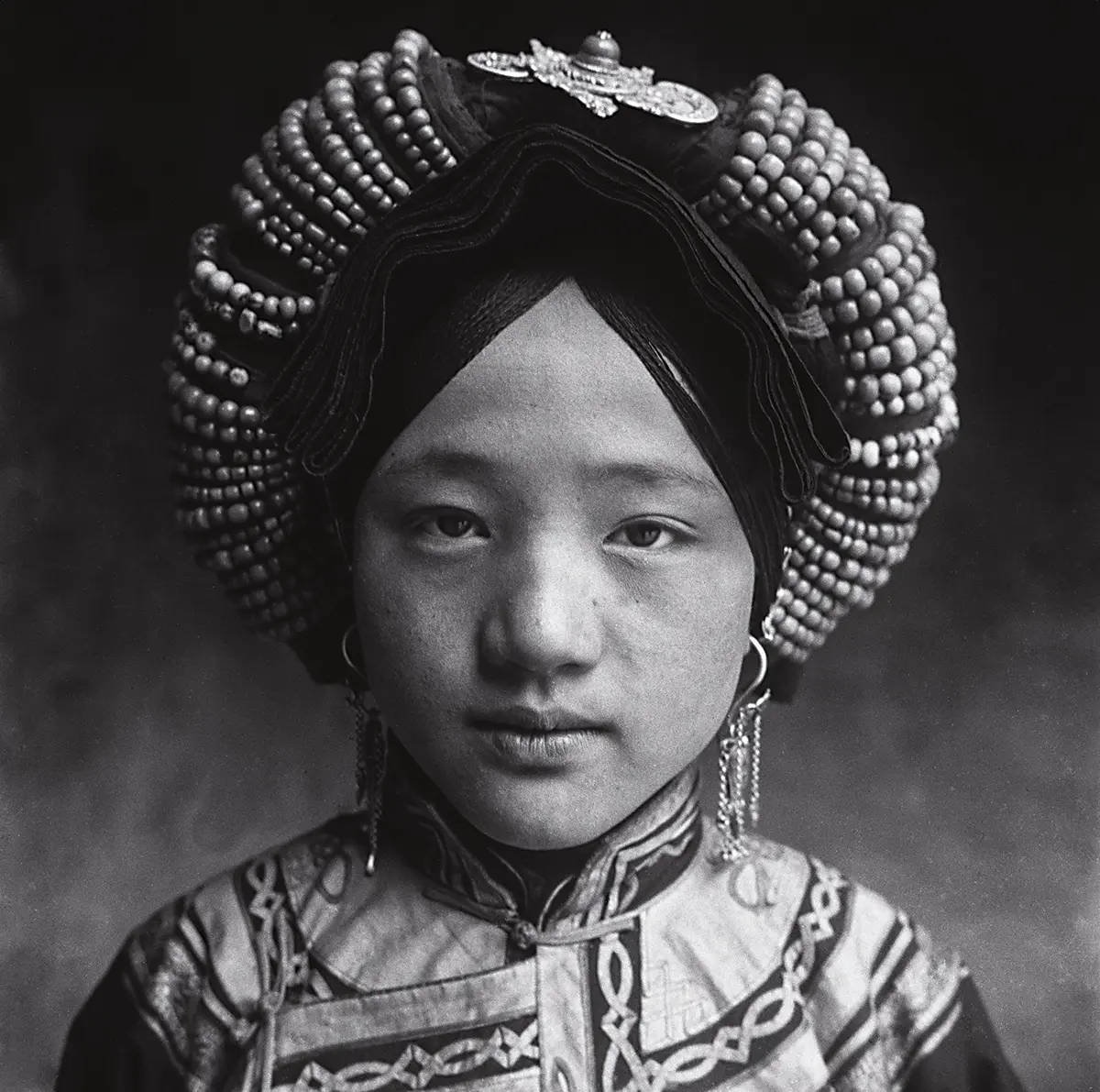
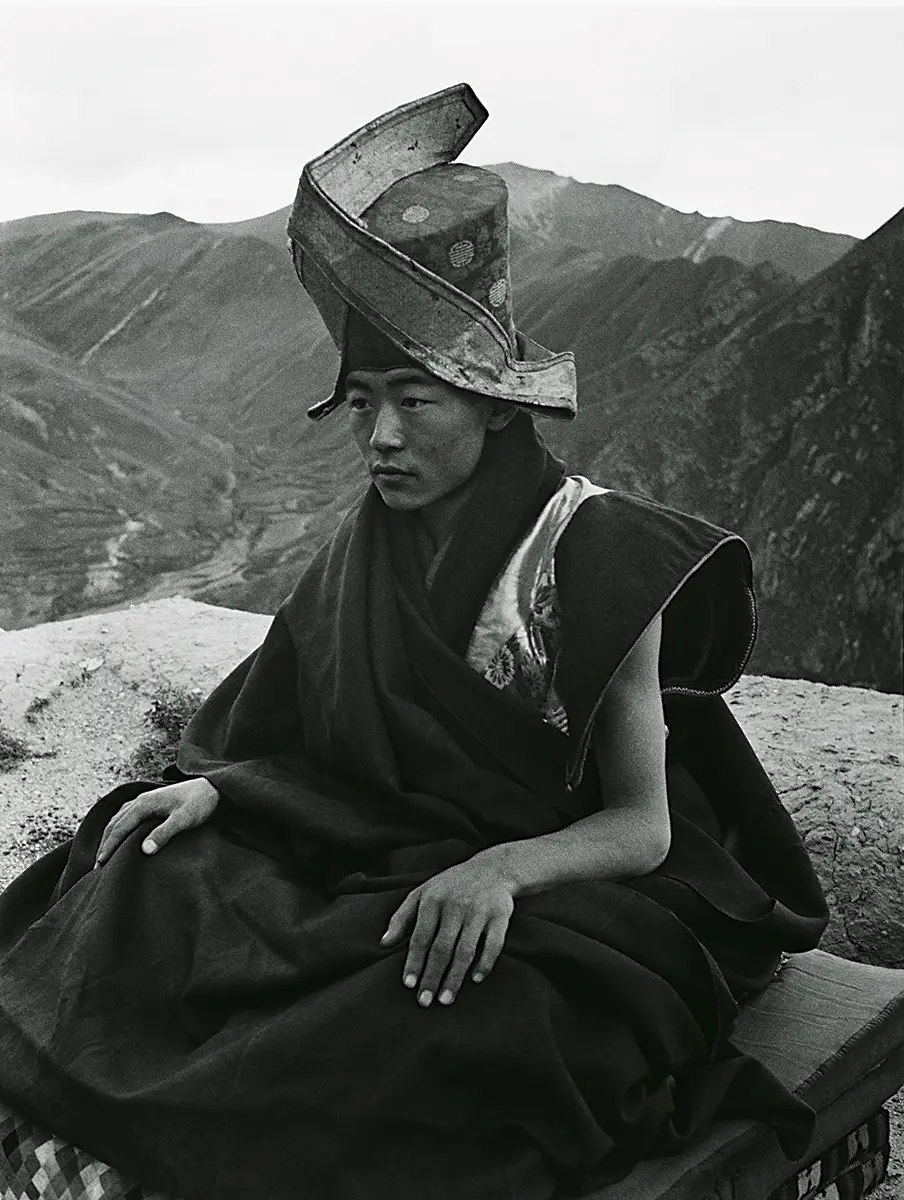
Red Memory was a section of the Fotofest-curated exhibit Ethnography, Photojournalism, and Propaganda, 1934–1975. This exhibition also included the work of two photographers who were active before the takeover of the Chinese Communist Party in 1949: Zhuang Xueben (1909–1984) and Sha Fei (1912–1950). In 2007, the magazine Chinese Photographer published the article “Zhuang Xueben: A Master Photographer Faded from People’s Memory.” Who was this master photographer who, according to the curator Zhu Qi, “has not even been introduced by any official publications on the history of photography done after 1949”?a During the 1930s, Zhuang left Shanghai to photograph the numerous ethnic minorities in the so-called “uninhabited lands” of southwestern China. Not surprisingly, he came upon its inhabitants and proceeded to photograph them and the inhospitable landscape in which they managed to subsist. In his work, Zhuang forged a modern aesthetic that focused not only on the factual content but also on the artistic attributes of the images. In 1949, his outstanding work even “earned him an interview with Chairman Mao Zedong” in spite of which Zhuang fell from grace. His “relationship with the high echelons of the Nationalist Party led to his eventual denunciation in the mid-1960s during the Cultural Revolution,” said Zhu Qi. Today, the oeuvres of both Zhuang and Sha Fei, the author of epic photographs of the Anti-Japanese War (1937–1946), are currently being researched, re-evaluated, and re-written into the history of Chinese photography.
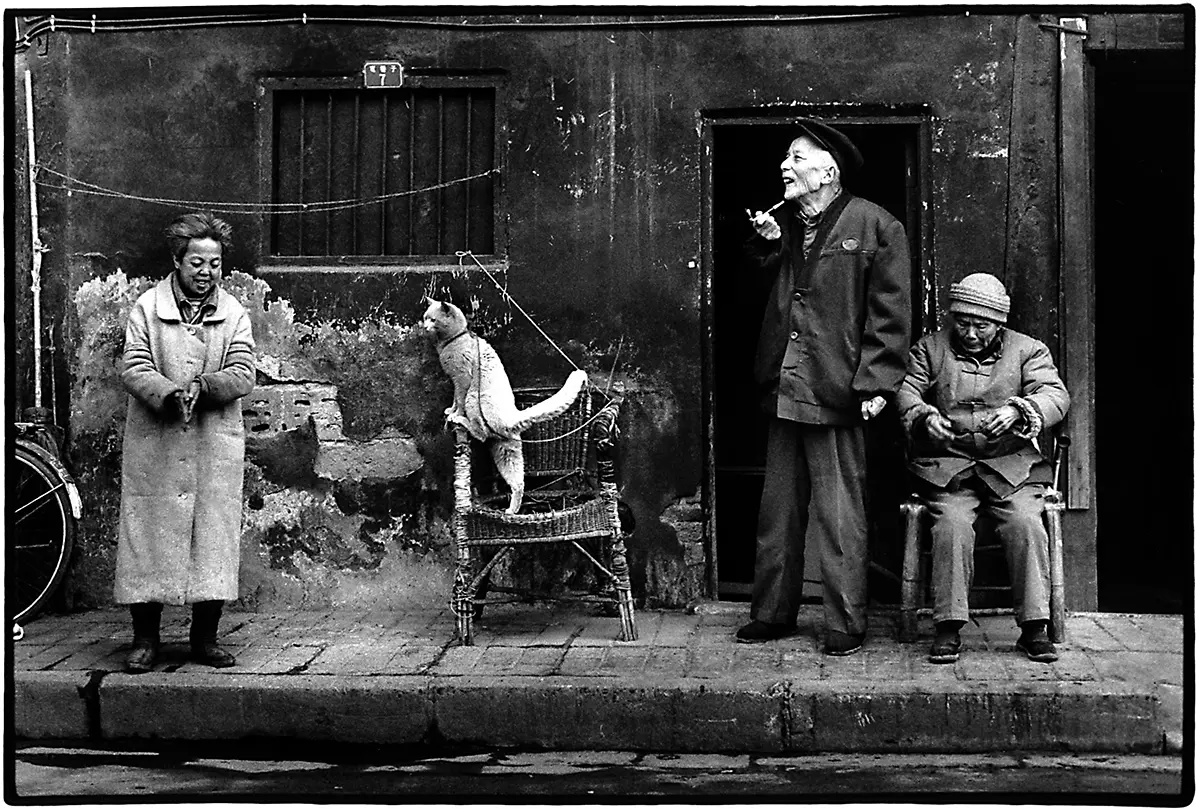
Independent Documentary Photography, 1985–2008, a section dedicated to more recent history, included the work of Wu Jialin, Lu Nan, and Li Lang. Unlike Zhuang Xueben’s heavy view-camera and the aesthetic it imposed, the equipment of these photographers is lighter and their cinematographic vision is more like Cartier-Bresson’s photojournalism. Indeed, Wu Jialin, who had a previous venue at Fotofest, stated, “In 1988, I saw forty-four photos from Views of China by the great French photographer Marc Riboud, and they impressed me greatly even though they were only two inches tall.” Wu’s independent work developed during and within the Communist regime. Wu said, “When I first started working for the Yunnan News Photo Agency in 1981, I spent almost all my energy photographing for propaganda according to the intention of others. This was a means of survival for me. Only during my free time, and now since I have retired from work, was I able to photograph the way I wanted, to record everything happening on the land where I was born and grew up.”
The section Contemporary Conceptual and Staged Photography, 1994–2008 encompassed the current Chinese era of Communist-state-sponsored capitalism. Its “New Photo, 1994–1997” sub-division was a sampling of the pioneering work of artists published in the underground art publication bearing the same name. According to the curator Zhang Li, in merely four issues, with thirty-four hand-bound copies per issue, New Photo introduced the work of sixteen artists; among them were Liu Zheng’s The Chinese and the Three Realms, Rong Rong’s East Village, Hong Lei’s Forbidden City, Zhuang Hui’s Group Photos, Zheng Guogu’s Yangjiang Youth, and San Mao’s Family Tree. The second sub-division, Current Perspectives, 1998–2008, included the most recent work of artists like Wang Chuan, Bai Yiluo, Yao Lu, Xing Danwen, Liu Lijie, and Sun Guojuan.
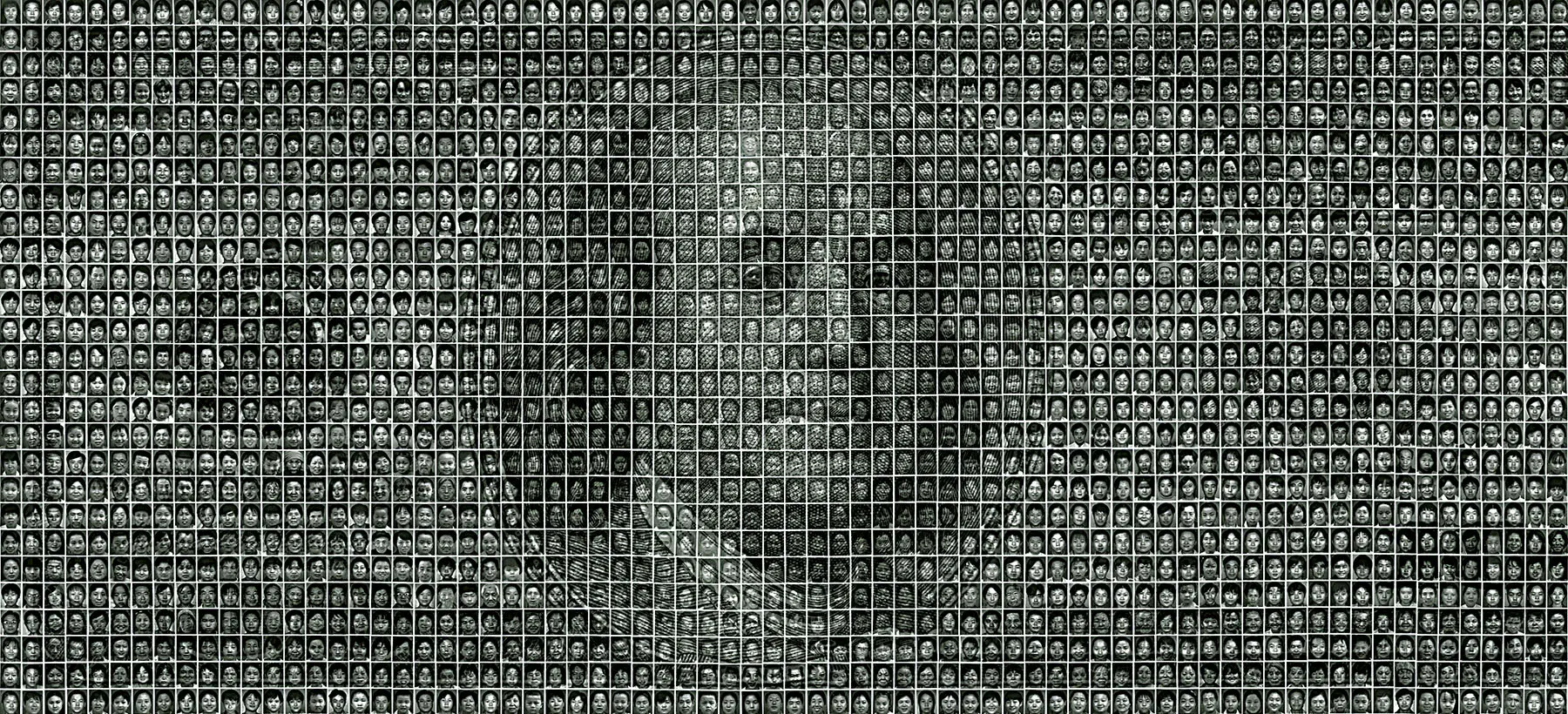
Bai Yiluo used to be a blue-collar worker. He became an artist because he found his work alienating (Where have you gone, young Marx?). His labor-intensive art—large images composed of numerous small images—echoes the repetition of industrial work (Liberation is in the final art product, Karl). Bai’s Devaluation (2005) is a depiction of a one-hundred-dollar bill made up of thousands of minuscule mug shots of Chinese men and women. As if by a “dialectical leap,” Benjamin Franklin’s face emerges from the myriad atomic portraits. Did Bai select the bill because of Franklin’s working-class background, his Freemasonry, his diplomatic record, or because he was the inventor among the Fathers of the American Revolution? In People #3 (2003), Bai used a similar technique to depict Marx, Engels, Stalin, Lenin, and Mao—the ubiquitous quintet (or quartet without Mao, if you were in the Soviet orbit) of secular saints in every communist state. Bai said, “The influence those figures exerted on Chinese people was very deep. Strange to say, it is gradually vanishing now, but even so, they are still shadows behind our lives. . . From afar, you can see them quite clearly, but the closer you get to the work, the more these images weaken and merge with the rest of the composition.”
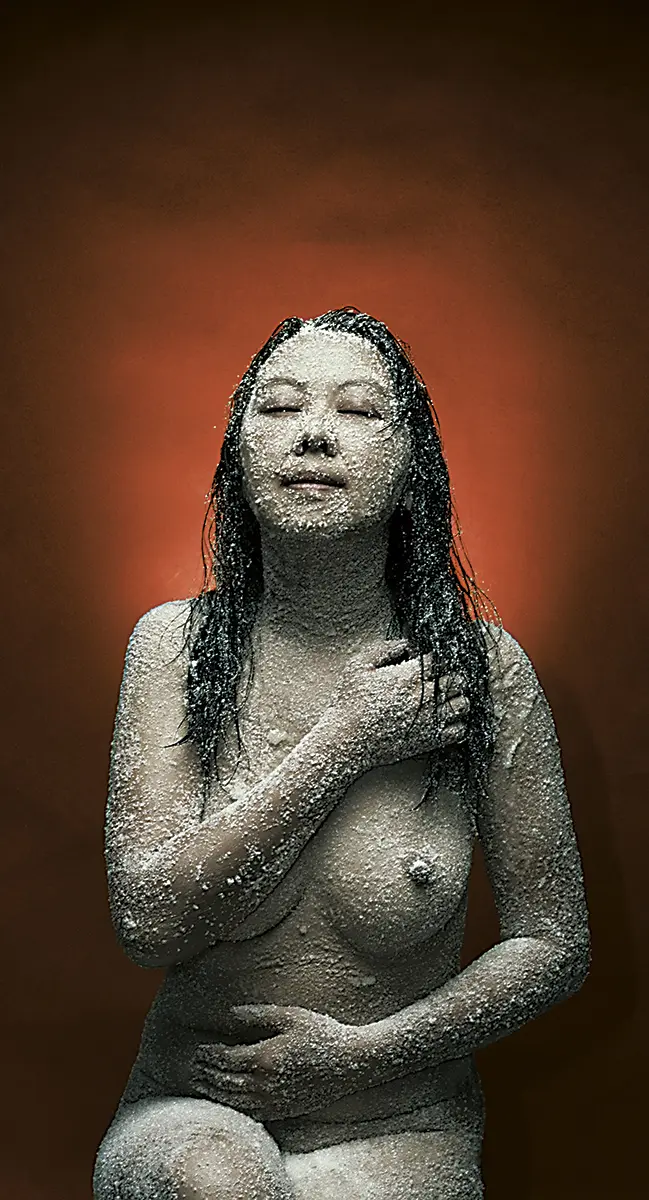
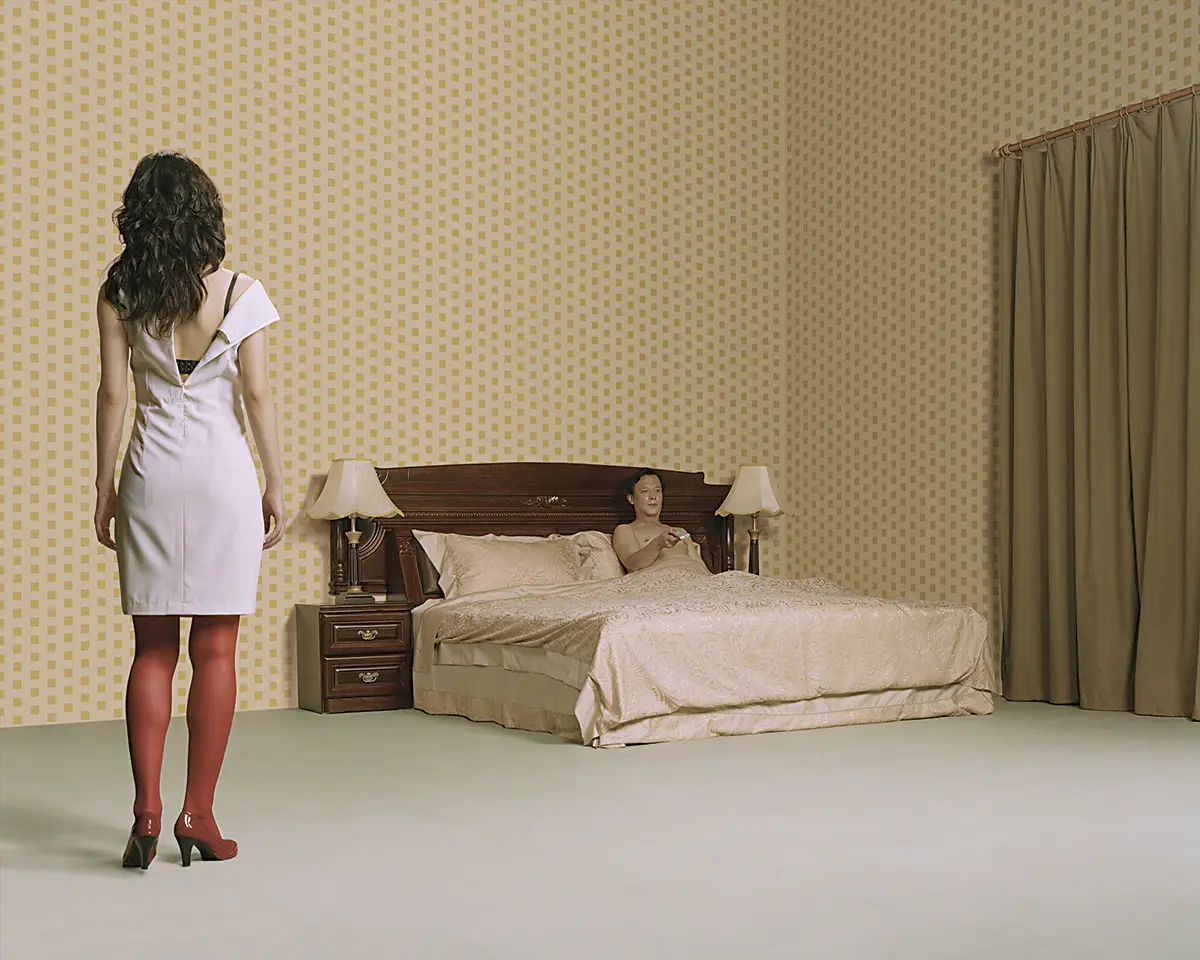
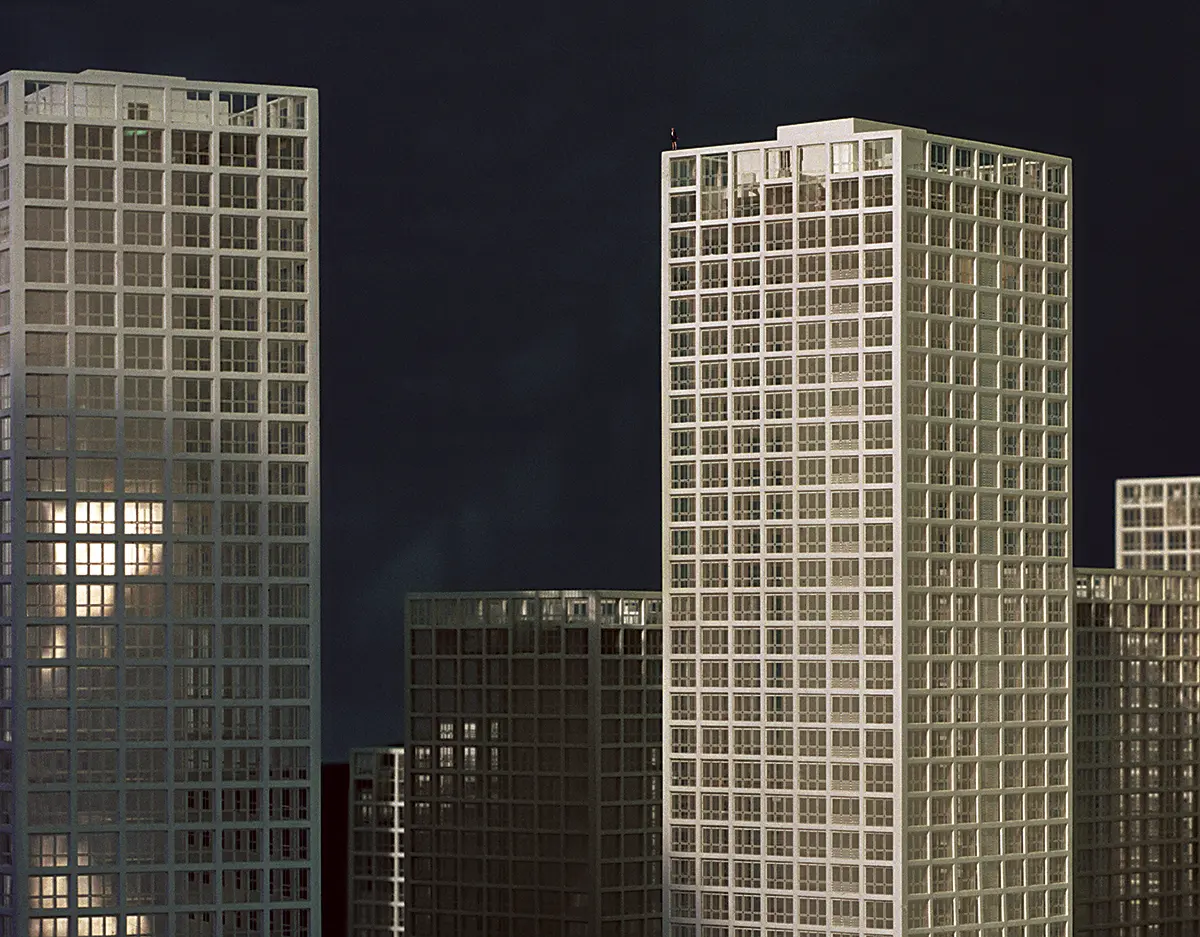
The works of Xing Danwen, Liu Lijie, and Sun Guojuan convey certain female angst in the midst of a rapidly transforming commodity-driven society. In the Sweetness Forever series, Sun photographs her own sugar-coated body. Does she see her persona as candy for sale? In Liu’s staged sets, young females undress under the gaze of a boss, a surgeon, or a voyeur. There is no eroticism in the scenes but rather an intimation of imminent danger. Xing uses maquettes of apartment buildings produced by real estate developers to construct her Urban Fiction series. With real actors, she stages and photographs scenes such as a woman about to jump off a building or a bride in a white gown running away from the groom. She then digitally transfers these scenes onto the images of the apartment-building models to create surreal composites that summon a mix of Hopper and Balthus in a postmodern urban landscape. Had not the brave new communist world substantially done away with gender differences? Has the relatively freer Chinese capitalism (vis à vis purer communism) brought back the idea that women are mere commodities?
The exhibit Mined in China at the Houston Center for Photography was very down-to-earth—into the very shafts where coal is mined. Subtitled China’s Black Gold, this multimedia exhibit about the coal industry in China included the work of several photographers (Adou, Dong Lin, Geng Yunsheng, He Chongyue, Ian Teh, Niu Guozheng, Pan Bo, Song Chao, Wang Dajiang, Wang Mianli, Wu Qi, Xing Danwen, Yang Junbo, Yang Shaobin, Yu Haibo, Zhang Jie, and Zhang Xiaowen). It brought home the environmental crisis spurred by global industrialization. Coal is vital for China’s economic growth: “70% of China’s electrical power comes from coal,” said Orville Schell, one of the project directors. That fact alone explains why the Chinese state will not be dissuaded to significantly improve its coal exploitation policy no matter how many miners die (China currently holds the record in mine accidents), or how much pollution it causes. Schell added, “As a long-time observer of and writer on China, my recognition of the urgency of the situation brought me together with Magnum photographer and curator Susan Meiselas and Chinese photographer Gao Lei, to start this project and galvanize this unusual group of Chinese photographers to collectively document “the story of coal” in contemporary China.”
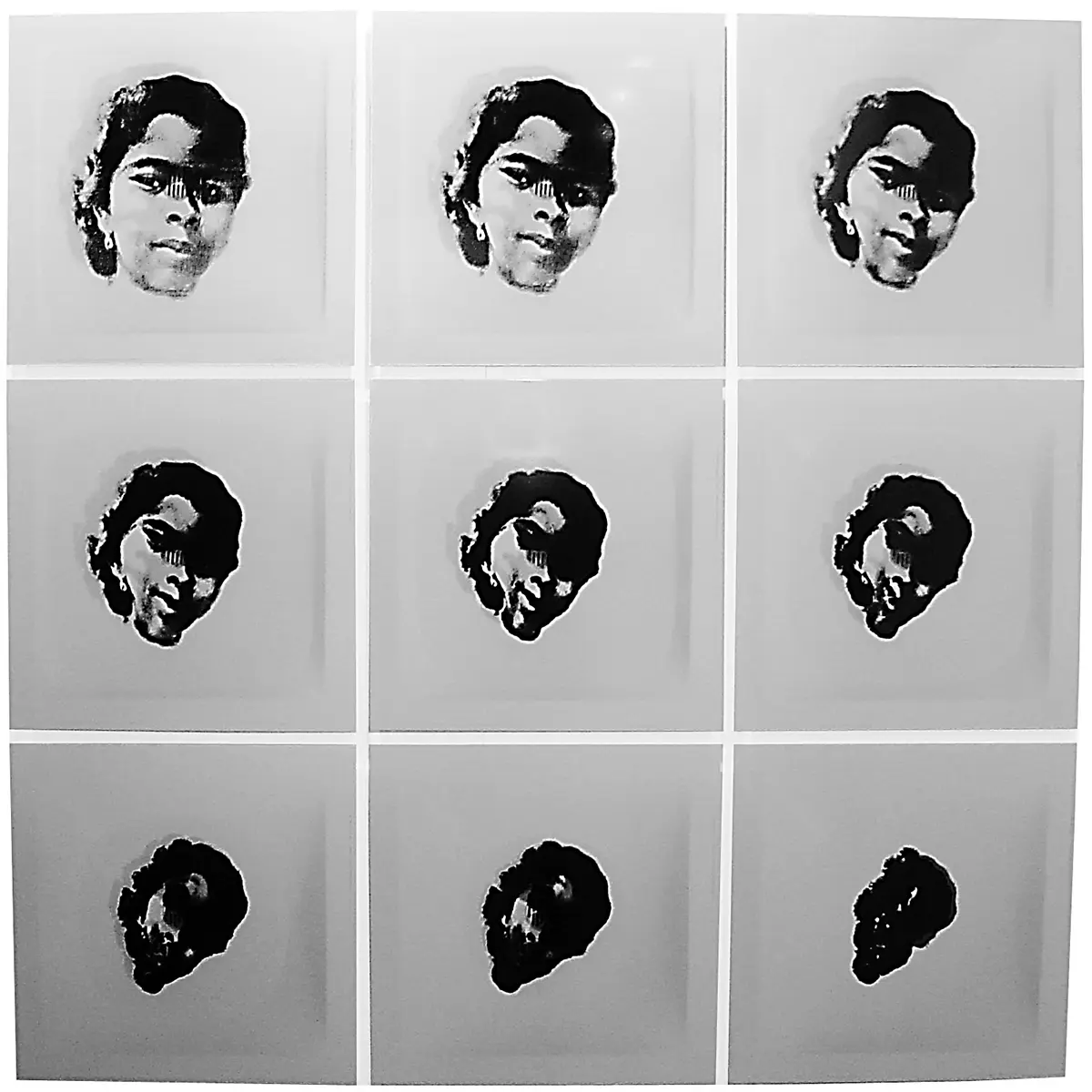
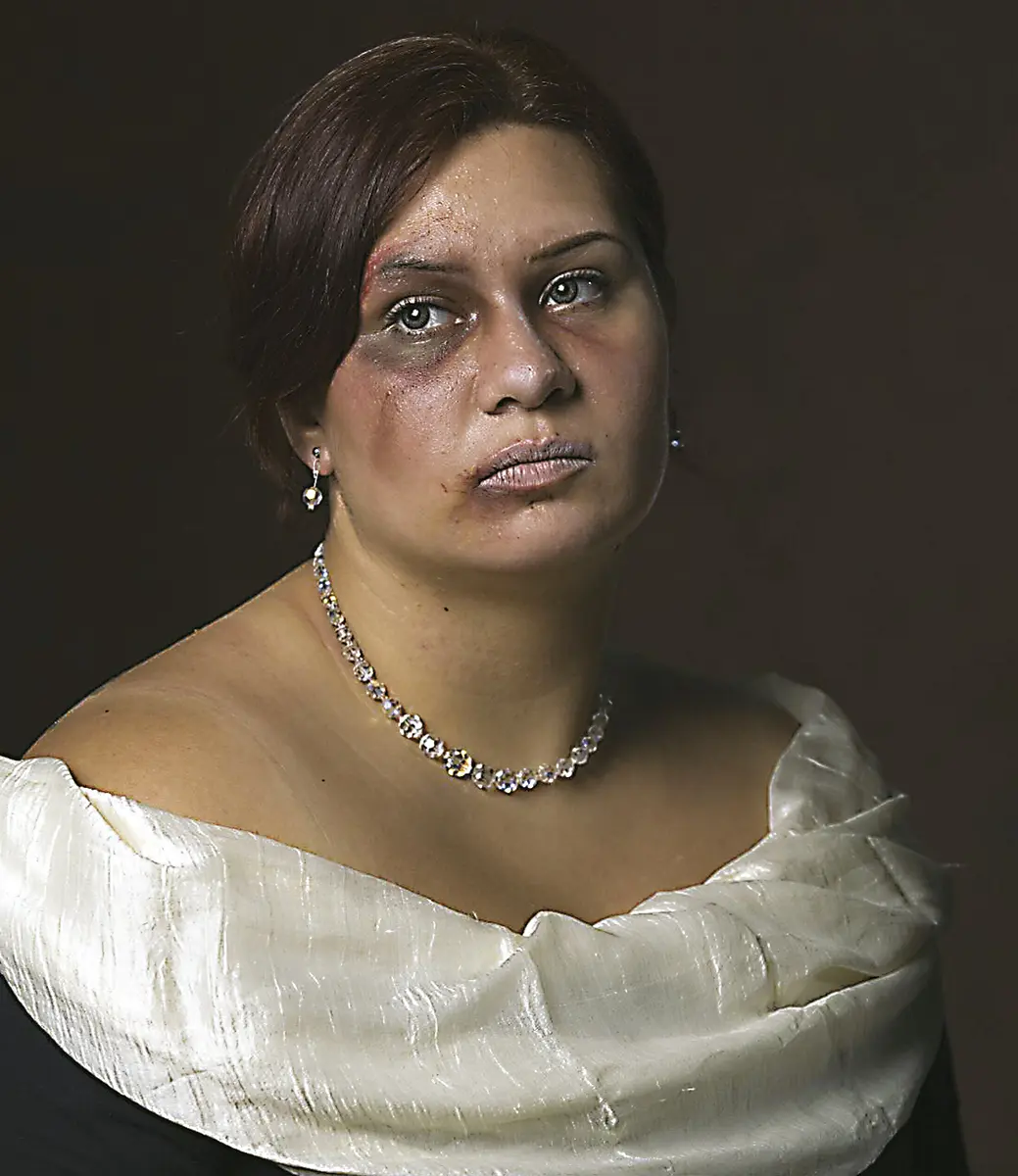
The Station Museum of Contemporary Art is the one exhibition place in Houston where the political edge of art is celebrated without apology. Apertura-Colombia was a group exhibit focused on the many sides of violence in that South American country. It featured works in diverse media from renowned artists like Oscar Muñoz, Miguel Angel Rojas, and Juan Manuel Echavarría, and others less known, like Andrés Sierra and Libia Posada. Sierra’s shockingly candid photographic series Karma Sutra showed amputees having sex with possibly the same woman (who was perhaps a prostitute or saint). Libia Posada’s Re-tratos were a series of color photographic portraits of battered women dressed in the attire of two or three centuries ago. At first glance, the portraits looked like paintings rendered in a nineteenth-century academic style; only upon closer scrutiny did the viewer notice the bruises on the beat-up faces. Colombia gained independence from Spain in the nineteenth century. Posada’s title took the word meaning “portraits” and hyphenated it to mean “repetitive treatments”—suggesting that the political independence did nothing to liberate women from recurrent domestic violence.
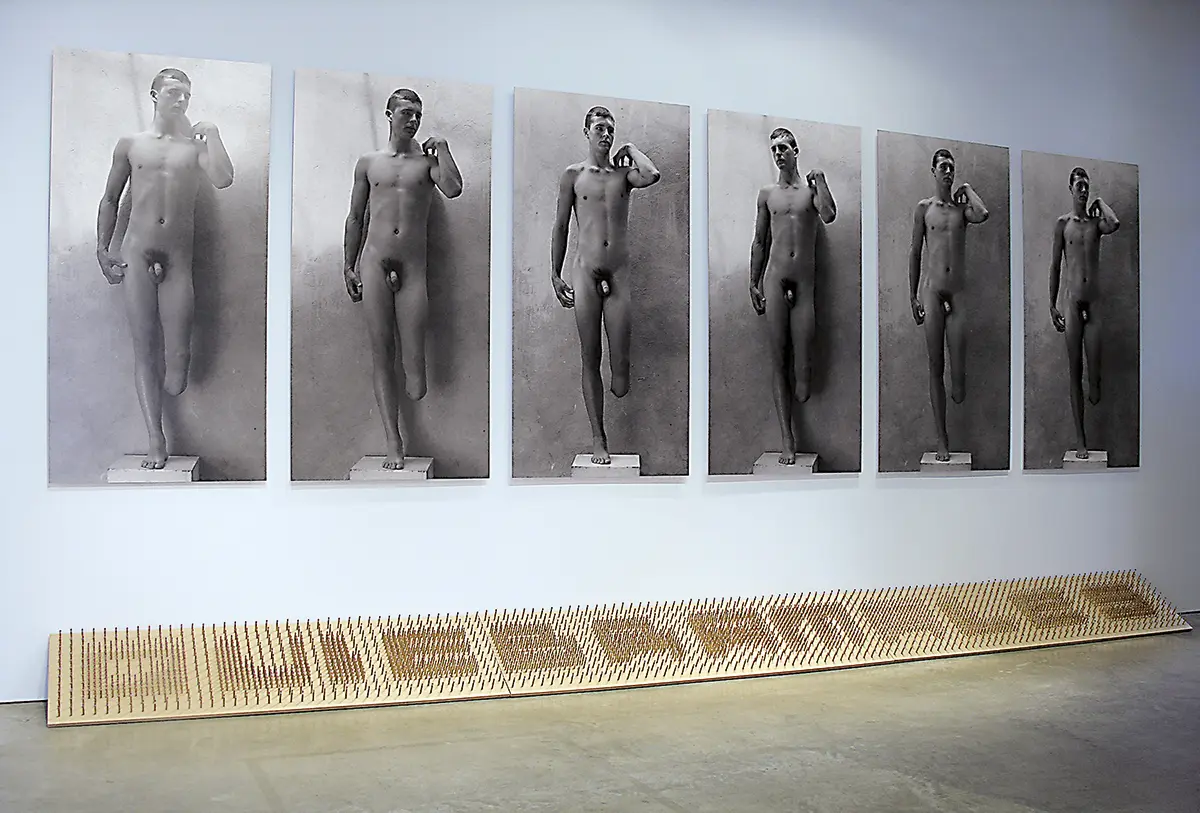
At Sicardi Gallery, Miguel Angel Rojas’s exhibit also dealt with the Colombian armed conflict although it was more focused on the art itself. His Rompemales (“evil breaker”) installation featured four life-size images of a nude, handsome, young soldier mutilated by a land mine (rompepatas). The pose of the soldier was unabashedly that of Michelangelo Buonarroti’s David. Like in the Renaissance sculpture, in Rojas’s photographs there was a homoerotic gaze that blended with evidence of combat. Rojas has a penchant for writing script in materials (coca leaves, dollar-bill confetti, etc.) that are as telling as the words. In the installation, the word rompemales was spelled with #2 yellow pencils so that the very tools for writing became the writing.
Two other exhibits also addressed conflicts. The Holocaust Museum Houston showcased the exhibit Darfur: Photojournalists Respond. The tragedy of Darfur requires no introduction: it is one of the great human disasters of our time and it goes on unabated. The cruelty and brutality of the Janjaweed Arab militias easily matches and even surpasses that of the Schutzstaffel (better known as the SS). Through the work of eight photographers—Colin Findlay, Sven Torfinn, Pep Bonnet, Ron Haviv, Lynsey Addario, Chris Steele Perkins, Kadir van Lohuizen, and Oliver Jobard—the viewer was exposed to the faces of both victims and victimizers. In the meantime, at the O’Kane Gallery of the University of Houston, the Argentine photographer Adriana Groisman showed Voices of the Tempest, a compelling installation about the sinking of the General Belgrano warship during the disgraceful Falklands/Malvinas war. It consisted of large black-and-white photographs of the high seas, a rubber raft similar to the one used by the sailors of the Belgrano, and a tape playing the voices of the survivors as they narrated their memories of death, endurance, and rescue.
De Santos Gallery showed two exhibits: Chen Changfen’s The Historical Wall and my Reasons of State (reviewed in ArtNexus #35, February 2000). In 1989, Chen Changfen was named by Time magazine as one of the eminent photographers of the past 150 years. For over thirty years, Chen photographed the Great Wall of China—the stone structure that scars the face of the earth, built for military reasons but celebrated as a great spiritual achievement. Chen’s work is both documentary and sublime. The wall extends thousands of miles, and Chen has photographed parts of it in remote regions that had never been photographed before. A larger version of The Historical Wall was previously shown at The Museum of Fine Arts, Houston.
The Houston Center for Photography displayed the panoramas of Jeff Chien-Hsing Liao, Habitat 7. Liao’s modus operandi was as intricate as the idea of the project was simple. The idea was to depict life along the route of the number 7 train that goes from Times Square to the borough of Queens, New York. Liao used an 8x10 view camera to capture several images of a particular place from the same vantage point. He then seamlessly blended the images digitally, not with the intention of creating a fantasy but rather the best combination of elements, events, and circumstances.
The unsettling staged work of the Japanese photographer Miwa Yanagi was shown in the main foyer of The Museum of Fine Arts, Houston, space seldom granted to this medium. The impressive selection of her work from the Deutsche Bank Collection included mural-size transparencies on enormous light-boxes of her series Elevator Girl. The series showed a group of a half-dozen pretty, uniformed, department-store hostesses in different mall settings. Their demeanor was as innocent and alluring as a mermaid’s song. The Elevator Girl series elicited thoughts about consumerism, submissiveness, eroticism, sexism, and fantasy.
A subtopic of Fotofest 2008 was the idea of transformations; we inevitably think of China as a prime example of this theme, as a country undergoing swift changes and revisions. One of the most insidious aspects of communist, nationalist, and religious ideologies is the distortion of historical events according to facile formulas in order to maintain power. Revising the official history then becomes a criminal and/or blasphemous act. However, historical facts have a way of surfacing in unexpected ways, and photography has become an important source of these facts since the mid-nineteenth century. Whether it is photography in the documentary, the artistic, the propagandistic, or even the commercial mode, images reveal not only an event that may have happened but also what we thought and valued at a particular time. Distortions hide reality but the transformations in our ways of thinking allow us to see through misrepresentations. Today, we think of the People’s Republic of China as a waking giant. Capitalists see it as a humongous market, ecologists as a huge environmental disaster, activists as a violator of human rights, military strategists as a major geopolitical foe, etc. It appeared that Fotofest saw China as a land of interesting image-makers. The question is how these artists see themselves. Will they passively find their own place in the free market economy or actively search for a role to play in the transformation of the world, for the better?
NOTE
1. All quotes are from the Fotofest 2008 catalog, Photography from China, 1934–2008.
FERNANDO CASTRO R.
Artist and art critic.