
Walter Benjamin has said, in reference to the far-removed quality of images, “The pleasure of a dreamer resides in setting limits to nature by constraining it inside washed-out images; it takes a poet to conjure up the appeal of an image.” Where does Hugo Lugo’s work stand in relation to that “complacent world view” so prevalent in images according to the German thinker, who believes this to be “obscure stubbornness against knowledge”? Lugo’s work creates images that refer inward, to the gesture that constructed them rather than to the subject that they describe; the drawing, then, becomes the object to be represented—the subject. Nonetheless, we may be mistakenly led to believe that the representation of objects is at the core of Lugo’s work; his images go further than that because the artist has decided that representation in itself is the subject. Thus, Lugo’s work never confronts the world and its image. The existence of the remoteness described by Benjamin, that which creates an unbridgeable gap between the world and the experience of it, appears to be something with which Lugo agrees. With the knowledge that he is unable to bridge the distance between image and world, Lugo opts to refrain from attempting this. Instead, he directly deals with representations.
Once humans overcome a nostalgic relationship with nature, it is common to hear the murmur of irony in human solitude. This is one of the prevalent characteristics in the pictorial work of Lugo, a Tijuana-based artist. Having left behind their anecdotal context either by choice or by tragedy, these representations can only stand on their own, sometimes in desolate diptychs. Representation faces its exile from the world, and the stirred instant of Lugo’s images of humans appear to be perennially a few steps from the abyss. At times, Lugo decides to depopulate these voids and to relocate them in the three-dimensional world. When his humans leave the frame, they inhabit the space with emptiness. One example is the artist’s recent project that was presented at the Tijuana Cultural Center (CECUT).
Many young artists living in Tijuana or San Diego are frequently invited by the Ephemeral, Arte en Muros (Ephemeral, Art on Walls) program at the CECUT to exhibit temporary works. In this forum, Lugo occupied a space commonly traversed by visitors. El Límite de la Memoria (The Limit of Memory) is a pictorial, sculptural, and sonic exhibit in which the artist explores the delicate and inflexible limits to which Benjamin alluded more than sixty years ago, now in the space of a few lines on the dreamer and the poet.
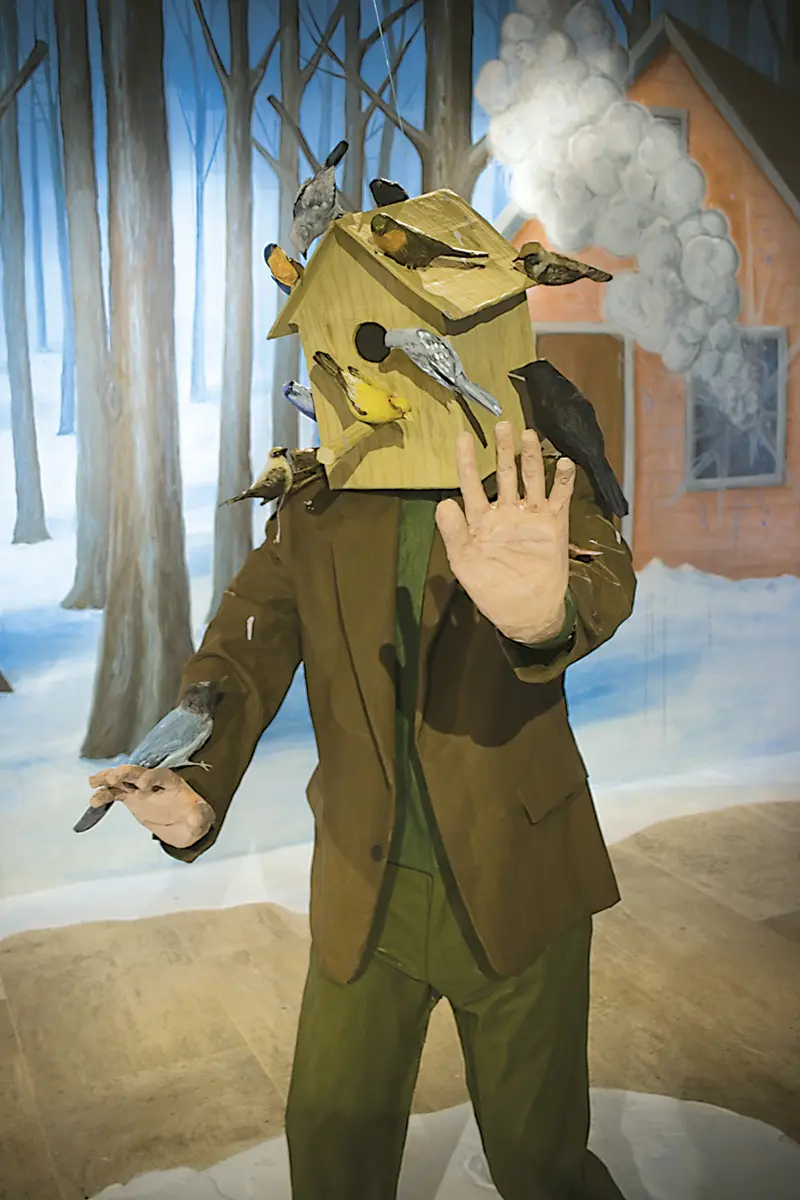
In the middle of the room, there is a man with many birds for head; on the surrounding walls, there is a replica of a forest—drawn in the linear style Lugo applies to his pictorial creations—that contains a pair of foxes, a deer, an airplane, and a brick cabin with a wood ceiling and with smoke glimpsed through the windows. The painted/sculpted man, with arms extended in front of him in a gesture of permanent significance desires to move forward and to avoid the damage afflicting the cabin, the deer, the foxes, and the airplane.
This significance is confined to a head fashioned of wood and artificial birds, over which the “natural” digitized sound condensing the environment of the piece can discretely be heard: footsteps, glass breaking, distant knocking, agitated breathing—or at least this is what one believes until a look into the vacant stare at the center of the room reflects the possibility of life back to the audio. Despite the possible continuities between what is painted, sculpted, or audible, Lugo’s scene is removed from a narrative, even as the work would appear to offer the spectator the subjects of a probably macabre story. Circling around this “false” subject, immersed in this “false” nature, amid noises of a simulated scene attempting to convey what is represented but ultimately betrayed by the repetitive loop, viewers have no choice than to inhabit the great remoteness that divides the image from the world, as if the limits of memory were close to being represented. Then we realize that the moments in the scene are repeated from different angles as we pass-through space, searching for the “other” moments of the subject—as if the memory of what happened there before our arrival could still be captured. Time separates dream from conjuring. Benjamin divided the creators of images into dreamers and poets. His reasons could also deal with memory. We see the painted sculpture of a man in the middle of the room, perhaps dreaming of himself walking through a cumbersome forest that would appear to share his lack of a past represented in his present. But it is probable that another of these little men on the wall, who from the depths of the image conjures up space still yet imagined, takes aim at a point beyond representation to attain a state with memory.
Reflecting on his work, Hugo Lugo has said that he is interested in representing “situations that are improbable in the world of real people.” To accomplish this, he suggests three levels to understand “nature”—one dealing with objects within the world, another via figuration as representation in the pictorial genre, and a third that is related to human beings and their affections. El Límite de la Memoria is a search to displace the time or permanence of that which is represented within the representation.
MARCELA QUIROZ