
Titled as if it were a fable and based on popular legend, Death and the River at the Josée Bienvenu Gallery in New York is the most recent solo exhibit by Colombian artist Juan Manuel Echavarría. Puerto Berrío, a community on the banks of the Magdalena River in Colombia, is witness to a “spiritual rescue operation”. In the town’s cemetery, a mausoleum was erected to guard the human remains found by the town’s inhabitants and rescued from the water. These are the remains of the NN, a term Echavarría used when referring to the project, which means “no name”, unknown.
During a roundtable that took place at El Museo del Barrio in New York on The Disappeared (2007) exhibit, Echavarría commented about this moving finding. In his recounting of the story, he explained the manner in which the locals in this Colombian community of Puerto Berrío would rechristen the remains, attribute miracles to the dead, and bring them offerings. The townspeople would care for them as if they were their own deceased family members and shared the same blood. From this custom emerged the term now in use to refer to the project: Escogidos (The Chosen).
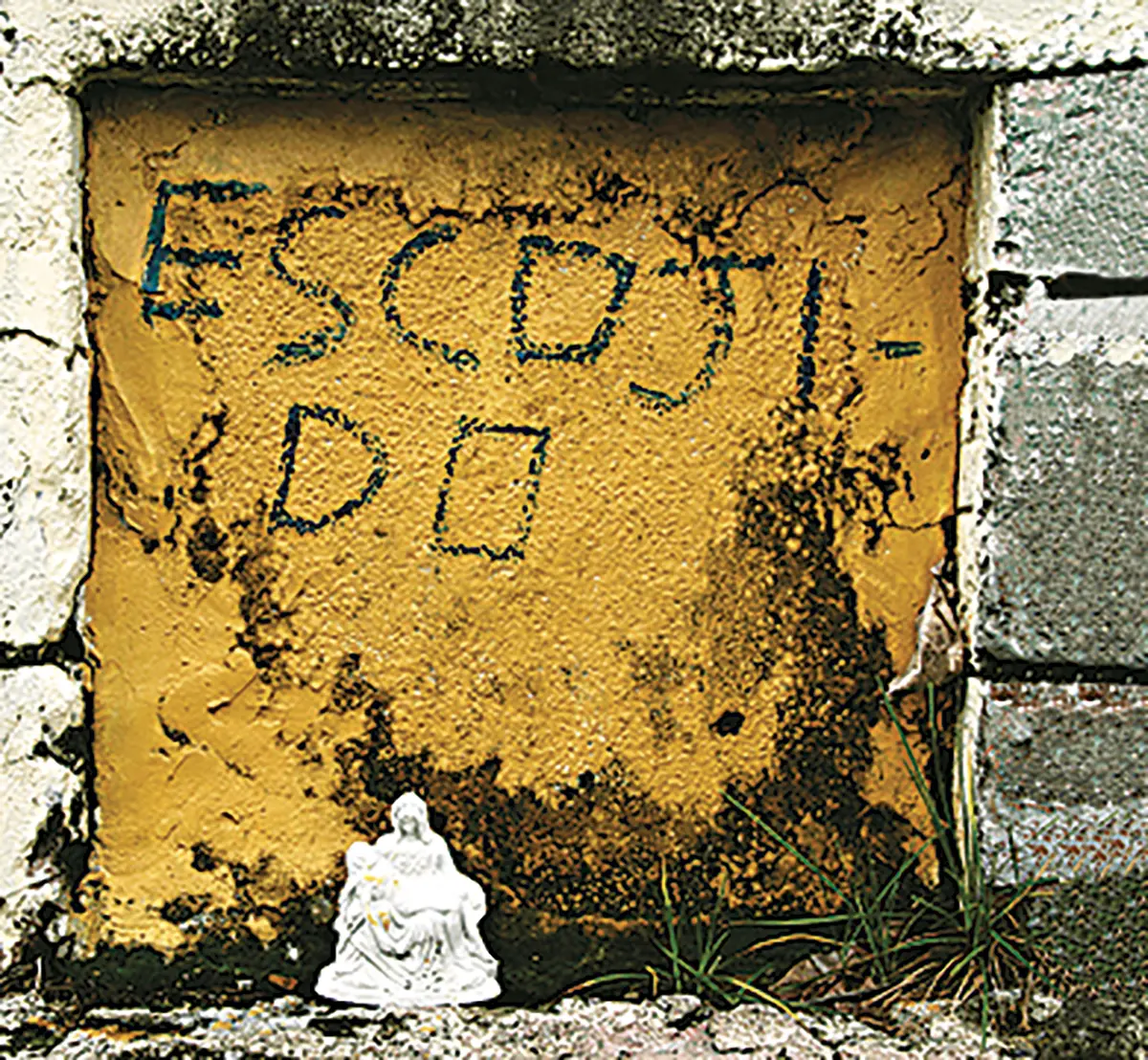
At the Josée Bienvenu Gallery, Echeverria partially recreated the NN Mausoleum of Puerto Berrío. The exhibit comprised 65 photographs inside 20 × 20 inches that form a thirteen-column rectangular grid of five rows. The resulting mural occupied the main wall of the exhibiting space. In visual terms, it is noteworthy that Echavarría did not use all images from every niche – this easily verifiable thanks to a panoramic photograph of the actual mausoleum surrounded by an intensely green lawn; to the contrary, Echavarría selected niches that appeared to be intervened and were visually appealing. He then rearranged the niches into a unique composition. (It could be affirmed that the mural was the only piece in this exhibit, were it not for the panoramic photographs and other prints detailing the niches. (Actually, this zoom-in the zoom-out effect turned out to be too accommodating, and took away from the monument’s strength).
By readjusting the mausoleum as he constructed it, Echavarría deviates from the direction he had been pursuing with Mouths of Ash (2003-2004), a video series that gave him international recognition. In this series, the artist brought together and exhibited popular songs in their original state, composed and sung by survivors of massacres and other violent acts. In other words, Echavarría offered a literal replacement of his own voice with the voices of others: witnesses afraid of telling their stories for fear of retaliation. Likewise, he gave the exhibit an ambivalent title (Mouths of Ash), because the spectator could interpret the title as a direct mention of the protagonists’ drama, while also alluding to Colombian toponymy and in particular, to the mouth of the Magdalena River that flows into the Caribbean. The Magdalena is also known by the same name as that of this exhibit. Such a context conferred a tragic tone on the local landscape.
In the Puerto Berrío Mausoleum, the voice of common people is suggested in the lapidary inscriptions such as Gracias NN por los favores recibidos (Thank you NN for favors received), Especial Carlos Mario saltan senderos (Special. Carlos Mario. Jump across pathways), or Milagros (Miracles). At the same time, it also underscores the visual vocabulary that each individual uses to honor his “protected”. Unlike the videos, in which the documentary record of the songs was the esthetic essence, in Escogidos the image becomes the central element. It determined the selection, the registry, and the eventual configuration of the mural. In other words, this work consolidates the gaze of a visual artist above that of the narrative and context.
Echavarría comes from a literary background, having authored several novels in the past. It is, therefore, not strange that at times his approach had taken the form of storytelling. In this respect, the video served him well as the ideal vehicle. Nonetheless, what is important is that his transference from one field to another did not occur in the typical intertextual-erudite manner that has characterized so many writers-visual artists. Contrariwise, he made sure to clean the lens and focus his attention on manifestations of popular, which he regards as generators of poetic discourse, arising at the crossfire of the Colombian conflict. First, Echavarría presented rather than represented them; subsequently, he subtly and respectfully intervened in them. This explains the freshness – not at odds with drama – with which the spectator approaches the theme of violence.
In serving as a channel to transmit the articulated messages of Mouths of Ash survivors, or of the caretakers of anonymous human remains in Puerto Berrío. Echavarría departs from the theme that has defined a great part of the discourse on Colombian art from decades past, but the artist also leaves the theme behind. Just as the characters in his stories were obliged to do, Echavarría offers the most humane possible alternatives to the inhuman situations with which these protagonists were confronted.
ELVIS FUENTES