
In spite of the early efforts of Russian constructivism and the Bauhaus, it was only after Abstract Expressionism that the industrial finish became common in art. North American Pop used it to give credibility to the commercial icon and Minimalism eliminated any personal touch in the object’s finish to avoid emotional contamination. Conceptual art appealed to it as well, in order to purify the idea. While not all of today’s art participates in this removal of the artist’s hand, the wish to transcend its presence continues one way or another. Even when the hand is present in the work, the final product often features a scale and spectacular elements that visually overwhelm whatever trace of technical struggle might be left. Machine perfection became a paradigm that, if not faithfully followed, at least demands to be beaten in competition. Marcel Duchamp already intuited some of the problems posed by this and, in trying to find an answer, co-opted found objects as art. Although Duchamp widened our perception of art, he did not focus on the aesthetic ramifications of the industrial finish.
The quality control established by industry was consistent with the formalist dynamics that reigned during the twentieth century. It led to our present situation, where art too often is limited to the big-format representation of small ideas. Slick and impeccable production diminishes any possibility of complex emotional dialogues. Embedded in a psychology of consumption, both artist and public expect that the work of art has a presence that is alienated from both, and that the art object, like any other commercial consumer product, exists on its own and generates instant gratification.
This process became a cultural trait of the capitalist cultural centers and therefore was placed above judgment—certainly above the judgment of personal art production. In fact, this characteristic may some day in the distant future be the weird stylistic description that unifies half a century of art production.
Keith Edmier’s work may be the perfect example of these issues, and it certainly raises good topics for discussion. A retrospective exhibition of Edmier’s work from 1991 to 2007, curated by Tom Eccles, was shown at Bard’s Center for Curatorial Studies and Art in Contemporary Culture.1
Nothing in Edmier’s body of work is particularly original. All works share elements used in many trends and by many artists. There is appropriation, reconstruction of architecture, conceptualist play, hyperrealist painting, collaborative work, and camp aesthetics. In seeking a common denominator, one could say that the exhibit was guided by “morbid kitsch.” However, what here might sound like an insulting term added to a damning list should not be interpreted negatively. Both morbidity and bad taste were carefully administered and became very powerful contributions to the whole exhibition. Edmier works in such a way that the aesthetic solutions one normally would wish away instead acquired the status of cultural markers with an imposing validity in this show.
Even more impressive is the way Edmier manufactures his work. Edmier began working in a dental lab making orthodontic casts and then went to Hollywood to create special effects for horror movies (among them David Cronenberg’s remake of The Fly). Although Edmier was always interested in art, it was only after these activities that he seriously studied art in a formal setting (although he never graduated). Thus, Edmier’s technical skills were developed outside the art environment and then applied to his art projects.
Edmier’s preceding professional experience equipped him with both an exacting demand for perfection that reaches the furthest extremes of credibility and a technical repertoire that is not usually explored by artists, with materials conducive to achieving these standards, like dental acrylic and different resins and forms of silicon. Edmier’s approach to art challenges the ideas that guide the technical education offered by art schools. He had access to tools and materials that are not usually acknowledged in academia; before even entering academia, Edmier had developed standards far beyond what is normally expected from the artist who executes his own work.
These standards, aimed at achieving credibility with the spectator, transform the hand into a dispassionate tool. For most of Edmier’s works, one cannot literally speak of an industrial finish since the objects are not machine-made. But no matter what material and technique are involved, there is the feeling that Edmier’s work abides by the highest technical standards established by the chosen trade (such as construction, tailoring, stone cutting, casting, and graphic design).
As a result, Edmier’s work shows a conceptually guided detachment; any personal calligraphic trace of the artist has been removed and we are presented with things that look like ready-mades. Extreme craftsmanship brings about a “materialization of the concept.” In old dogmatic conceptualist quarters, this might sound implausible, oxymoronic, and retrograde; however, the Bard exhibition succeeded in making it credible.
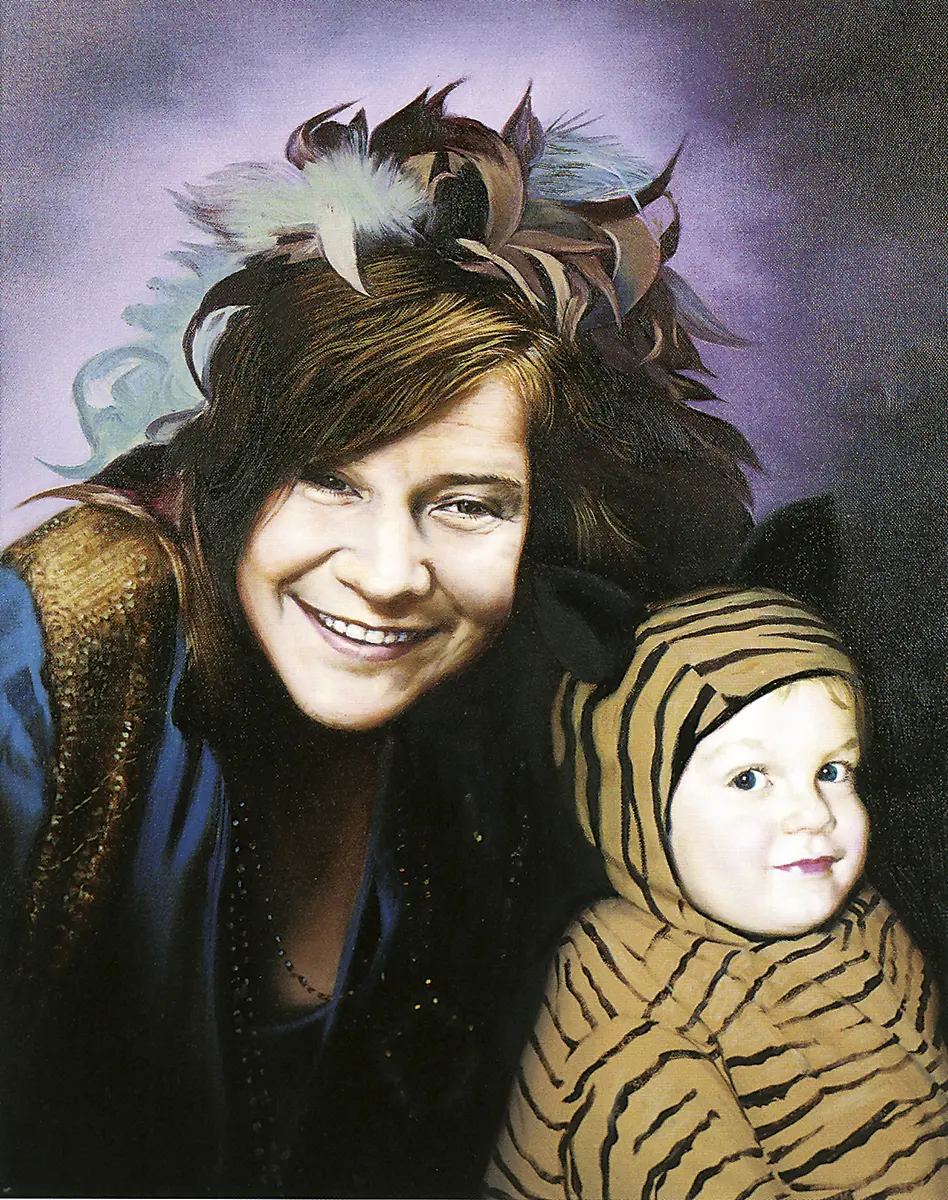
Edmier left art school after only one semester to become an assistant to Jeff Koons and to Matthew Barney. His work incorporates some ingredients from both artists and integrates them into his own personal narrative. Within a discourse about distancing, Edmier consistently focuses on autobiographical and emotional topics. He perceives that the events in his life, however emotionally loaded, are not particularly different or remarkable. Rather, according to the U.S. standards, they are statistically plain. This plainness allows him to blend himself as one more character within a sociological mean that may be defined by the aesthetics of a Sears & Roebuck catalog or by his (very common) infatuations with Jacqueline Kennedy and Farrah Fawcett. In his work, there is an echo of Woody Allen’s Zelig, but Edmier doesn’t fake his insertion of himself into his works (a piece with Janis Joplin is an exception), but he establishes actual contact with his icons in different ways (Farrah Fawcett and Evel Knievel are the more direct examples).
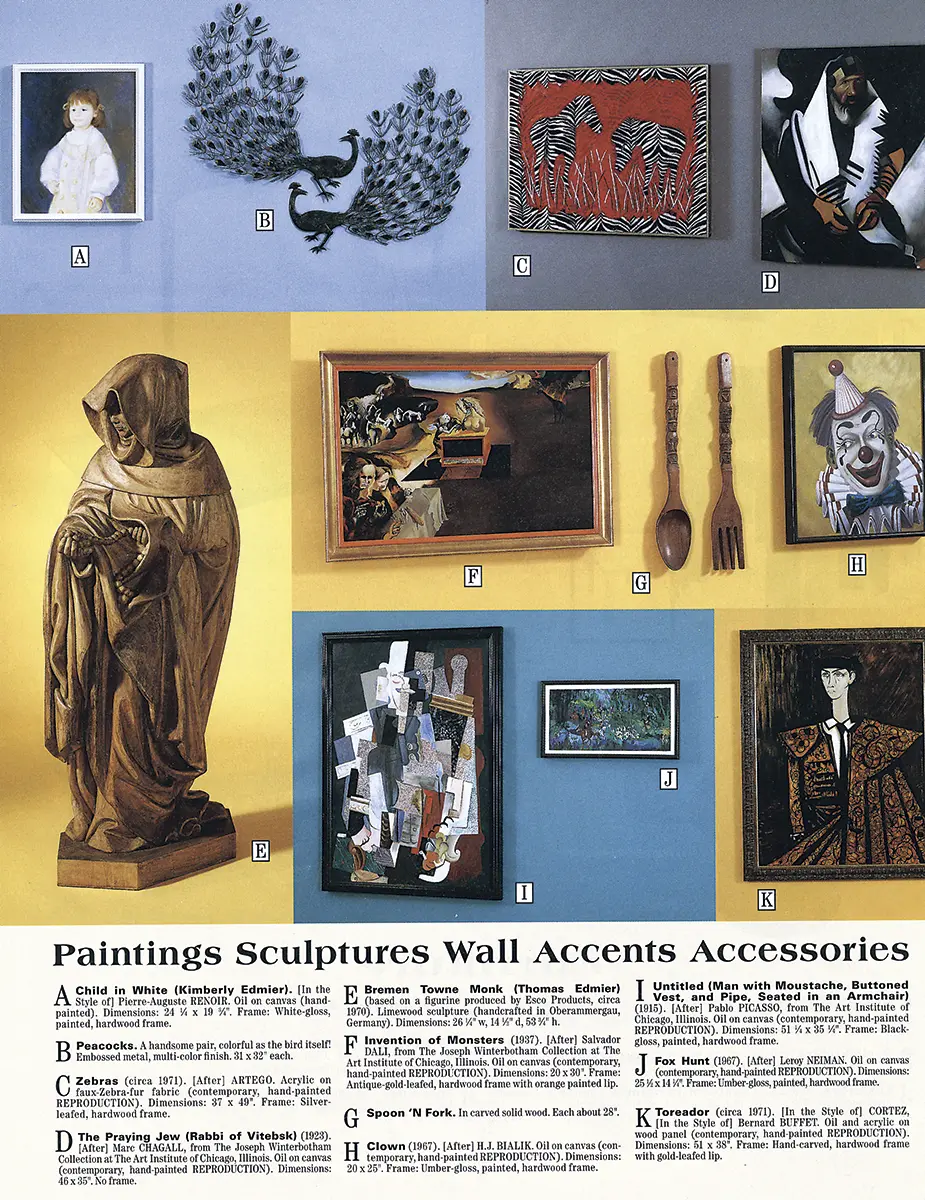
The most ambitious installation in the Bard exhibition was a replica of the interior of the house in Bremen Towne where Edmier grew up. Bremen Towne is part of Tinley Park, a suburb of Chicago and a true sample of middle-American impersonal character. The home’s reconstruction was limited to those rooms shared by the family, with no access through the doors behind which bedrooms and bathrooms would have been, and the precision was obsessive. Every detail was covered, from wallpaper to artwork, from drapery to refrigerator to knick-knacks. Appropriate for this exhibition within the exhibition, Edmier prepared a separate little catalog. The publication could have been produced in the early 1970s (the family moved into the new house in 1971), and it itemized all the accessories, room by room as if they were offered for sale in a department store. Laboriously painted canvases reproduced the original printed reproductions that hung in the house. These ranged from a work by Salvador Dalí to a perverse interpretation of a pitiful Cortez print of a bullfighter done in the style of Bernard Buffet. Thus a fourth or fifth-generation reproduction (Buffet’s painting to print to Cortez's painting to print to painting by Emier) was now sanctified by the museum as a new, valuable original.
Jacqueline Kennedy was semi-reincarnated in the work Beverly Edmier (1967) (1998), a sculpture of the artist’s mother. Beverly, seen pregnant with the artist, is dressed in the same Chanel suit that Jackie wore on the day of JFK’s assassination. The detail was not to be taken lightly. Edmier contracted the designer Linda Labelle to order a new weaving of the fabric (which is today unavailable) to then custom tailor it for the sculpture.2
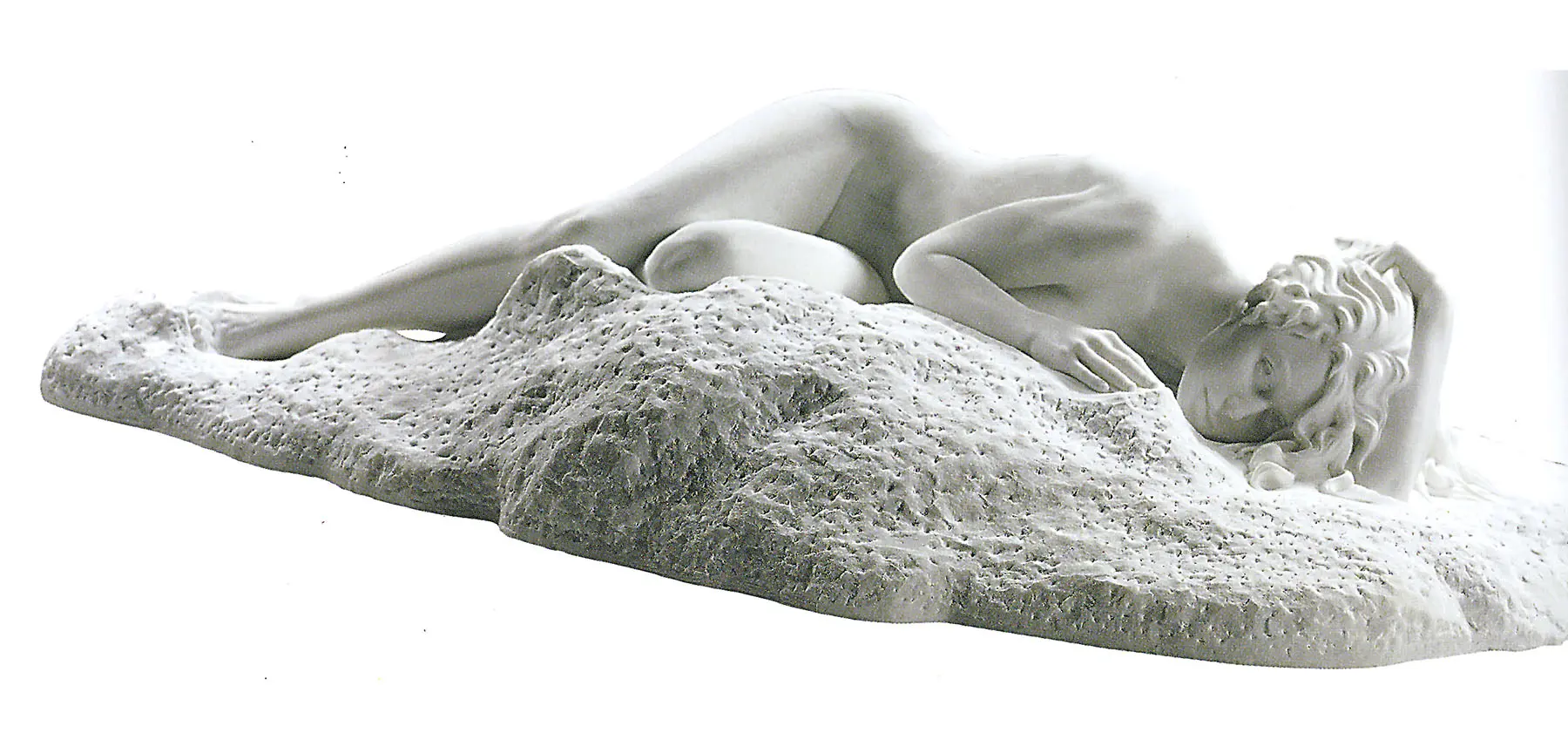
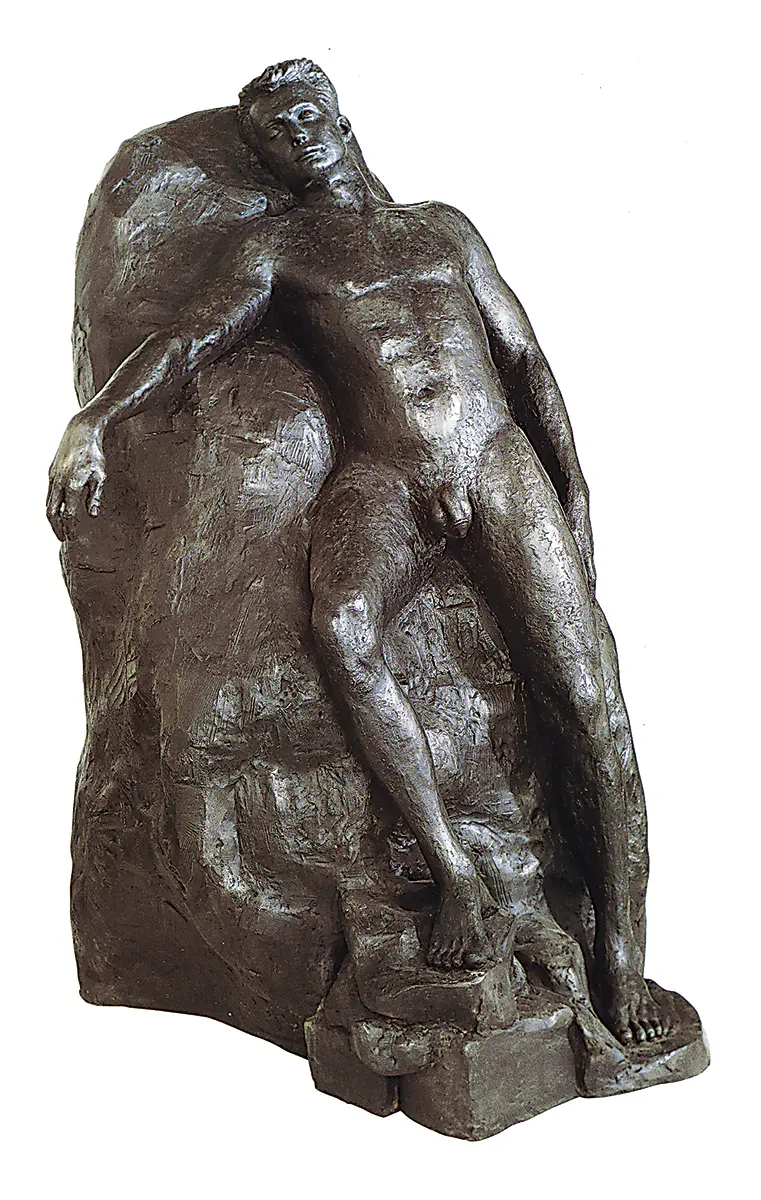
Farrah Fawcett’s presence was even more real. Fawcett had been an art student before becoming a TV and movie personality; Edmier invited her to collaborate in the creation of Keith Edmier and Farrah Fawcett, 2000 (2000–02). The result was two nude sculptures: Fawcett was the subject of a marble piece by Edmier and the author of a bronze that depicted Edmier. Both sculptures were, in the most reactionary sense, amazingly academic. They reminded one of late-nineteenth-century funerary sculpture and were imbued with nostalgia for irrecoverable aesthetics only reachable through a time machine. The unexpected sculpting skills of the superstar Fawcett added an extra thrill to this collaborative work.
The idea of a time machine may be a precise metaphor for Edmier’s work. With memorabilia gathered either from actual experience or from wishful thinking, Edmier doesn’t attempt to confide in the viewer or to share his emotion. Instead, he sets a stage where his personal life is nothing more than a helpful prop. In Beverly Edmier, the translucent belly of his mother showed him as a fetus, and yet the whole remained a period piece marked by the memory of an assassination that fabricated heroes (Edmier was born five years after the event). A hyperrealist painting of Janis Joplin (I Met a Girl Who Sang the Blues, 1991) included a snapshot of Edmier as a toddler. A handmade Photoshop trick, Joplin’s smile became a sign of proud motherhood thanks to the intrusion of the artist. But although Edmier was there, the painting was not about him; his direct look at the viewer only served to guide us in the trip back in time.
Beyond reclaiming time, these works also reclaimed realism as a surprisingly valid and contemporary form of expression. Traditionally, realism had been more a narrative vehicle than an experiential one. The narrative content was contained in the work and the viewer was led to “read” it. Thus, realist art was used to inform, and the demands for viewer participation were primarily rooted in literary devices. The shift toward more analytical, expressive, and musical uses of media (in Cubism, Expressionism, and abstraction) led to the view of realism as an illustrative technique, as a visual restatement of a story. Unlike the newer forms of art, realism allowed recognition to take the place of cognition and lost some of its interest. A realist painting was easy to understand once the story was clear. One could like the story and the skill of its rendering without ever contending with any art issues.
Edmier does not stand alone in the revalidation of realism.3 On a more modest scale, Paul Thek’s 1964–65 Technological Reliquaries series can be seen as a precedent. More recently Ron Mueck, with equally exacting and ambitious work, seems to come much closer. All three artists are related by the use of a false blankness. Unlike the figures of Duane Hanson’s life-size, three-dimensional snapshots, Thek, Mueck, and Edmier use extreme realism not to tell a story but to engage the viewer in a complex emotional response. In certain ways, the model for presentation is like theatre: with a stage through which the viewer can circulate and enliven the props by establishing a relationship that includes drama, sadness, and humor. Edmier’s Shell (2001) is a huge sea conch (cast with blue Crayola crayons) filled with sand and bearing two footprints as if Boticcelli’s Venus had just left for a stroll.
Edmier’s approach (and those of his colleagues) actually enlarges the scope of traditional realism. It sometimes flirts with surrealism, but realism is applied as much to reality as it is to the memory of reality or to the interpretation of reality by others. In many cases, even if the object or material concerned is still available, Edmier feels obliged to remake it or have it remade since it is one way of integrating his memory into the object.4 For one of his projects, he intended to use molten lava, only to learn that lava from national volcanoes is federal property. This obstacle led him to melt basalt in a bronze foundry.5
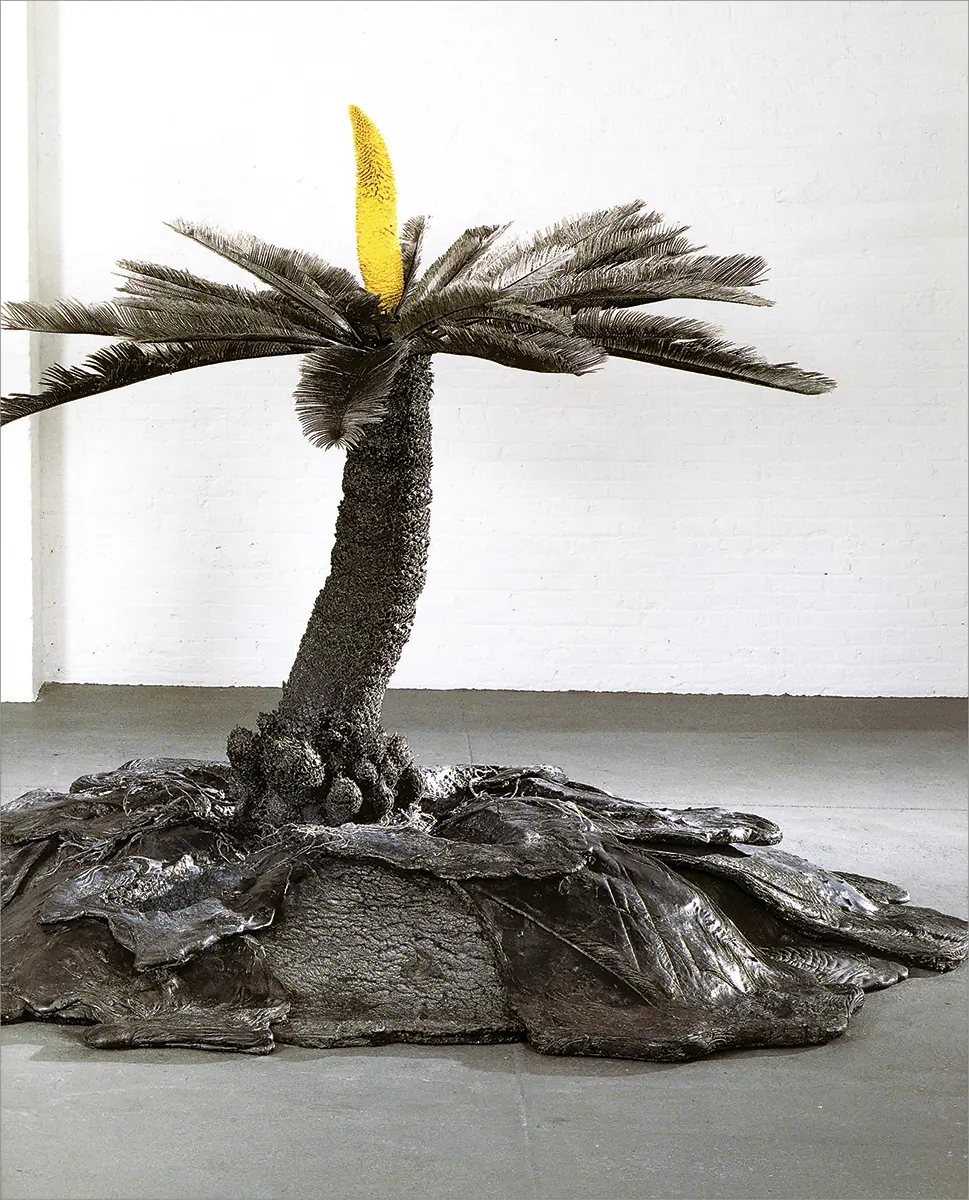
The theatrical quality of Edmier’s work becomes more apparent in his depiction of plants, which are of a huge scale and loaded with sexuality and aggressively confront the passerby. Victoria Regia (First Night Bloom) and Victoria Regia (Second Night Bloom) (1998) was over nine feet tall and dominated the Bard space as animal/vegetal hybrids.
Finally, the catalog is worth mentioning because, although it is a book, it is also a multiple that is impressively consistent with the exhibited work. Lined with a pink silicon rubber cover (embossed with a “Van Gogh Studio” logo) that forms a frame around a photograph of a little girl, it opens to a flattened rose cast in red plastic. Enclosed in the catalog is the small catalog for the Bremer Towne work as well as a photo-store envelope with family snapshots. The informative catalog has reproductions of the works and standard texts (among them the introductory essay by Tom Eccles and an interview with Matthew Barney). Edmier’s works define chapters in the book that are filled with notes and comments.6 The information provided by the notes surpasses any possible interest one might normally have regarding an art object. And yet, this rigor over trivia—that so often makes art historical studies unbearably irritating—becomes an organic extension of the art. Data that under different circumstances would be totally unimportant and forgettable here become important components of the works. In that sense, the catalog is an exhibition of its own but also makes one want to revisit the show space after reading it. Mulling over this exhibition, it is difficult to decide if it was good art or a revealing cultural symptom that helped one to understand the U.S. Time will tell if, perhaps, it was both.
NOTES
1. Keith Edmier 1991–2007, October 20, 2007–February 3, 2008, Hessel Museum of Art, Center for Curatorial Studies, Bard College, Annandale on Hudson, New York.
2. Linda Labelle, “Fabric for ‘Beverly Edmier’” in Keith Edmier 1991–2007, exhibition catalog (London: Booth-Cliborn Editions; Annandale on Hudson, New York: Center for Curatorial Studies, Bard College: 2007) 97.
3. I refer here to true realism, not to figurative art as exemplified by Lucian Freud or Philip Pearlstein.
4. Interview by Matthew Barney, in Keith Edmier 1991–2007, 162.
5. Notes, in Keith Edmier 1991–2007, 148–149.
6. The notes were organized and edited by Jade Dellinger.
LUIS CAMNITZER
Emeritus Professor at the SUNY College, Old Westbury.