
In his latest exhibit in Paris, Argentine artist Leandro Berra (1956) presented a group of composite self-portraits by patients at the Domingo Cabred Psychiatric Hospital in Buenos Aires – also known as the “Open Door Colony” – each placed alongside Berra’s photograph of the corresponding patient. The exhibit also presented a twenty-minute video conceived of by Berra as another series of portraits in which the patients are individually recorded in real-time. These self-portraits were created with the help of special U.S. software called Faces, commonly used by the police to create composite sketches of delinquents and criminals. Leandro Berra is an owner of this program and had used it before in a previous exhibit, in which he invited cultural personalities and anonymous families to create their self-portraits.
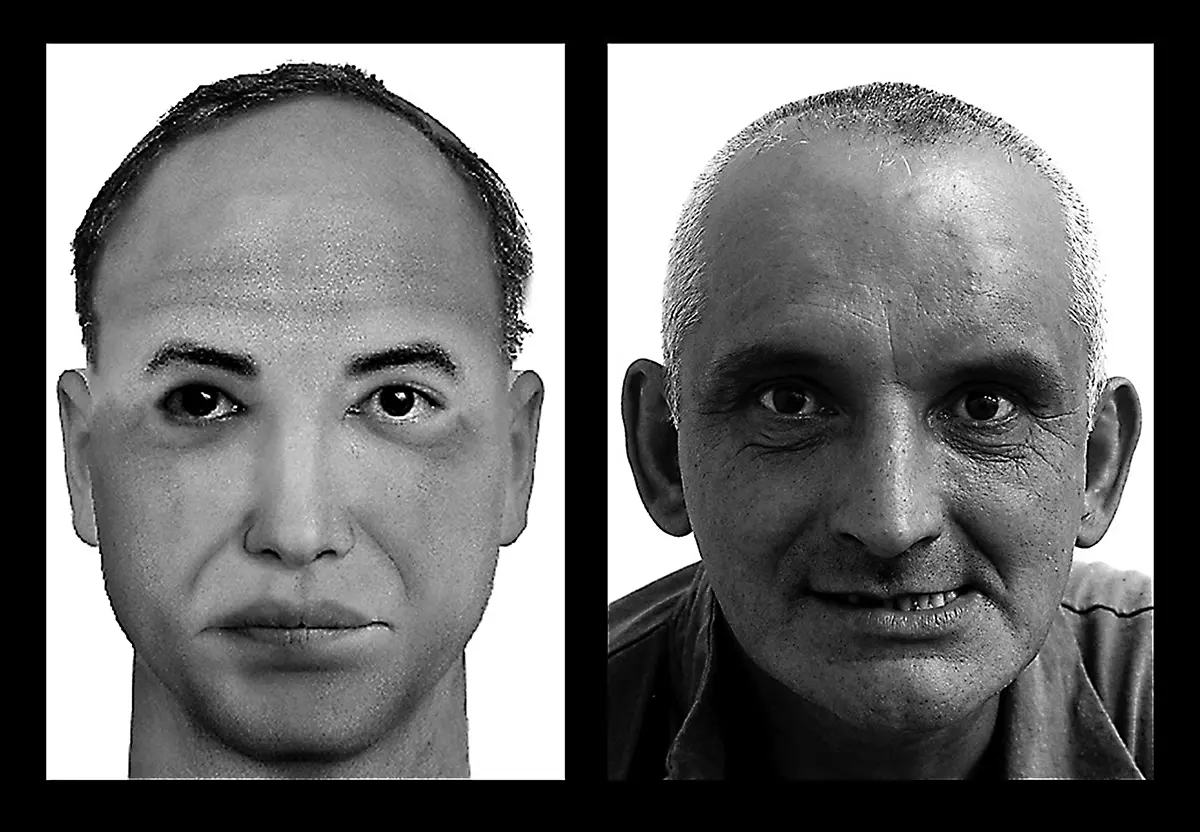
In Open Doors, the occasional “creators” are persons who have been marginalized socially and psychologically as a consequence of their mental illnesses, schizophrenia in the majority of cases. The twenty double-portraits exhibited and presented in diptychs, correspond to an equal amount of institutionalized patients who accepted Berra’s offer to participate in the project and who voluntarily undertook the difficult task of reconstructing their faces from memory – without the help of mirrors or photographs to guide them – as they sat in a common hall in front of the artist’s recording video camera. Each double-portrait in the exhibit includes a black-and-white photograph was taken by the Berra of the person chosen, which is accompanied by a black-and-white reproduction of the same size (40 × 28 cm) of the subject’s imagined portrait. Both are frontal, close-up renditions with no depth of field, resembling the image on a photo ID card. The first impression one receives from contemplating the “true” faces of these men of different ages is their mellowed or tortured semblances, external truths revealing in some the greater part of their internal suffering. Our gaze leads us to the imagined portraits, and we discover a flagrant contrast between these and the “original” portraits, because the patients appeared to have preferred presenting themselves with features belonging to eternal and serene youth, characterized by a certain feminization of facial features that perhaps has to do with the velvet-like rendering – similar to that of a drawing – of the image produced by the computer. Whether as a nostalgic evocation of their childhood and/or a rejection of their current state, memory flourishes to the surface during this exceptional act, as a glance back at the ideal. Their new frontal and direct “gazes” appear to be questioning time. Could they perhaps escape for an instant the suffering of their personal stories?
This particular utilization of police technique for searching for the truth – which on the other hand, has its own limitations as far as the proposed physical norms are concerned – toward its application in the field of art, presents several kinds of questions, particularly ethical. Here we are interested in the philosophical and esthetic questions that such an intervention generates, notwithstanding the purely psychoanalytical reasons that led to the institutionalization of these individuals. The unfolding of a human into God or animal, or of animal into a human and then God, has comprised a recurring theme throughout art history, from pharaonic Egypt to Christian civilization, gaining momentum during the Middle Ages. Divine beliefs and superstitions have dominated human thought. Freud was to arrive at the point of human beings beginning to know themselves and admitting to their conscious selves. But throughout all this time, Socrates pronouncement “Know yourself”, taken from the inscription engraved on the façade of Apollo’s temple in Delphos, and Voltaire’s conclusion in his Candide that incited humankind to “Cultivate our own garden”, is no more than two expressions of the same uncertainty: that which is confirmed in another assertion by the Greek philosopher: “I only know that I know nothing”.
These double self-portraits represent the terrible and overwhelming proof of such uncertainty. This traduttore traditore (translator/traitor) had his work cut out for him. The patients are clearly disconcerted (as it can be observed in the video) by the array of elements available to them to aid them in reconstructing their faces, be it a nose, a mouth, eyes, ears, or hair…, despite that these same patients appear to be very focused and alert. The most disconcerting part to them is not only the endless assortment of available elements – a variety that would provoke confusion in any mortal – but finding and answering the famous query, “Who am I?” If it was as simple as just saying “I think, therefore I am” and in this case, “I exist, therefore I am”, everything would be a lot simpler for all of us, without exception…
From the realism of the Fayoum mummy portraits in Egypt to the idealized representations of Roman emperors, from Goya’s and Velázquez’s grotesque caricatures to the self-portraits by Dürer and Rembrandt, up to Francis Bacon, just to mention a few, the theme of identity prevails in both portraiture and in self-portraits and influences their idealization or their veracity. What these mentally ill people are doing, consciously or unconsciously, is nothing less than engaging in the difficult search for a familiar detail with which to find their lost identities. If their illness represents the loss of their own image, how can we then measure in these sick individuals the mental efforts required for the reconstitution of their own faces? How can we not imagine it to be a challenge impossible for them to overcome when their memory has been altered by their sickness to such an extent? How can we, then, evaluate the results and the esthetic value of the concept applied by the artist?
It is at this juncture when one is able to pose the question on the presence/absence of the artist, creator, and mediator Leandro Berra, without whom these self-portraits would not be organized in this fashion. Thus, certain occasional artists (the patients) and an artist of a defined status come together in a joint effort to create a work of art. If the artist’s responsibility is unquestionable and not questions exist concerning the role of each of the participants in this process, it is not – because of this – less true that we are confronting a situation never seen before, in which the work is created with four hands and with the same objective: the self-portrait and other people’s portraits of the subjects. The artist disappears and simultaneously becomes the artisan of both processes, in which the creative act is doubled, although it continues to be the artist who has the last word in rendering the final work possible, that it, what we now see exhibited.
Whether a rebirth or a transfiguration of the self or ego, these self-portraits are of necessity incomplete and therefore fragile, since their “reality” is dependent upon the limitations set in place by the computer program and errors of memory. On the faces of these men put in the position of having to describe themselves, one may ponder the existence of a discourse centered on the men themselves and what their motivations are in choosing the details for their faces in portraiture. We cannot avoid thinking that there is a certain religiosity in this gesture, similar to a miracle, of recuperating, if solely for an instant, eternal youth and being immortal. In fact, the questions are many and passionate, for they refer to that other self, the double self summoned by Rimbaud, a theme dear to Leandro Berra that has accompanied his work for some time. The physical and the spiritual are intertwined, and although the tools have changed, the meandering of memory remains the subject of the questions. Selective, consciously, or unconsciously, the self-image each of these individuals chooses will always be a part of what they opt for disclosing themselves to others. The risk of this game is to discover who we are, but also implies the possibility of communicating that dark, dreamed, or imaginary side common to us all: the simultaneous desire that makes one hide while simultaneously exposing oneself.
Panic and rejoicing can therefore be associated. The double- portraits by Leandro Berra provoke contradictory sentiments as they invite us to the many reflections affecting the fragility of our own identities. They dispatch us to that mysterious unrecognizable side, the rejection, and pride that inhabit us all, which these mental patients divulge to us with no guile, with no visual culture, because they have severed the links with a world whose marvelous fragment they attempt to reconstruct by means of this process.
NOTE
1. Retratos Hablados, Retratos de Familia (Composite Sketches, Family Portraits) in June 2006 at the same gallery.
CHRISTINE FRÈROT