
Two years after his death, Pablo Suárez (1937–2006) received with this exhibit the kind of tribute usually reserved for artists many years after their passing, when the true dimensions of their talents can be assessed with the help of historical perspective. In Suárez’s case, it was not necessary to wait: for a long time, he has been regarded as one of the most prominent artists in Argentina and his early death only propelled the desire to review his artistic production in a voluminous exhibit that covered his career’s several stages. The vastness of this exhibit, curated by Patricia Rizzo, could not be measured solely by the large number of works selected but also by its atypical and the extensive national tour, which began at the Castagnino-Marco Museum in Rosario, continued at the Recoleta Cultural Center in Buenos Aires, and will later be presented at the Caraffa Museum in Córdoba and the National Fine Arts Museum (MNBA) in Neuquén.
A figurative painter and sculptor, and an extremely cultivated artist who was also in love with the popular, Suárez coined a style that was unafraid of excessive narratives or of parody. These characteristics identified his work even in periods dominated by other less strident tendencies such as Conceptualism in its most antiseptic version, Minimalism, or Abstractionism. Always against the current yet perennially relevant, Suárez deployed grotesque figuration as an emblem, a luminous banner that to this day continues to gather adepts in the art market and followers among new generations of artists, who have recognized and admired him since the nineties.
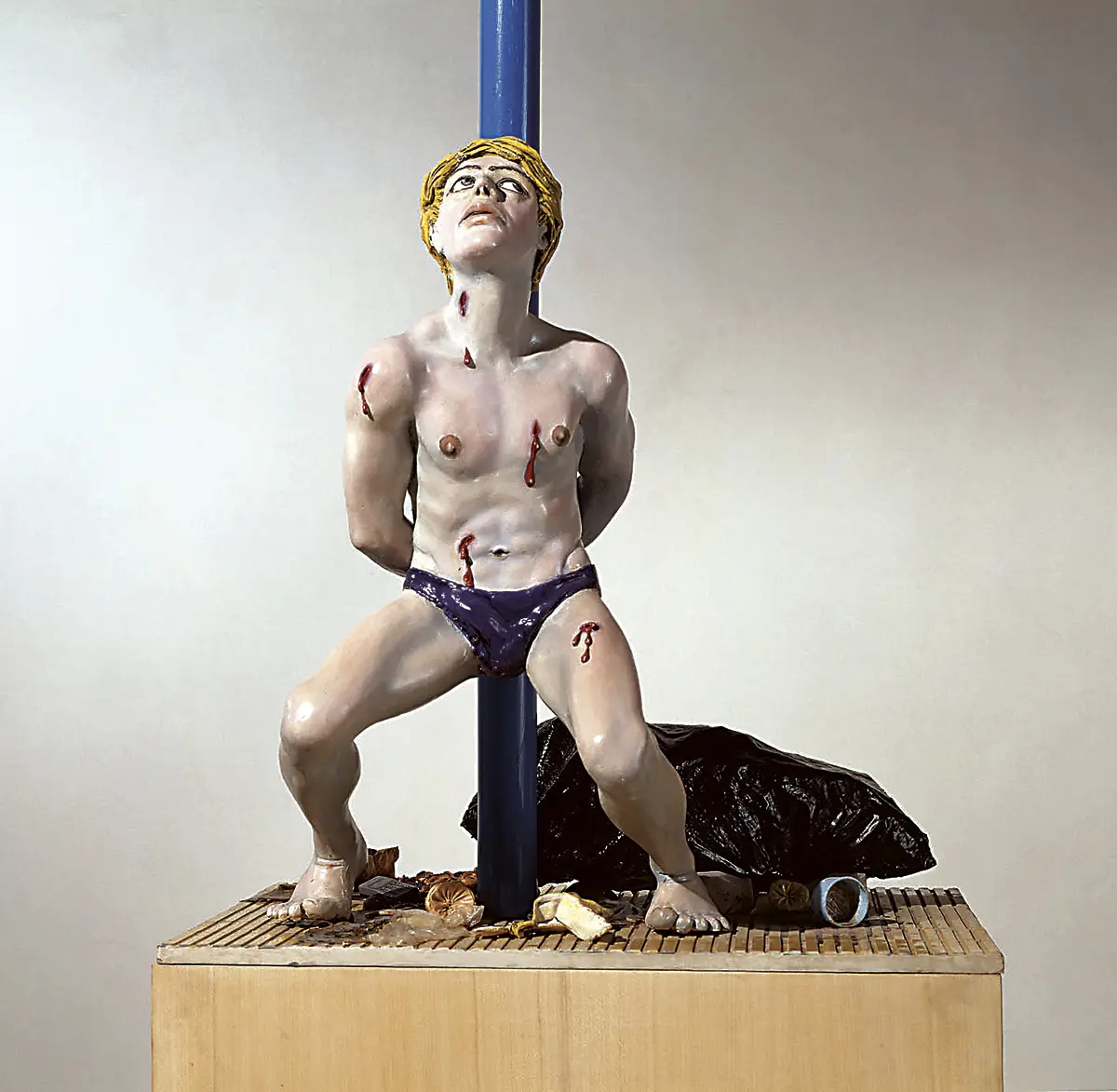
The exhibit included a wide variety of formats and techniques; even if not considered a retrospective, the show contained artistic works from several periods and revealed that Suárez followed paths and continuities. There were acrylic and oil works from the seventies and eighties; works made of epoxy resin with and without other materials or objects, characteristic of his work during the nineties; and some other paintings and sculptures created in recent years. Suárez’s themes could be divided into several areas of interest. They appeared and disappeared through the years, but they focused on Suárez’s derisive but always affectionate depictions of the urban popular classes, with hyper-stereotypical characters that aimed for, as he would continually say, a direct communication with the public. Marginal anonymous protagonists—prostitutes, beggars, taxi-boys, the unemployed, hustlers, and survivors in general (characters that Antonio Berni adopted in his work, undoubtedly through Suárez’s influence)—were the heroes of a personal pantheon portrayed with customary mannerisms that have been seldom adopted with such freedom by a contemporary artist.
Another theme in Suárez’s works honored the Argentine landscape tradition from Río de la Plata, perhaps the most bucolic and most silent of his themes, and one not necessarily inhabited with characters. But the greatest asset of his two- and three-dimensional works was his particular way of representing men, who at times were portrayed more universally, and sometimes more individually. In these figures, Suárez proposed more metaphysical and existential problems. These generic men—notwithstanding their nudity and displayed genitals (it is not coincidental that there were no women among Suárez’s resin figures)—embodied ahistorical and atemporal preoccupations; they denounced and prompted reflection on dubious moralities, dead-end streets, and injustices of all sorts.
Suárez conferred an intensely ethical meaning on everything he did—and his work should be approached with that understanding—such as his vigorous political activism during the decade of the sixties. His famous letter in 1968 to Jorge Romero-Brest, then the director of the Di Tella Institute, laid the ground for a radical non-conformism that Suárez eventually moderated as years went by. Nonetheless, its irreverence still floated among the works included in this well-deserved retrospective.
EVA GRINSTEIN