
Rosemberg Sandoval, a Colombian artist born in the provincial city of Cartago, who declares himself the son of displaced peasants and the oldest of fourteen siblings, is a pioneer of performance art in Colombia. His career began in 1982, with a series of actions in which he drew or created objects using bodily traces—viscera or hair—from anonymous corpses. “In 1987-–1988,” Sandoval says, “I used a knife to erase a photograph. In 1999, I rubbed the body of a hungry, horribly smelling adult indigent man on the walls and floor of a museum. In 2000, I drew, using my own torn pubic hairs, the tender face of a baby. In 2001, I crushed with my hands thirty dozen thorn-covered red roses until my blood mixed with the fallen petals. In 2004, I redesigned flags of first-world countries using dirty papers picked up from the street.”1
In Sandoval’s work, there is frequently something mortifying, something that seems to cross the limits of the tolerable, as was the case with Viennese Actionism. This emotional charge and the artist’s often-brutal way of assuming the body could perhaps be understood on the basis of his personal experiences. The artist says that the first body action he ever saw “was by a sister of my father, who lived for a while with us when I was very young, and it consisted of her sitting very still on her raw-wood trunk, which contained her small possessions; she then tore that absolute quietude with a convulsive state that brutally knocked her off her pedestal and caused her to hurt her eyebrow, her mouth, her elbows. Her image—staring into space, dressed in a patched floral dress, a toothless face, and her straight hair carefully arranged under a shiny headband—has remained with me forever.” The force of this image has been present in all of Sandoval’s works, including those in Acciones políticas, a solo exhibition presented in April at the Casas Riegner Gallery.
The show encompassed twenty-one actions, some of them partaking of the brutal condition mentioned earlier, of a presence of a body that seems to reach a limit. The artist described them in the following terms: "In Caudillo, from 2000–2007, I posed wearing black clothes and with the tongue from an anonymous human corpse attached to my neck (with a formaldehyde pool filled with human corpses as the background). El cuarto del artista (2007) was a body action inside my brother’s room (in my parent’s house), where I hung a homeless person from his feet in the doorway. In Caudillo con bebé, I was conspicuous, covered in black clothes, and I posed with the corpse of a baby hanging from my neck and the gesture of a contemporary deity (also with a formaldehyde pool filled with corpses as background).”
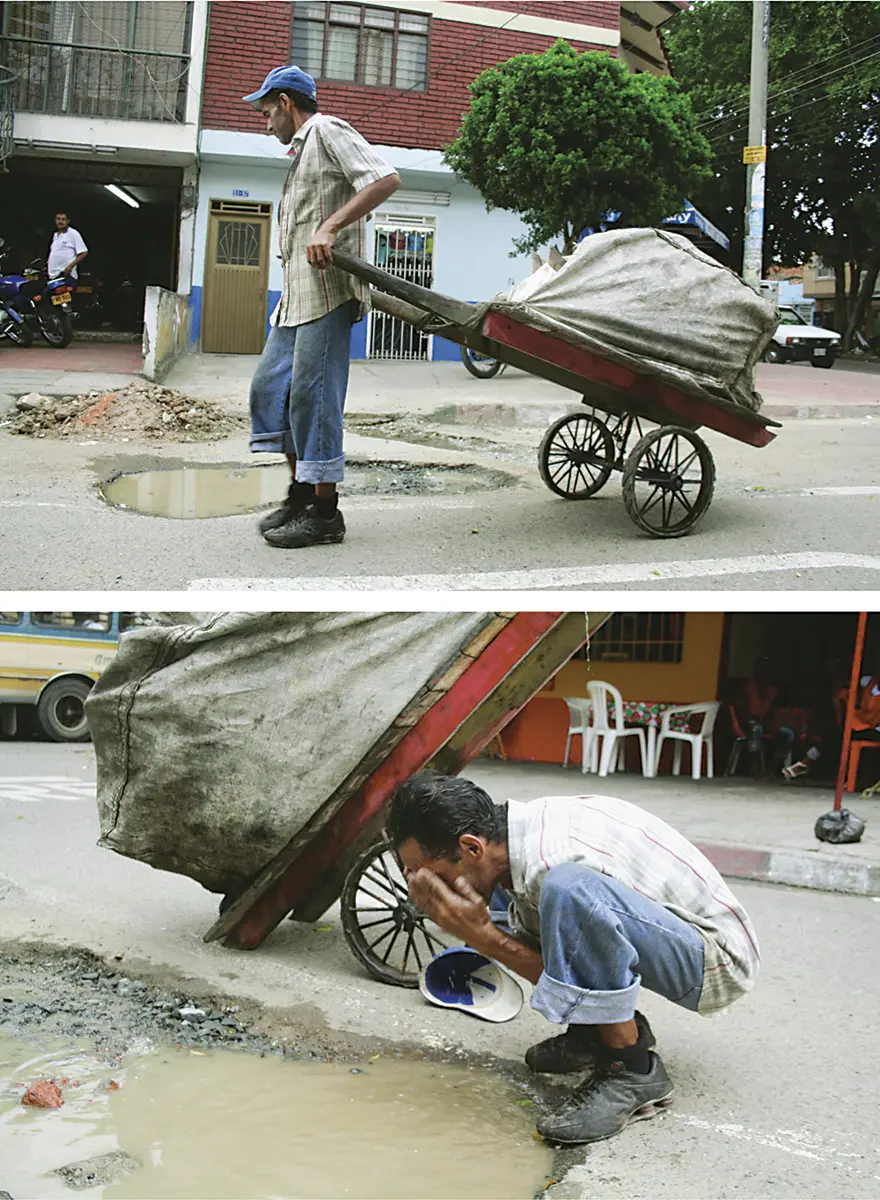
The tone of the other actions was very different but just as forceful; I don’t know if the best word to characterize their less brutal condition is subtlety. They were less direct and explicit but not any less effective. These are the artist’s descriptions: “Caudillo (con machete), 2000–2007: while standing, in funereal dress and posing like in an I.D. type of photograph, I will place on my chest one of the few objects brought along by my parents during their forced displacement in 1960, from Cartago to Cali.” Two of the most unsettling actions were titled Amanecer con fango and Casita de arroz. “In Amanecer con fango, in front of my parent’s house, a homeless person washed his hands, arms, and face in a muddy puddle before restarting his day’s labor. Casita de arroz, 2004–2007: an elemental little house made using a few raw grains of rice was placed in the palm of my hand; I closed my hand, destroying the house.” These works pointed out conditions of the world and achieved Sandoval’s goals: to allegorize and present “agony and death as irreversible threats, demonstrable facts, and conditions of matter that transform us into exteriority, dust, mud, dirt.” Inarguably, they achieved “permanence in the viewer’s active soul.”
The actions were presented through videos and photographs, and some of the objects used in each of them were included. In some cases, the high quality of the videos and photographs diminished the potency of the actions; the objects had a less antiseptic appearance. For example, in the photographs, the toys looked like catalog items, with shiny colors and new, smooth surfaces, while the real objects had an unsettled aspect that linked them to possible stories and events. Some of them were covered in dust and were somewhat damaged by use, which increased the impact of the objects and matched the artist’s intention. Sandoval said: “To insert politics in art, to connect the ancestral and the contemporary, to make art lumpen; to digest the social, the political, and the economic from the power of the marginal; to challenge good taste and money... are part of a great aesthetic project: to make art into a proper system for the interpretation of reality. Morality as attitude, support, and precondition for producing art!”
NOTE
1. The various quotes have been taken from the artist’s dossier and the text Acciones políticas (Political Actions) that accompanied the show.
MARTA RODRÍGUEZ