
Many agree on the characteristics and critical judgments of Saint Clair Cemin’s sculptural work. Much of it was confirmed in his recent exhibition Witness, titled after one piece in the show. To claim that each piece invoked “universal philosophical issues” was a bit, well . . . strained. Eclecticism is the most commonly named characteristic, while Cemin’s work is described as playfully creative and often allegorical. But let’s look closer.
Cemin has no one style or medium, although he does remain with media clearly identified with sculpture, such as metal, stone, clay, wood, and plastic. You won’t find painting, glass, paper, fragile materials, or even found objects in his work. There is the occasional nod to installations, but he does not mix genres. He is in love with traditional physical materials, their feeling and shape, and the formation of and changes in surface effects and processes. He is seriously and conservatively devoted to the history of sculpture in spite of all the rhetoric over his so-called refusal to be a traditional sculptor.
The artist’s references are also eclectic in their wide range of sources. One observer wrote that you could likely find a historical sculptural precedent for each one of his works. Others have remarked on the non-sculptural breadth of his references, ranging from furniture to toys and popular culture. Both were true in this exhibit.
The Artist was a cast bronze ensemble, with a figure laid on a base. The figure was plaster-white (with touches of red), and the base was dark bronze. The color and the writhing surface invoked a crossing of effects from Medardo Rosso and Jean Dubuffet. The figure arched upward, with the head thrown back and the neck exposed, inviting comparison to Giacometti’s Woman with Her Throat Cut of 1932. This traditional ploy implied greatness by association rather than inherent creativity.
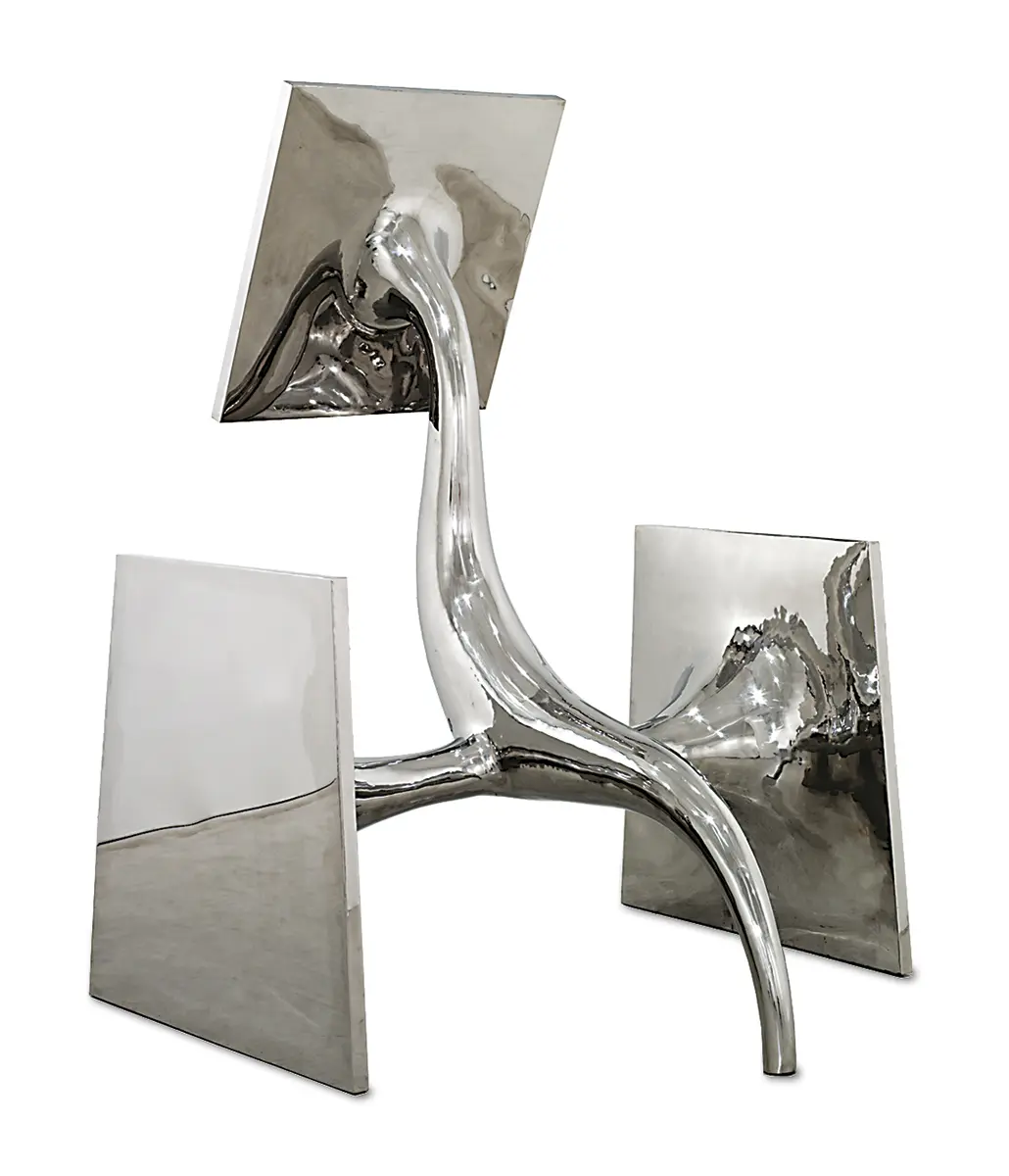
But Cemin is creative. Much of his eclecticism is characterized as witty, at times ironic, and certainly “child-like,” a concept dear to the art world for the naïve state of creativity it conjures and enshrines. In the recent show, the lighthearted play was everywhere. The tendril-like biomorphic forms of Portrait of the Word “Why” (2008) greeted the visitor at the entrance of the gallery. It evoked the playful creatures from the Surrealism of Miro and Arp, but here the creature was the viewer. The highly polished stainless steel, feeling slightly at odds against the organic form, reflected the viewer’s face in the polished flat piece at its head. The viewer was the portrait of “why” but not alone, as the surroundings were also reflected.
In the work Witness, Cemin continued to reference the anthropomorphism of the Surrealists, the movement he is most frequently aligned with. The artist has used chair forms in the past, but this work seemed one of his best. While earlier chair works have been frightening, this one, despite its height of about ten feet, made one want to hold its hands or legs and skip down a lane into a rabbit hole. But what did it witness? And how? Here, a more problematic aspect of Cemin’s art appeared.
The most spectacular work in the exhibit was the eight-feet-tall patinated copper octopus holding two small houses with its tentacles. Its title, Allegory, went to the heart of the same problem raised earlier. When everything can be an allegory, then nothing is; creativity fails to be informed and celebrates itself. The chasm between—or dismissal of—intention and accomplishment is too great to bridge.
Many have remarked over the years on Cemin’s unevenness and on his obvious talent as betrayed by his flirtations with change under the name of creativity. Whether one chooses to see the inevitable downside of this—the uneven quality of the work is the flipside to play—as positive (Cemin is not afraid to take chances) or negative (Cemin lacks critical discernment) depends on one’s values. One example was Violoncego, a life-size viola shaped of wood, painted pink, and surmounted with a gnarly bronze handle. Without strings, and thus blindly silent, it vaguely reminded one of Man Ray’s photograph Violon d’Ingres, but Cemin’s bland pink parody of flesh died on the music stand. Or was it an allegorical whimsy?
A lot of this ambiguity under the rubric of poetic vision, symbolism, allegory, and even criticality—i.e., the necessary stripping of past pretense for wholeness in recognition of reality—is incomplete. No doubt our reality is partial and belongs to a signified world. But I question (without the profundity of Benjamin and Derrida) where and how we move the experiential back into the allegorical imagination. When do we need to face into the Portrait of the Word “Why”?
RICHARD LESLIE