
Like accidents waiting to
happen, Alejandro Almanza Pereda’s works challenge structural integrity as they
engage the concepts of stability, risk, and danger. In his second show at
Magnan Emrich Contemporary, the artist has fine-tuned his iconoclastic,
sculptural assemblages. Moving away from founding objects and furniture, he builds
on groundbreaking shifts in materials first expressed in Jeff Koons’s fish tank
and Haim Steinbach’s commercial items displayed on shelves. Pereda’s new show
extends his earlier balancing acts while smoothing some rough edges.
Lighting fixtures are still part of Pereda’s trademark vocabulary, as are construction tools. As seen previously, objects are re-contextualized in startling combinations, and height is examined; works are precariously elevated and placed out of reach.
In the work It is for our own safety, the cachet and elitism of red velvet ropes are telescoped and spoofed at the same time. By making the metal stanchions ten feet tall, Pereda amplifies the materiality while rarifying the vision. Above the viewer’s head, the seductive ropes sequester a sparkling chandelier. The silver, red, and crystal surfaces are imminently appealing, evoking class and exclusivity and exuding a faux fairytale aura. Yet a visceral feeling of smallness, rejection, and insecurity falls on the viewer as he or she walks between the poles and under the chandelier.
Much of Pereda’s muscle comes from his ability to symbolically charge the atmosphere and mirror emotional states. Nowhere is this more apparent than in the central work of this two-part exhibit. Based on the game of Rock, Scissors, Paper, items are ensconced in a glass grid. Shiny metal clips hold transparent squares and rectangles together. Evoking domesticity, industry, panic, violence, life, and stagnation, the different items inside create a schismatic dialogue.
Some of the objects are repeated. Six paper globes glow, each lying on its side with wires running up and into the ceiling. There are five axes emblazoned with the logo TRUPER. A cone of confetti, some lumps of coal, two bonsai trees, five cinder blocks, nail clippers, a law book . . . a discourse is opened between these disparate entities. In a top compartment, a glop of cement has smeared the sides and hardened in the center. Characteristically, Pereda has inversed the balance and put the heaviest substance on top of a seemingly fragile structure.
In one of the bottom cubes, an open tallboy in a brown paper bag completely deflates the elevating concept of a display case (which usually houses esteemed relics, not empty beer cans). Witty and irreverent, the piece is also aesthetically intriguing with its rhythms and reflections. At the heart of it, all is a wad of fifty-dollar bills. An ax in glass communicates emergency as well as temptation. This is not a passive display; it mirrors anxiety and impulse.
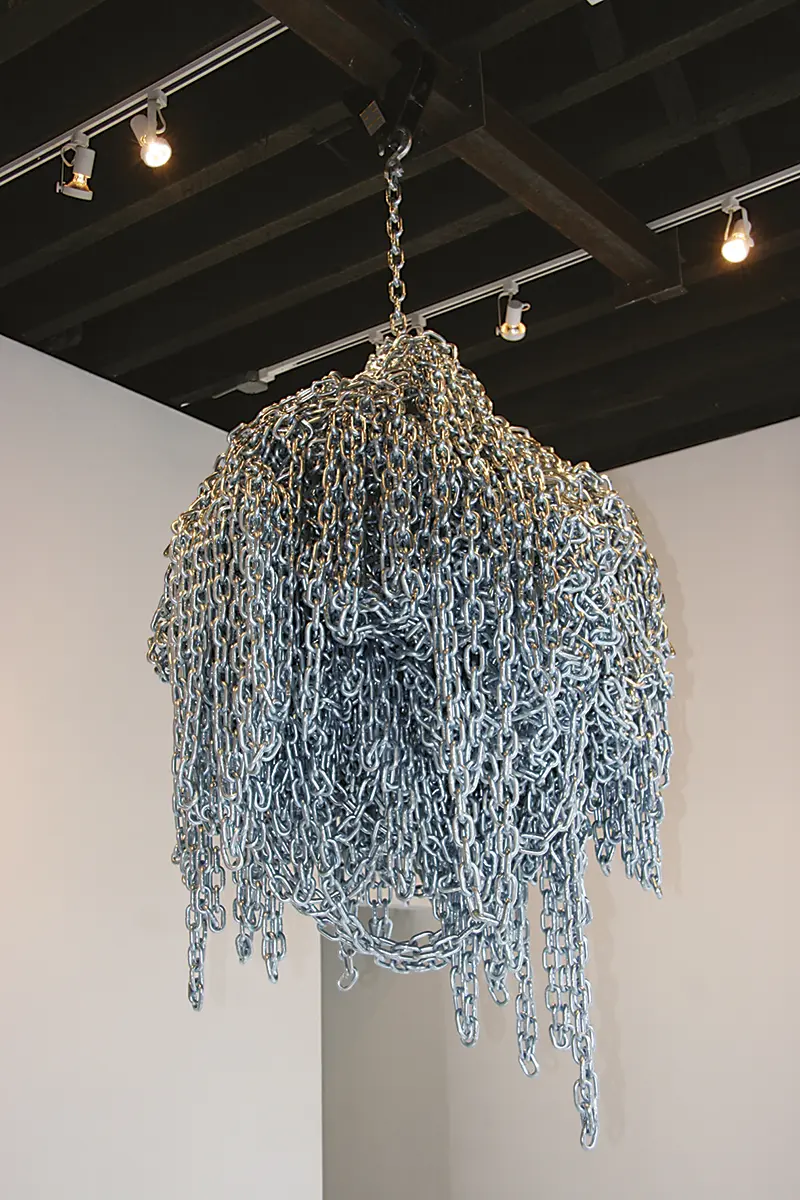
Weight is conflated with the idea of light in a giant ball of chains hanging in the Magnan Projects space. Pseudo-chandeliers in art (pioneered by Petah Coyne) possess inherent magnetism, but this one also carries a disturbing mass. The work Out to Lunch/Closed for the Day calls into question our reliance on safety codes and official inspections. The shiny metal coil (approximately one ton’s worth) approaches the limit of the chain’s strength. Pereda’s recurring strategy is to take things right up to their breaking point.
In another incredible piece, a forty-gallon fish tank perches atop a slender welded frame, roughly ten feet tall. In the water, a host of red Christmas balls are tethered to a suspended mallet. The mallet’s wooden handle floats up but the heavy head drops down. In this sculpture, Pereda’s intense vision has moved literally from support to suspense.
The buoyancy of a holiday is countered and re-channeled. Opposing equations co-exist. The possibilities of sinking, breaking, and flooding are held in check but exert an ever-present pressure. Action is implied, specifically the possibility of the mallet smashing the bright ornaments or the glass tank. The contrast is paralleled by the opposing elements of air and water.
In a pair of serigraphs, Pereda echoes this balanced opposition. He depicts eggs in cartons, first on top of a scale and then underneath it. By placing the scale on top of the eggs, hope is threatened but reinforced. We gasp at Pereda’s art, as the normal order is reconvened in unexpected signals of renewal. The ephemeral parts of life hold up the concrete. The light holds up the dark and the heavy.
Remarking on his playful title, The Fan and the Shit, Pereda quipped that it was about the fans of art coming to admire his new shit. Art can be considered as the byproduct of mental digestion. This show presented some potent cerebral fertilizer.
JEFFREY CYPHERS WRIGHT