
On entering the exhibit titled Fact or Opinion by Giovanna Aguirre Peresson, we find ourselves in front of a war, Chess, complete with wooden figures and a glass chessboard that have been placed by the entrance.
The terrain to be covered is established in the next chess move, which takes us directly to the drawing Tumbas (Graves), to subsequently move on to the other three works in the exhibit: Soldados 1 (Soldiers 1), Camuflaje (Camouflage), and Soldados 2 (Soldiers 2). We are left standing in a past/present that is forgotten and renovated in no specific time, in many possible and impossible places. Traces of oil pastels blur identities to separate us from this other dimension. Nevertheless, even if only as spectators, we know we are face to face with a reality of this world and unchangeable life in the present time. Even then, up to this point, no judging has been involved, only observation, which is geometrical, analytical, and in perspective. It prompts us to reflect upon the past and the war drawings that have been created throughout history.
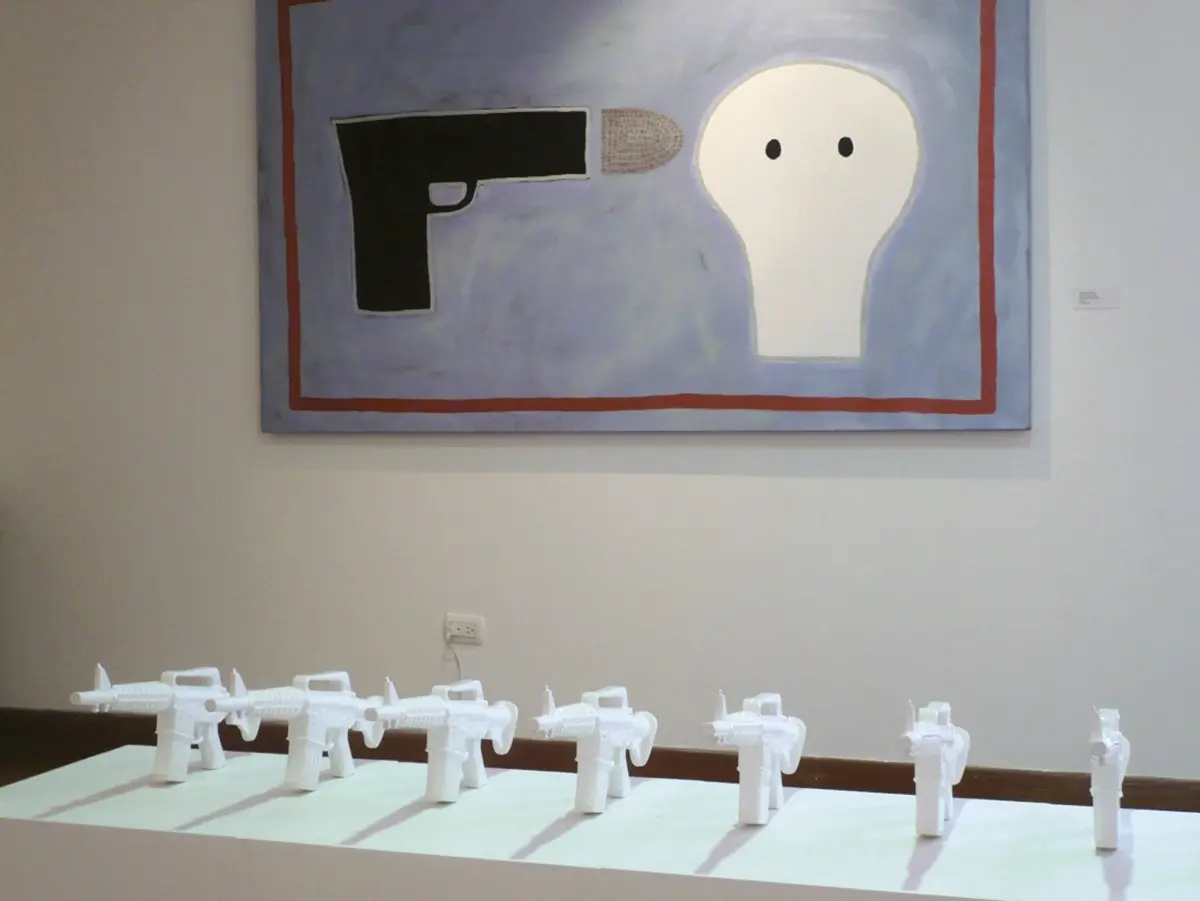
While the drawings present us with scenes, the three acrylic paintings on canvas included in the exhibit convey iconographic images. An Ambulance makes us pause as if it were a traffic sign. Further along, we must stop as a new image is revealed to us almost as an anti-logo. It is the mortally wounding shot of Global Lobotomy that, in with uninterrupted text, travels through the interior of a bullet that is about to impact the head of a small man. His simple face, consisting of only two eyes that in attempting to suppress a Munsch-like scream, reveals the disasters and risks humans to which are exposed. The most disheartening panorama is illustrated more decisively by black raindrops falling onto the white background canvas of Vida (Life), the last piece of the exhibit.
Four glass vases are lined up, revealing the formation of a Misil (Missile) shape. Its content elevates the fragility of the material to that of a flower… It takes the concept of the missile to the extreme opposite of its original nature, as Aguirre transforms it into a harmless prop and decorative object. It is this de-contextualization of elements and themes, stripped of the most essential meanings that transform them; it fills them with an aesthetic significance that distorts their original nature and enables them to remain among us without making us uncomfortable.
Likewise, the ten rifles, smaller than life-size, owe to their dimensions and ceramic fabrication – also painted with white enamel in an attempt to wash away their bellicose content – their post-modern decorative qualities that, ironically, prevail, despite continuing to possess their original rejecting and violent nature, this suggested by the fact that they have been arranged for all to point in the same direction, like a small firing squad. The various uses human beings confer their objects allow this artist to convey a sentiment that is radically opposed to the original purpose of such objects.
War was the unavoidable theme upon entering the Espacio Alterno Gallery at Uniandinos, in Bogotá. The parallels with Colombian reality are obvious, but the exhibit manages to present its themes as universal phenomena. This is not only because Aguirre-Peresson employs a clear language that any country and culture can understand, but also because this artist chooses not to specify the particular place or people who inspire her work. On the contrary, her creative gaze proposes a fresh approach to a theme nearly always presented by means of the shocking impact of crude imagery, which while it may serve the purpose of recording history – precisely as Aguirre does with her work – finally resorts to a mediatic approach rather than to a creative interpretation of the subject.
Despite maintaining her neutrality to avoid irrelevant stances and restricting herself to the contemplation of the most subtle game between the forces at play, Aguirre does choose to finish her statement by using the image of a one hundred U.S. dollar bill, which confers another layer of meaning to her mysterious black rain. There is a music box between Global Lobotomy and Vida – the final two paintings of the exhibit – that when you peer inside through its display window, reveals the smiling face of Benjamin Franklin. Through headphones, we listen to bombings, explosions, and shootings, which have the effect of distorting the Mona Lisa-like smile of this politician and inventor who could not have anticipated the negative consequences of inventiveness and knowledge. Unfortunately, Franklin’s own image is part of the monetary symbol in which lies the explanation behind atrocious acts. It is clear that there is a tendency to think that avarice plays a central role in promoting and sustaining wars, although this may sound like only an “opinion” to those interested in reaping the benefits of this macabre game.
MARCO VEGA