
An
artist who can do without a cell phone or a laptop, Heriberto Mora spends his
time in his workshop transiting with earthy enthusiasm through parallel
realities as he establishes two-way bridges between others and his internal
sensibility. Not only could he very well be a standard-bearer for a type of
aesthetics that renounces postmodernist influences, but also a real champion of
the resistance against over-the-top dependence on technology and the
frivolities of modern living. One must be careful, however, not to characterize
this Cuban artist was solely a redeemer of conservative aesthetic values, when
in actuality, this Cuban painter has been able to adjust to the ups and downs of
the U.S. industrial society. Mora is not precisely a defender of the
traditional discourses in art; to the contrary, his work deals with the
contemporary tensions between the spiritual and material worlds; he eloquently
opposes the effects caused by the lack of communication and the precarious the emotional state of abused modernity; Mora’s art convincingly speak about the
times to which he belongs. For all of these reasons, we are able to state that
Heriberto Mora belongs to a small and select group of metaphysical avant-garde
artists.
In his most recent exhibit, Susurros de Luz (Whispers of Light), presented at the Espacio 304 Gallery (San Juan, Puerto Rico), it is possible to observe the intellectual weight that a palette and brush can achieve in the hands of a contemporaneous mystic, even at a time when the artistic endeavor is so closely associated with megabytes and high-resolution.
Without neglecting current tendencies that allow Mora to recover historic visual discourses, he creates the traces, contrasts, and textures influenced by impressionist painters as well as by the Itinerant Russian painters (particularly Serov and Levitan) to obtain existential poetry and allow an extrasensory connection that feeds from Mora’s own existential evolution and very choice spiritualist readings. He stays away from complacent rhetoric and delves into purifying processes that enable meditation and contemplation. The construction of his allegories derives strictly from the conciliation between ecstasy and philosophic discernment. For that purpose, Mora chooses a naïf and even childlike approach to figuration that is in contract with the underlying text, evoking with personal eclecticism the dream world of Magritte, Turner’s glow, and Hopper’s obsession for the gaze that can cut through the banal.
Mora’s themes emphasize the need for ethereal satisfactions, and are expressed through symbolic relationships that include suggestive fragments from the surroundings; the artist works toward procuring this, all the while distancing himself from the dramatic illumination of Tenebrist painting, previously casting some of his works. He applies eloquent pigments that range from serene ecological shades to a more urgent reservoir of colors that the artist subtly blends with a delicate and conciliatory spatula.
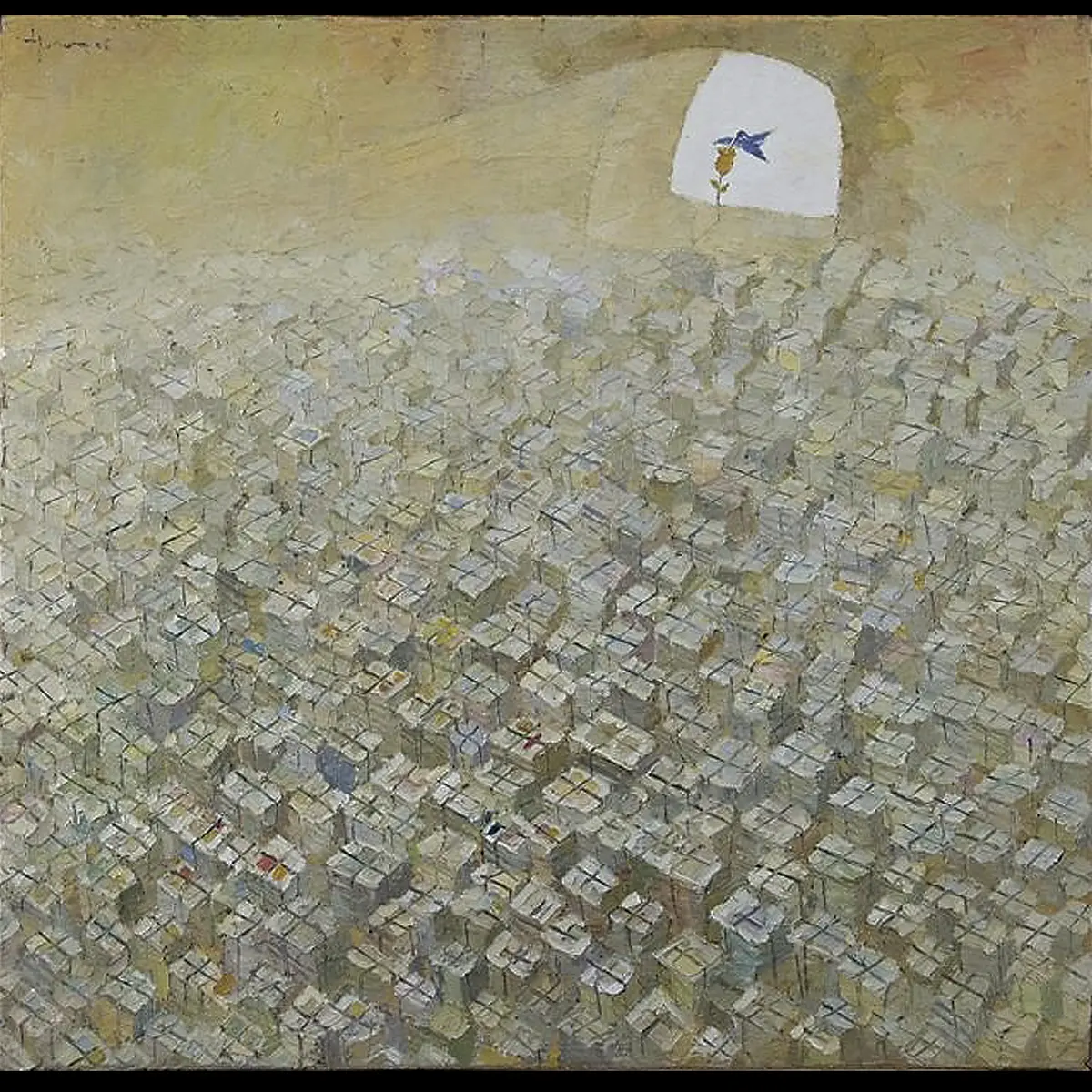
Mora calls window-threshold to one of the most recurrent images in his work, a bridge of the light between two dimensions: one that stands for evident, immediate references and the other insinuated and encouraged, which can only be fully experienced through a subjective connection with values such as spirituality, time, love, beauty, peace, and unity.
It is remarkable the way Mora renders the crowds in the majority of his compositions. These are multitudes that are arranged so tightly closed that they are practically fused into abstractions, only to be interrupted by a unique and contrasting element. A case in point is the work Renacimiento (Rebirth). It presents a landscape made up of a group of cubes that extends toward the infinite. Flower sprouts from one of these as a symbol of the amorous act gestated in the bosom of this frigid geometric gathering. In Reconciliación (Reconciliation), flags from countries around the world surround a white dove; although this comprises a risky allegorical composition because of having been used so frequently, Mora manages to infuse his version with an unprecedented charm. In La Reina del Hilo (The Queen of the Thread), the spinning of the Queen that transforms light into multicolor threads that fill a multitude of spools, becomes a metaphor for the spiritual warp generated by a creative mind. This entire congregationist reiteration unavoidably leads to the vital necessity of interconnecting with and searching for motivations to attain a spiritual union among human beings, both locally and globally, a sort of pastoral eclogue about a definitive planetary integration based on fundamentalist, unprejudiced, and truly altruist principles.
In Retorno (Return), Mora takes human beings back to their original natural state. This is a canvas painted in greens and violets in which the artist vindicates the reverence to the original source that gives rise to life. In Mensaje de Luz (Message of Light), the author combines art and inner healing by presenting the well known iconographic image of The Vladimir Virgin with Child as a symbol of virtue for counteracting the evil of social interaction, while in Atelier, Mora attempts to recapture a genuine sense of love by representing a man and a woman working in harmony as they weave tapestries, seated in the intimate shadow of a threshold that divides the interior domestic world from another exterior, more essential and transcendent one in which the mystery of co-existence is guided by affect.
Without question, this exhibit centers on an oratory that is poignantly humanist, in which nearly the entirety of the constructive requirements for a fulfilled co-existence is generated by means of simple arguments that are, nevertheless, powerful and profound. Despite their ethereal and tranquil nature, the images do not renounce labyrinthine explorations; these will most likely come to the fore in luminescent whispers, to those spectators who are attuned to receive them.
JESÚS ROSADO