
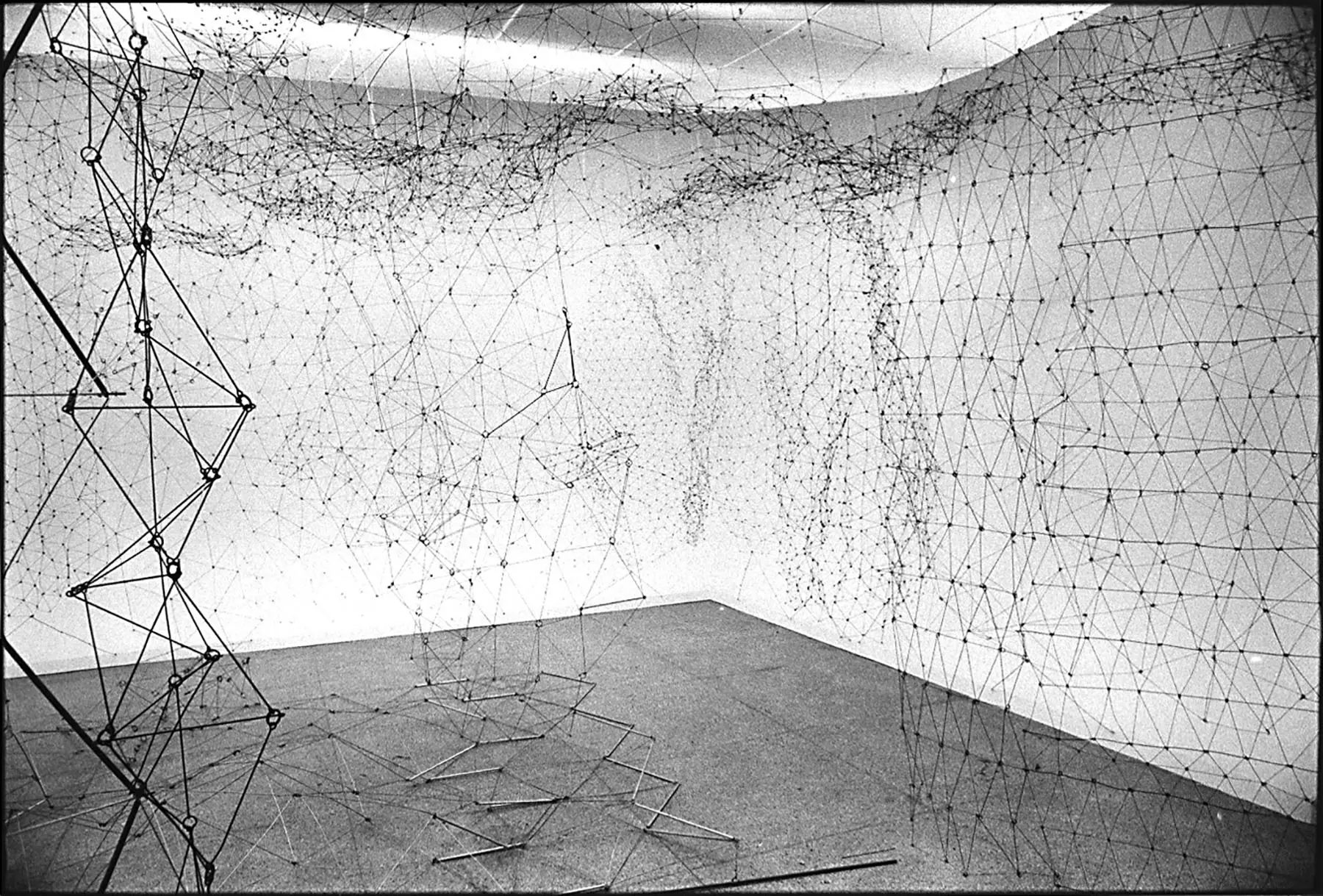
Yes, I really love her work. Her constructions were more like tapestries, flat surfaces. We were trying to do something that had more of a 3d truss/space frame-like character to it, but similar effect to Fuller’s Necklace Dome, or Gego’s sculptures. Best, Michael
This is the answer a visitor received to an e-mail she’d sent to the Whitney Museum of Art after learning that the Gego-like piece at the entrance to their Buckminster Fuller exhibition was not, in fact, a Gego but rather a construction intended to honor Buckminster Fuller. She had complained to Michael Meredith, Associate Professor at Harvard University’s Graduate School of Design. In his response, he at least acknowledged having some knowledge of Gego’s work, but he seems to have missed Reticulárea, Gego’s emblematic sculpture that looks like it inspired Meredith in his construction.
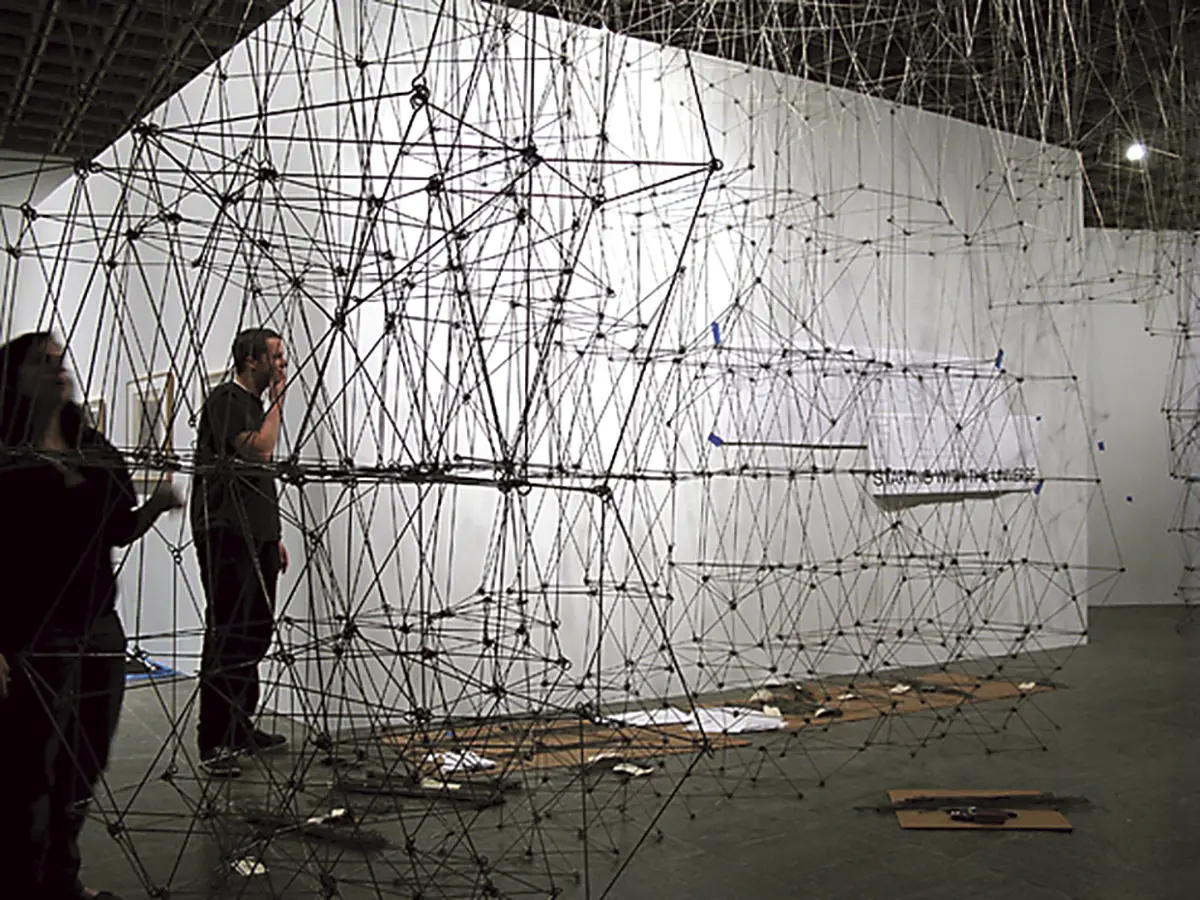
The entrance installation was surprising. I confess that I, too, was duped, and, for a moment, took pleasure. I thought it was an unexpected homage to Gego and it seemed to be a brilliant move. Buckminster Fuller was interested in closed structures, in exploring economic ways of spanning large spaces with maximum structural stability. Gego was interested in webbing space, in capturing but not enclosing it, in making space sing. Both of them were drawn to similar formal structures, though with very different and complementary purposes. Thus, to open a Fuller exhibition with a Gego piece seemed a wonderful insight and gambit - expanding culture, both conceptually and (less importantly) geographically. If that had been the intent, it would have placed Fuller in a broader and richer cultural context – by connecting the ingenuity of a U.S. inventor with the poetry of a Latin American artist (stereotypes notwithstanding). Sadly, however, I found no label crediting Gego, and the piece turned out to be a derivative construction devised by Michael Meredith.
Bárbara Gunz, Director of the Fundación Gego in Caracas and daughter of Gego (whose full name was Gertrud Goldschmidt) lodged a strong-worded complaint with the Director of the Whitney Museum. Her letter prompted a longer and more thoughtful response from the curators:
Meredith’s construction is a hyper-calculated computer algorithm that radicalizes modern objectivity rather than negating it …[W]hile all of Gego’s Reticulárea are unambiguously hung, Meredith’s project touches the ground and quite subtly appears to be capable of bearing its own weight from the bottom up (like Fuller’s octet truss structures). It is only after careful observation that the viewer realizes that the structure is, in fact, hanging (like Fuller’s aluminum tensegrity mast in the exhibition)... Perhaps this experience has shown us that there may be a closer association between Fuller and Gego than any of us previously thought.
Disappointingly, however, the Whitney did not honor Gunz’ request that a note of clarification be added to the exhibition mentioning Gego’s Reticulárea in a way that would avoid further public misunderstanding of the entrance piece. Given the authoritative role the Whitney plays and wants to play in the contemporary art scene of the U.S., the institution’s response combining courtesy with a lack of scholarship certainly is both surprising and puzzling.
LUIS CAMNITZER