
Perhaps the powerful impact Luis Frangella’s work had at some point in Buenos Aires –the city of his birth and where he lived until he was thirty-four years old–, prior to his untimely death (1990) may be at risk of weakening because of his absence. It may also be that he was constantly creating a buzz about his art when he was alive, even as he spent the last fourteen years of his life in New York. To some extent, it appears that to appreciate the magnitude of his work fully, one was required to be physically near the man’s appealing persona. Nevertheless, the art has transcended the man, and it remains possible to appreciate the work on its own merits, thanks in part to the many exhibits curated by Elena Oliveras, who has been closely studying Frangella’s work since his passing. These exhibits have not spoken only for Frangella in his absence, but they have, little by little, unveiled several new aspects of the creativity found in his work.
The first of these exhibits was held at the Centro Cultural Borges eight years after the artist’s death, and the most recent showing returns to that same place to present oil paintings on canvas and drawings on paper from the decades of the Seventies and Eighties. The Leonardesque title La Pittura e’ Cosa Mentale (Painting Is a Mental Thing) somehow aims at presenting Frangella as an artist who not only belongs to the explosive pictorial period of the Eighties –the era to which he is usually confined and surely his most vital period– but in whose work, according to Olivera, one can find commonalities with Conceptualism and even Minimalism.
Frangella, who lived in New York from 1976 on, first studied at Massachusetts Institute of Technology Center for Advanced Visual Studies (MIT-CAVS). What he learned there helped him in, among other things, the creation of a series of 3-D works that were part of his 2003 exhibit at the Centro Recoleta. Seen through stereoscopic glasses, these works appear to be three-dimensional and reveal the spatial conception of this artist-architect.
Frangella is a typical representative of the last instance that art assumed a true critical attitude, irreverent before the differences between high and low culture and the succession of styles. He indistinctly approached his work from conceptual or surrealist perspectives, as is evident in this exhibit in which large scale and smaller works from the Seventies and Eighties co-exist and include drawings on paper and mural-size images painted on canvas.
The spectator can appreciate the thoughtful quality running through the brushstrokes of these great works. Frangella is able to discern and convey each of the elements represented, and then, leaves them unresolved, only exposing the drama that is part of the representational art of this period. In his early career, during which he concentrated on the inner workings of perception, Frangella was also able to connect with a conceptualist experience. It was then that he collaborated in the multimedia experiences Lecture on the Weather (1981) and Empty Words (1981) by John Cage. But without a doubt, it was Fragella’s time in the East Village during the Eighties contributed to the unleashing of the peculiar power of Frangella’s better-known works. Along with Jean Michael Basquiat, David Wojnarowicz, and Mike Bidlo, Frangella was part of the East Village’s art scene of the time, something that bestowed upon him a special aura during his visits to Buenos Aires. Although he participated in collective exhibits at the most important venues of that decade in Argentina, such as CAYC, the Julia Lublin Gallery, and the Museum of Modern Art, his persona became truly legendary in the underground world of the Café Einstein, where the alternative culture reflecting the end of the military government and the return of democracy in Argentina emerged.
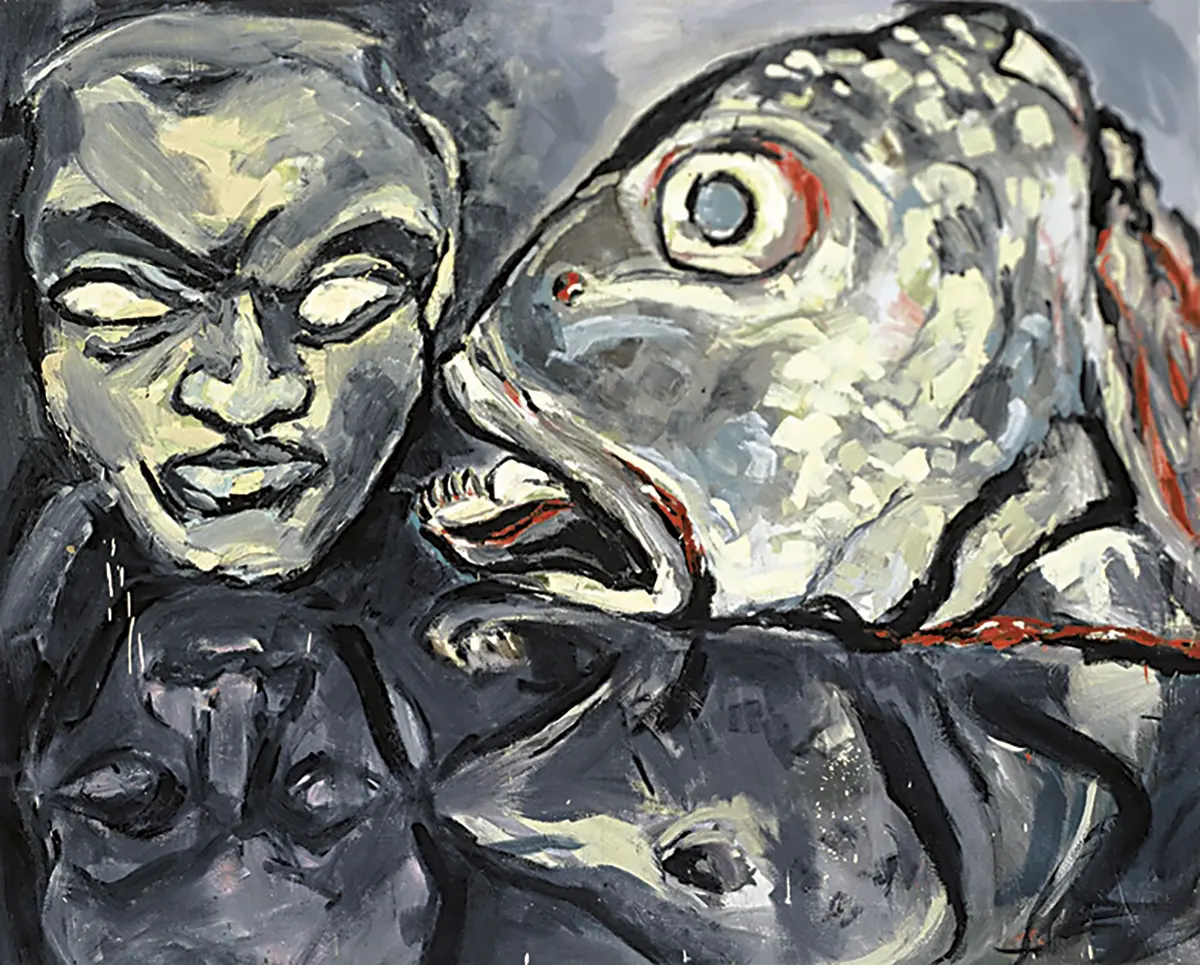
His pictorial performances were memorable in that underground stronghold: Frangella would paintworks in public on the scale of Cabezas de Pescado (Fish Heads, [1988] (2.2 × 2.9 meters), or Detalle de Mano con Coca Cola (Detail of Hand with Coca Cola) (1985) that are part of this exhibit; other works such as the 8 × 3-meter Rata (Rat) (1985) was part of the exhibit at the Centro Cultural Recoleta; many other works disappeared when these cultural evenings ended.
Frangella was an artist admired and respected by the effervescent Argentina of the time. His intelligence, critical attitude, and free-thinking connected him with the young people of a new generation, who saw in him a model capable of thinking about painting from a different place, someone able to take art to an entire new level, but who could also design bags, suitcases, and purses. It does not matter from which perspective his art is contemplated, the thinking behind his work always presents as something that was put forward to be tested and to emerge renewed from this process.
ANA MARÍA BATTISTOZZI