
The solo exhibit Hipo-Real by Marco Maggi (born Montevideo, Uruguay, 1957) took place on the main floor of the Nara Roesler Gallery from August 13 to September 13. It was curated by Adriano Pedrosa and was accompanied by a catalog with critical texts.
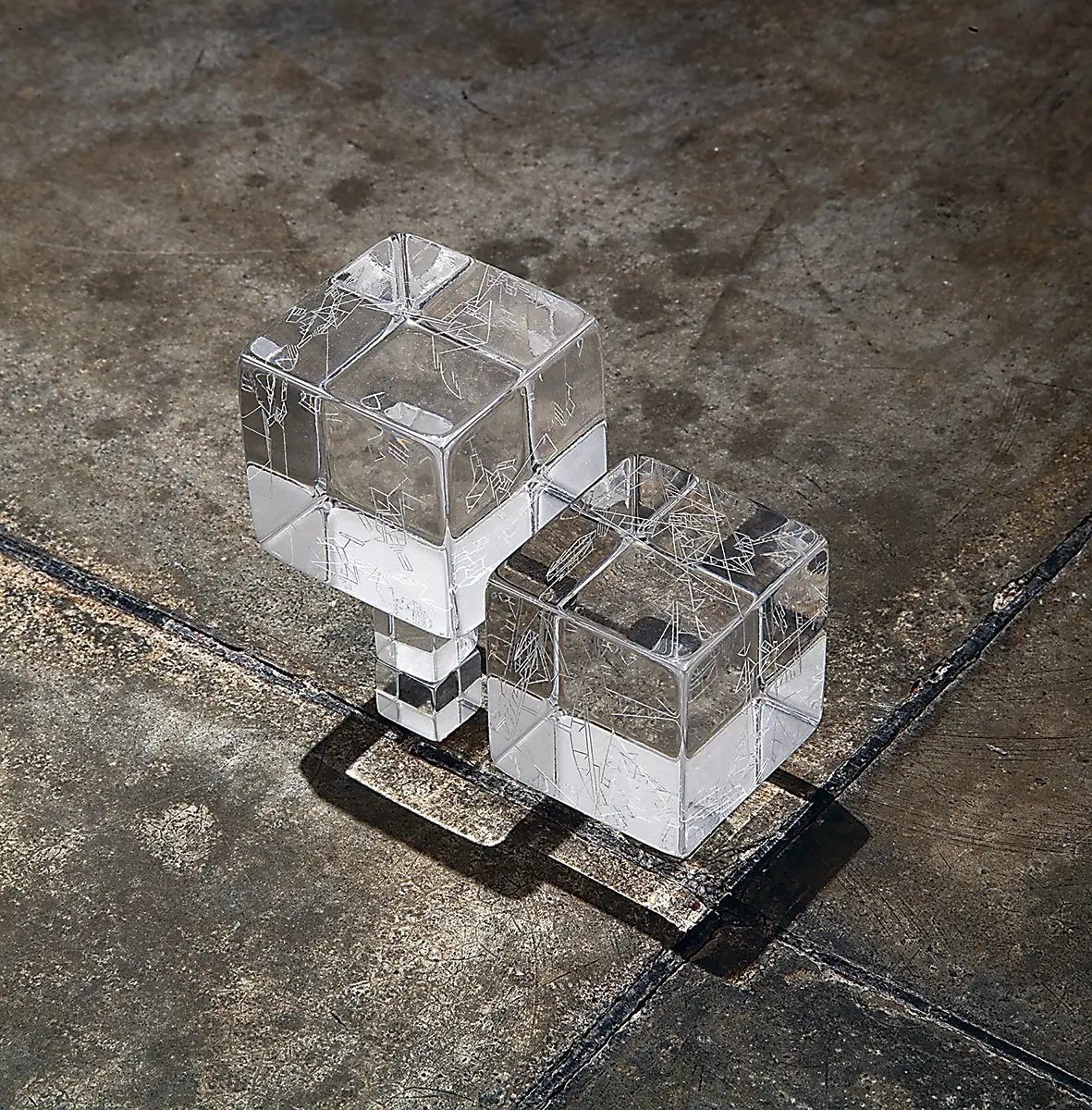
From Lacan, we know that there are three fundamental aspects of psychic life: the imaginary; the symbolic, and the real. Within this context, Maggi, in Hipo-Real, points out the diametrical difference between what is real and what is true, for the latter has nothing to do with language and with the symbolic realm. The exhibit is infused with Duchamp’s infra level (inframince) indicator, presenting characteristics that can confer, in terms of meaning, a certain degree of opaque irreducibility, even as some works here play with transparencies in terms of the absence of any type of dialectic enunciation. Tautological relations and posthumous homages can be discovered in this group of works. They appear to leave behind a shadow – like a less vivid and muted silhouette that attempts to vanish, but is not able to do so completely – revealing enigmatic and unsettling components that are subtly signaled in Hipo-Real. To see this, one solely must analyze works such as Complete Coverage on Klein and Fontana (diptych), created with paper clippings and Plexiglas, San Andreas Fault, drypoint on aluminum, Malevich, graphite on paper, and Complete Coverage on Warhol (Marilyn). Somehow, Maggi worked obsessively as a bricoleur on this opus of small-format pieces by applying simple elements: sheets of paper, Plexiglas, using a passe-partout, graphite, and incisions on transparent acrylic, to shape a group of works in which Maggi has drawn from a good part the avant-garde. Making it into an ingenious tool for the calculated development of a refined sensibility that is both ironic and comical —for it renounces the seriousness with which both artists and critics usually interpret modern aesthetics. This entire nucleus of appropriations and free interpretation of “artistic” and auratic texts— by, for example, Andy Warhol, Lucio Fontana, Ives Klein, Robert Ryman, Jasper Johns, Sol Lewitt, Piet Mondrian, and Latin Americans l Jesús Rafael Soto, Lygia Clark, Hélio Oiticica, Lygia Pape, and Mira Schendel —is given new meaning by Maggi.
It is precisely that strange velocity and restlessness of the historic vanguards —that frenetic and fast exchange of theories and meanings, occurring one after the other— that indicated certain desperation, where formal strategies such as the collage, the readymade, the monochrome were used as dwelling places, final refuges against banality. One must stop at this point to reflect on the “time of the work” and the “intention of the bra” Maggi proposes, in contrast with tempus fugit. Confronted by the isolation, harshness, and indifference of today’s world that is so prevalent in this post-communicational era in which we live – where human relationships are always transitory and transferable— this Uruguayan artist appeals to the recovery of personal contact, as he invites the spectator to view his work calmly and to discover in his installations —always created with minuscule objects that nevertheless transform and redefine the spaces they intervene— the way in which a micro-universe can expand ad infinitum. This is why there is no narrative concerning the minimum space in Maggi’s installatory and objectual poetic. Instead, it promotes a greater perceptive, sensorial and conceptual grasp of his intervened and installed pieces. This is the case with Hip-Real, the work for which this solo exhibit is named. There, it is possible to observe that double-weight so typical of Minimal and Post-minimal art, which implies a duplicate process: constructive and destructive, a posteriori. The installation covers the walls and floors with a serialized dispositio to promote the need of renaming, generating volumes, composing, subtracting, erasing, scrapping, and correcting. This first phase of individual effort in the production of artifacts become reduced drastically when “deciding” the final destiny of the works, in other words, assessing whether or not they are finished. Although the sculptural works in this instance present an internal concatenation that is more or less pronounced, the rhythm of repetition intentioning eliminates a pretension of originality while accentuating other features. According to Maggi, Hipo-Real represents art that creates and builds its own language, its idiolect, as a source that enables a perception to name and communicate a world.
Marco Maggi has a Master of Arts degree from the State University of New York at New Paltz, New York. He has participated as a guest artist in the Fifth Gwangju Biennial in Korea, in 2004, in the 2003 8th Havana Biennial in Cuba, and in 2002 in the 25th International Biennial of São Paulo, in Brazil, curated by Alfons Hug.
His most important recent collective exhibits include New Perspectives in Latin American Art, 1930–2006: Selections from a Decade of Acquisitions at the Museum of Modern Art in New York (MoMA) 2008, and Poetics of the Handmade, Museum of Contemporary Art (MOCA), Los Angeles, California, 2007.
CLAUDIA LAUDANNO