
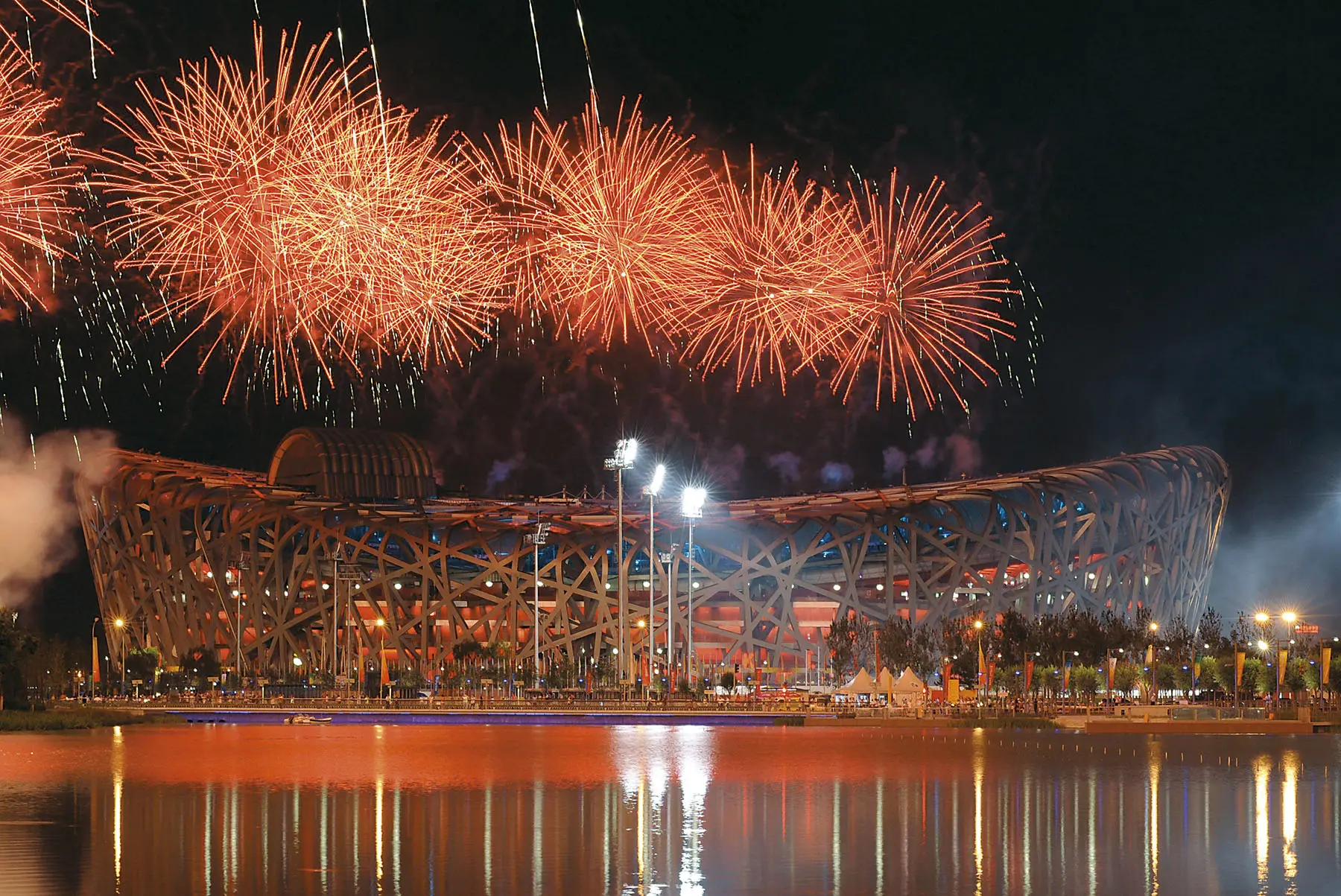
It is estimated (by the Chinese authorities) that 4 billion people watched the opening spectacle for the Olympics on August 8, 2008. The production was an amazing feat, and it appears that every single member of those 4 billion spectators--across all social and intellectual classes--watched in awe. It was a memorable event and one would hope that some kind of a taste standard was set that will, forever, clean out the debased aesthetics we are annually subjected to by Oscar night and similar events. This is not to say, however, that there is now an aesthetic model to be followed to the letter. What was admirable about the event was that a high level of quality was achieved and was able to cast a spell across all imaginable cultural divides. Some of the implications, however, are less admirable.
The Olympic Games proclaim a certain idealism. They claim to be apolitical, competitive in a gentlemanly and ladylike fashion (they are, after all, a nineteenth-century reproduction of the original), and they try to set an example that extols both individual and team achievement. The charter of the International Olympic Committee states that its purpose is to “place sport at the service of the harmonious development of man, with a view to promoting a peaceful society concerned with the preservation of human dignity.” It is therefore an event aspiring to be virtuous and, hopefully, drug-free (this time around, five athletes were disqualified for doping), but nevertheless and above all, remains an arena for the expression of national chauvinism.
It is no coincidence that both the Venice Biennial and the Olympic Games were created or revived around the same time (1895 and 1896 respectively). Their purpose was to provide yet another stage for territorial states to assert a national identity, internally unifying through competition with other states. In the Olympic Games, this national pride and chauvinism are expressed not only on the field of athletic competition but also in a competition for the honor of hosting the event and even in the competition to provide the most-watched sports coverage of the event. In 2008, NBC negotiated an earlier date for the Games so as to avoid conflict with broadcast coverage of the games of the U.S. National Football League (the NFL) and managed to have the swimming and gymnastics competitions performed in the morning in China so that U.S. audiences could see them live during U.S. television “prime time”.1The Olympics, as a spectacular global event, provides a vast opportunity for imagery serving the public relations of the host nation, as well as of the countries with corporate media in a position to support extensive television coverage. It also is an opportunity to construct new and sometimes path-breaking architectural statements that endure as national symbols long after the games are over. A stunning example in 2008 was the “Bird’s Nest” stadium conceived by Swiss architects Herzog and de Meuron.
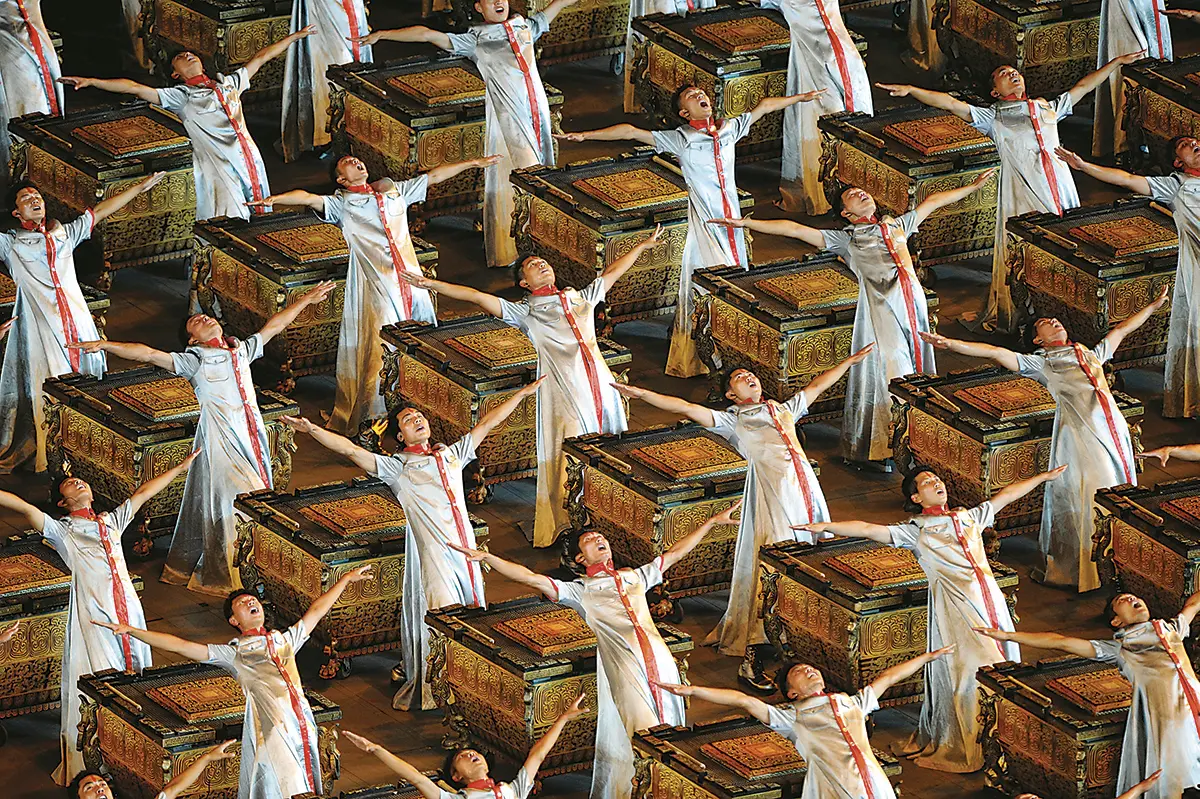
It is the opening production number at the Beijing Games, however, that invites the real discussion here. Renowned Chinese film director Zhang Yimou was able to bring into reality all the dramatic cinematic staging he had previously exhibited in movies such as House of Daggers and Hero. The term “reality” merits some caveats here, for, as it turned out, some of the fireworks were doctored and slipped into the TV presentation, and Lin Miaoke, the girl who appeared to sing, was only lip-synching. Yang Peiyi, whose voice was selected and broadcast for the whole world to hear, had apparently been rejected in a performance role because she was deemed insufficiently attractive by high Chinese officials.2 This minor cheating was intended to enhance perfection.
Zhang’s movie experience was invaluable in creating a memorable and breathtaking experience. With it, he established a new standard against which any celebratory spectacle of the future will have to be measured. There is, however, a difference between movies and reality: The knowledge that one is seeing a live production and not a cinematic fiction influences one’s perception and thus also one’s reaction. In Zangh’s mythical action films, the choreography possesses the aura of a fairy tale. Understanding that the spectacle is a manufactured image, an unreality, provides a certain imaginative distance that makes room for dreaming. The viewer is able to select and endorse heroes and to see streams of blood as color rather than true rivers flowing into death. In the films, the masses of warriors and weapons are no more than shapes and pigments used to make kinetic paintings. They never become vehicles to express real violence and sadism.
Opening night of the Olympiad had similar visual elements, and without weapons, or blood. The effect should have been quite harmless, even more so than the operatic films. And yet, in spite of its beauty, there was an ominous residue as a result of inevitable echoes from previous mass events. The North Korean Mass Games that have been conducted since 1946 are one example, in which 100,000 gymnasts perform in synchronicity while 25,000 children flap colored cards around to make perfectly realistic pixilated backgrounds. In an interview, Zhang expressed his admiration for the North Korean model.
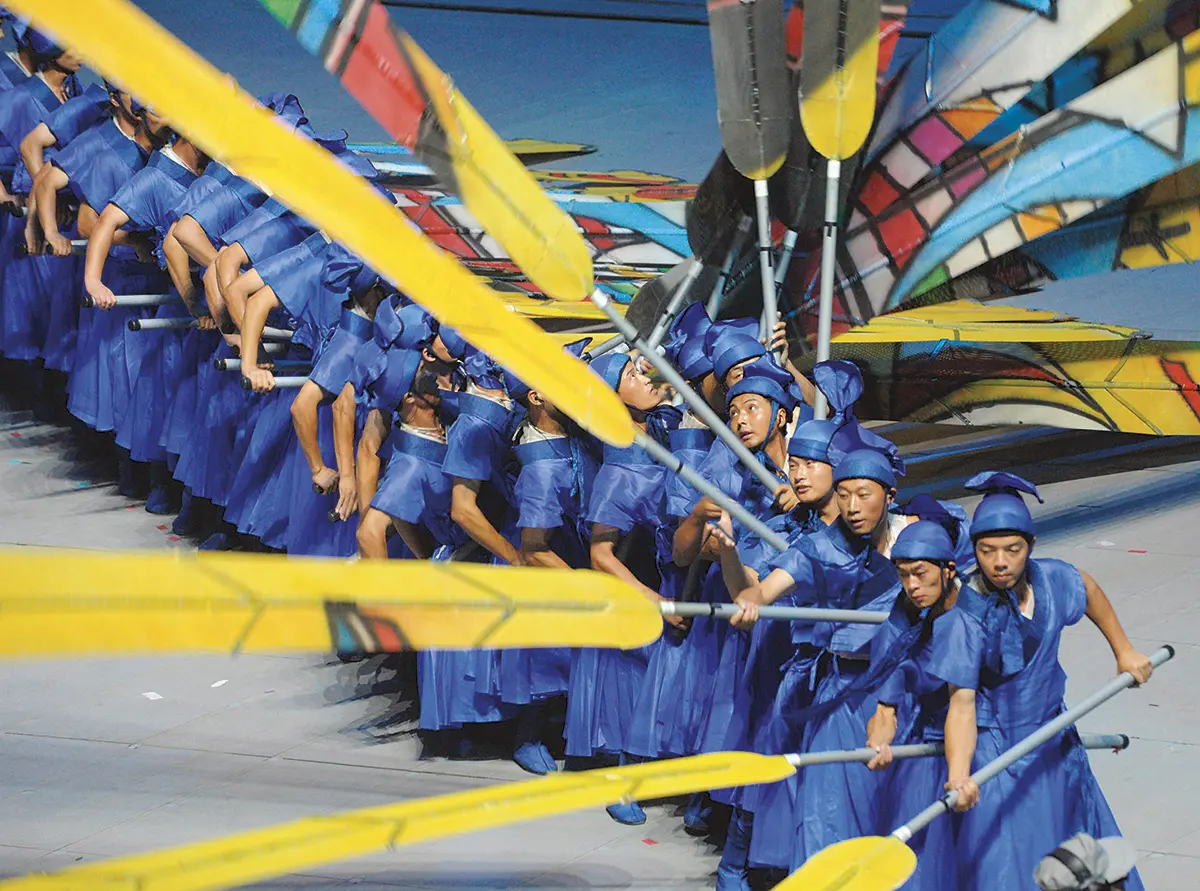
Mass Games developed in close connection with gymnastic shows during the nineteenth century (originating, it’s believed, in the Czech lands of the Austro-Hungarian Empire and with a nationalistic intent). North Korea developed mass games to an extreme, but there have been many other and many earlier examples of mass events. In 1918, photographer Arthur S. Mole assembled 18,000 U.S. soldiers to reproduce the image of the Statue of Liberty. As it turned out, the chosen day was extremely hot, up to 105 degrees Fahrenheit, causing many soldiers to pass out during the exercise, which took several hours. That spectacle was organized to sell bonds for the military. In 1932, in a more modest version of mass performances, Radio City Hall inaugurated the now-famous Rockettes show, a display of perfectly synchronized female bodies of similar height, and until 1987 of similar complexion (white).3
A film precedent for the 2008 Olympic Games was Leni Riefenstahl, whose Olympia aestheticized the 1936 Olympiad in Berlin. While her film has since become notorious for having served the aspirations of the Nazi regime, in fact, it idealizes the athletes more than it does Hitler and his policies. She explores sentimental abstraction as it was fashionable in photography at the time, focuses more on documentation than on the aesthetics of mass synchronization. In her film, mass activity shows up mainly in non-athletic sequences showing "Heil Hitler" salutes by un-choreographed crowds.
In the interview in which Zhang expressed open admiration for the aesthetics of the North Korean mass games, he said: “That kind of equality brings beauty to the fore. We Chinese can do that as well.” But he also went on to make a point that revealed his essentialism with respect to culture: “Performers obey orders; they can do it like a computer. (…) That is the Chinese spirit.”4 In the same interview, he criticized the West noting that spectacles in his preferred style could never be successfully staged in a Western cultural context because of lax work habits, the strength of unions in the performing arts, and excessive notions of human rights.
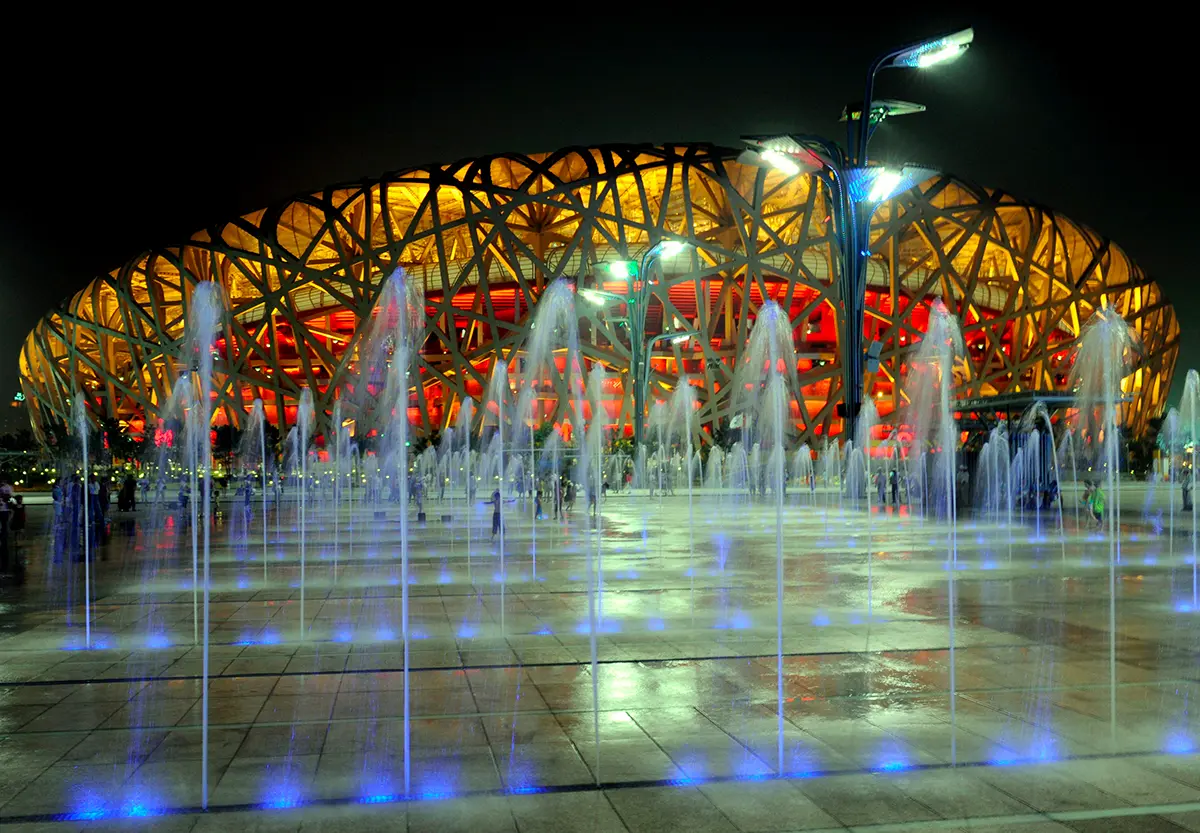
It’s possible then to see Zhang as someone who perceives himself as the all-powerful artist controlling the will and timing of a non-individualized mass of people. In the West, the prime example of this attitude is the military aesthetic of the goose-step, originally developed by the Prussian army during the nineteenth century and kept by the Nazi Wehrmacht, but also adopted by the Soviet, Chilean, and Iranian armies as well and, more surprisingly by the Cubans. The original German name for this parade device is Stechschritt, which has the aggressive meaning of “stab-step.” It is awkward and quite difficult to perform well, requiring endless practice and for that reason, among others, is used to enact for public consumption a spectacle of extreme discipline. In the Cuban case, the aesthetic was copied from the Soviets to personify and promote the transition of an anarchic guerrilla movement into a mature regime with a national army capable of defending the Revolution.
The goose-step is a good example of mass aesthetic insofar it’s original intent and its enduring appeal in the countries where it’s used is the presentation of a spectacle of depersonalized meshing into a human-machine expressive of macho ideals and capable of remarkable endurance. One message of this aesthetic to the public audience is that these soldiers are so well trained and so physically fit that they are not only capable of enduring the pain, but of remaining threatening in spite of the ridiculousness of the parade step itself.
Obviously, Zhan’s devices are in no sense ridiculous, but he does aim to achieve the total disappearance of individuality (except, one assumes, his own). The human cells in his spectacle, as with armed men in goose-step, possessing no interest in and of themselves. None is meant to attract particular attention; they are all supposed to disappear as drops in an ocean in which only the pattern of waves matters. An interesting footnote is that when the drummers in the opening sequence rehearsed with poker faces, as initially directed, the effect was judged to be so potentially intimidating to a global audience Zhang agree to make an adjustment. In the end, he directed the drummers to smile, toning down the anonymity of the performance.
Given the nationalistic dimension of mass spectacle, at the Olympic Games as in many other contexts, it is nevertheless worth noting that using art to express national pride is certainly preferable to using aggressive speech. Unlike rich and powerful Western nations, China hasn’t yet developed a policy of promoting its standing in the world by means of cultural exports under official aegis. The recent success of Chinese art in the Western market is a phenomenon independent of Chinese government policy, resulting rather from a combination of undeniable quality combined with gallery greed and the creative exhaustion currently afflicting the West. New Chinese art is the result of a remarkable ability to maintain some elements of traditional Chinese art while recycling and integrating the contributions of cutting-edge movements originating in the West. Chinese artists combine an affirmation of individuality with a respect for the established languages of their culture. The product of a much longer academic education both in years and daily hours, Chinese artists today blend respect for craft with a sense of the spectacular without being bound by either. Against this background, it is possible to see that Zhang’s grand spectacle, while it has something in common with the work of Chinese gallery artists, is markedly different in spirit. Aesthetically his staging is somewhat closer to a Rockettes production than to the work of artists like Xu Bing or Cao Guo-Quiang, two of the several Chinese artists who have been extremely successful in the West and are known for their spectacular installations. Xu Bing, in particular, maintains thoughtfulness and subtlety with his pieces about language, even when the installations may reach bigger-than-life dimensions.
Zhang’s show, of course, transcends by far the banality of the Rockettes, yet it applies a similar principle, the anonymization of individuals in a multitude. He claims this reflects a strain in traditional Chinese culture, and, certainly, the enormous scale of Zhang’s mass aesthetic does seem to go beyond Western standards of synchronicity. For that reason, from the vantage point of Western culture, Zhang’s spectacle delivers a somewhat threatening experience. The perfection of the execution is awesome and the result is stunningly beautiful. It is the abrogation of the self by the individual participants that makes it threatening.
During the nineteenth century, Western governments deliberately embarked on official cultural policies. The goals were chiefly two: to build a “national” identity for diverse populations forced to live within the same territorial boundaries; and to secure colonial empires, stamping them with the “superior” culture of the metropolis. A text used by the French colonial government in French West Africa in the 1950s actually contained the phrase “Our ancestors, the Gauls . . . .”
In the decades following World War II, most Western European countries and the U.S. and the U.S.S.R. developed foreign cultural policies based on maintaining cultural outposts around the world with the purpose of promoting cultural exchange. One objective has been to promote a reputation for international public spirit and generosity; another has been to publicize national achievements and offer them as models. Strategies have varied. The Soviet Union did little more than flood the developing world with indoctrinating books and magazines. One could buy the complete works of Marx, Engels, Lenin, and Stalin for next to nothing everywhere from Montevideo to Zanzibar. Spain, on the other hand, has been investing a lot in renewing and strengthening cultural bonds with Hispanic countries that had eroded during the dictatorship of Francisco Franco.
U.S. cultural policy has used art as a vehicle to promote “values” foreigners are invited to identify specifically as “American.” An Art in Embassies Program was created in 1964 for this purpose. The conception behind the program was summed up in a publication celebrating its 40th anniversary in 2004:
“The understanding that art influences international relations goes back to ancient history, manifest in the Romans’ installation of statuary and architecture in cities throughout the empire. The conscious, proud American-ness of American art remained largely undeclared until the 1860s. Then all at once, the United States came to see the glory of its art, to believe that this nation, which excelled in so many kinds of activity, was able fully to match and sometimes to exceed the cultural accomplishments of other nations.”5
Further on in the same text Lee Kimche McGrath, the program’s director, is quoted as saying (in 1984): “Art conveys directly the substance of the culture from which political power is derived.”6
This rationale would seem to fit well the way in which the Chinese government conceived the celebration of the 2008 Olympiad in Beijing. China used an estimated one million volunteers and 43 billion dollars to polish its international image. The Olympic spectacle in Beijing was clearly grounded on the idea that “art conveys directly the substance of the culture from which political power is derived” and was clearly intended to demonstrate that China “was able fully to match and sometimes to exceed the cultural accomplishments of other nations.” The degree of investment made was so far beyond what any other country in the world could ever afford to attempt that the Beijing Olympics will stand as an unrepeatable feat. Bolt, Phelps and other super-men and super-women will also be remembered. But above and beyond their individual achievements will stand the image of the extraordinary opening spectacle created by the resources of the nation and the artistic genius of Zhang.
The concluding act began with the same high level of quality of the opening celebration. Following more of Zhang’s inventions, the arena was opened to a refreshingly anarchic entry of the participants. Temporarily the show was converted into a fraternizing carnival. With military pomp, the Olympic flag was delivered to the Mayor of London, which will host the next summer Olympics in 2112. From that moment, everything went downhill. Leona Lewis appeared to be lip-synching herself, and David Beckham was allowed to kick a ball into the crowd, presumably to symbolize the passing of responsibility for the 2112 Olympics to Great Britain. A pathetic choreography of British invention followed, giving a taste of what to expect four years from now. The spell was broken, and Zhang’s spectacle was never able to recover. It degenerated into pure Las Vegas kitsch, which even the phenomenal fireworks display at the end was unable to repair.
When all is said, however, opening night will remain a historical event, as will the question of whether an artist should engage in this kind of work intended to serve national chauvinism. Whoever thought up the Prussian goose-step probably was proud of the feat. To have the power to force armies into performing these particular patterns of marching must be an ego boost. Maybe he (it definitely was a man) even thought of himself as an artist, or perhaps more specifically a choreographer. It is very unlikely he saw himself as deranged, or that he entertained any doubts about the soundness of his taste. The thought of attributing ridicule and madness to that enterprise is probably reserved only to a small group of snobbish pacifists.
The deeper questions underlying this entire event are to whom should the artist be speaking with his or her work, and whose message is he or she to be carrying? Even if the patterning of anonymous masses is traditional in Chinese culture, as Zhang believes it is, is that really what he wants the world to use as a marker of Chinese identity? And since his fellow Chinese also watched the spectacle, is that also the marker he wants to reaffirm within China?
The designs Zhang ordered worked like clockwork. The flaw, which suggests this was a symptom of hubris and abuse of power, lies in the words “order” and “clockwork.” The word “order” separates the author from those who serve as anonymous modules for the design. The word “clockwork” underlines the robotic precision and submission of any individuality for the benefit of the greater design. It is then when one should ask for whose benefit that greater design is working.
In the case of goose-step or any other form of military parading, the overarching purpose is to aesthetify a killing machine. In the case of Arthur Mole, it was to sell military bonds. In the case of Zhang, it is China’s glory or Zhang’s glory. Thinking of either one diminishes the pleasure.
(edited by Selby Hickey)
NOTES
1. NBC paid 894 million dollars for the U.S. television rights. Bill Carter, “On TV, Timing Is Everything at the Olympics,” The New York Times, 08/25/2008, pp. C1, C4
2. Gao Xialong, one of the technicians working on the project, reported to the paper Beijing Shibao that only the last of the 29 footprints on the sky was true and that the others were done with computer animation. http://www.spiegel.de/kultur/gesellschaft/0,1518,571129,00.html. In regard to the girl substitution, the musical director of the ceremonies Chen Qigang explained, “It was a matter of national interest. The kid had to look good on camera, be expressive.” http://www.spiegel.de/kultur/gesellschaft/0,1518,571507,00.html.
3. According to Wikipedia it was only in 1987 that the Rockettes were integrated, the previous argument being that differences in color would disrupt the spectacle.
4. The interview appeared in Südliches Wochende and is quoted in SpiegelOn Line, Andreas Lorenz, “Chinesischer Starregisseur spottet über westliche Kultur, ” 08/21/2008, http://spiegel.de/panorama/0,1518,573181,00.html
5. Andrew Solomon, “The ART in Embassies Program: The American Tradition of Cultural Diplomacy,” ART in Embassies Program, 40th Anniversary, U.S. Department of State, Washington, U.S., 2004, p.1
6. Solomon, p.13
LUIS CAMNITZER
Emeritus Professor at the SUNY college, Old Westbury.