
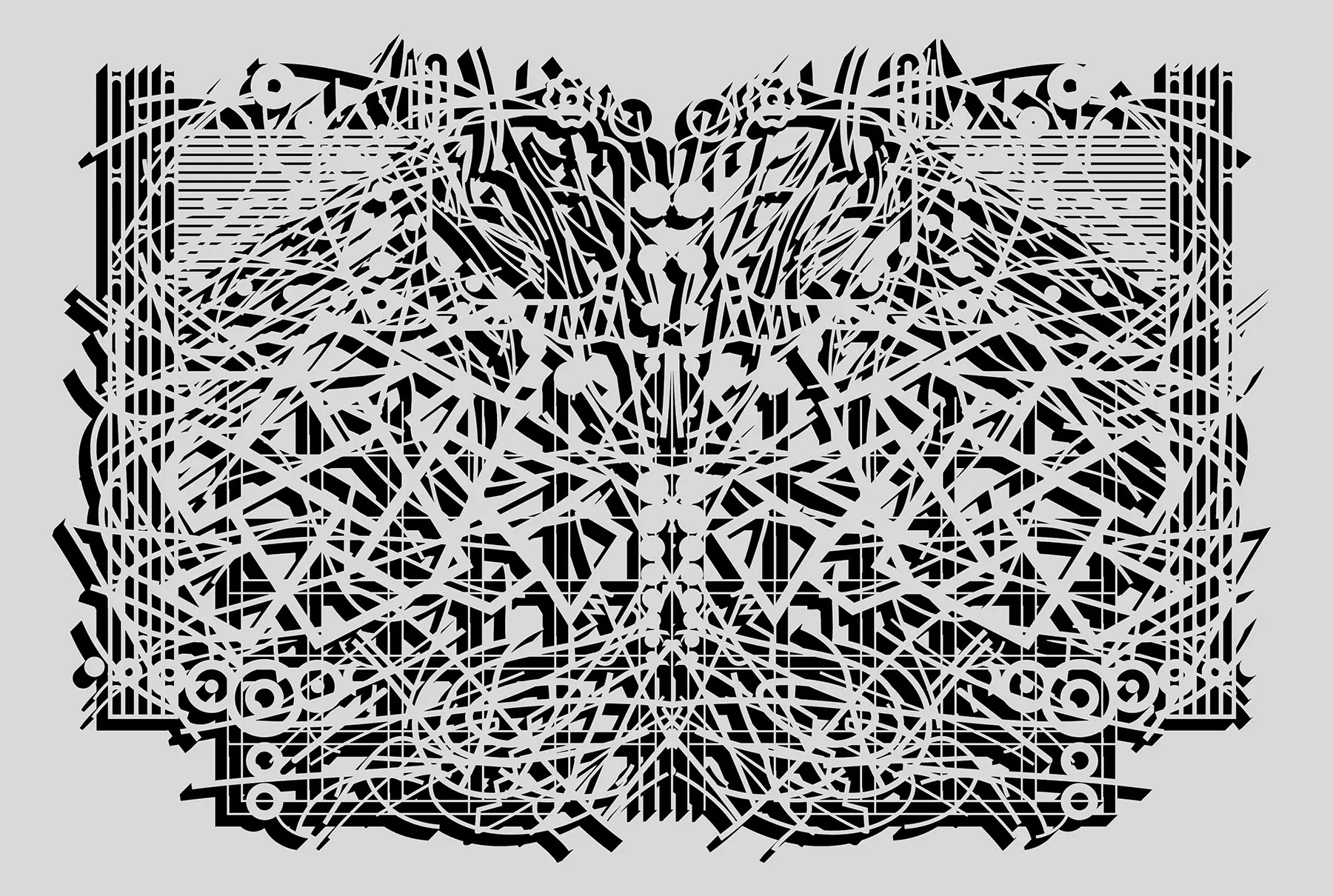
The geometric scaffolding under Siquier’s oeuvre is evident. Why, however, have critics spoken of drawn lies, of hallucinatory reason, of a fascination with mirages? How was this shift from geometric certitude to uncertainty made at the dawn of the twenty-first century, and how is it expressed in Siquier’s work, making it so spellbinding in its enigmas, its ruses, and its ambiguities? A possible clue is Borges’s “small interstices of unreason.”
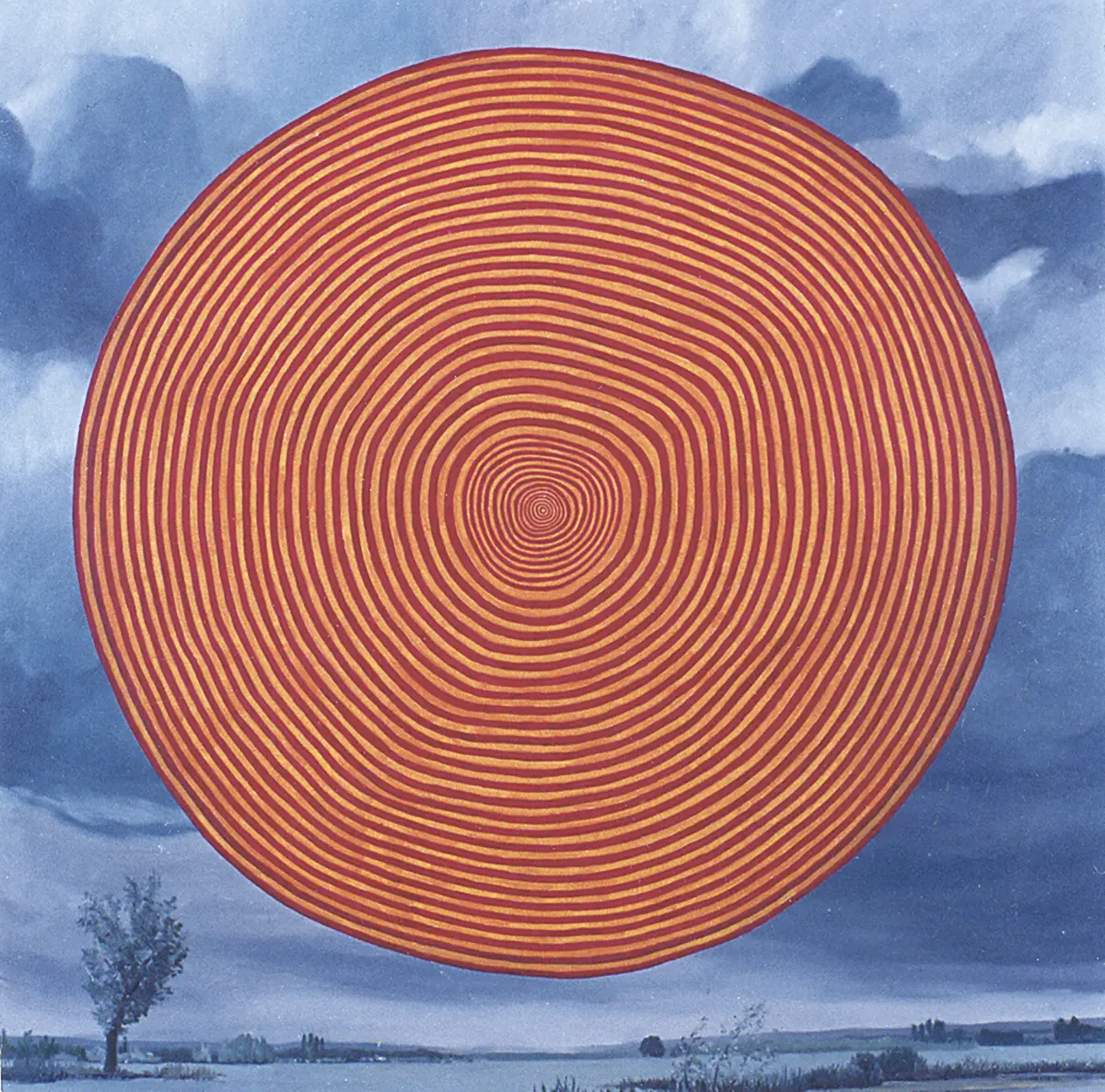
We recognize a shift from Siquier’s earliest period, which Ivo Mesquita—the curator of the artist’s show at the Reina Sofía Museum’s Palacio Velásquez—locates between 1985 and 1989. An emblematic work of the period, 8806 is a traditional, almost romantic landscape, with the horizontality that characterizes the Argentinean pampas (Siquier does not make concessions to the viewer and titles his works with the year of production and their number in the sequence of works within that year). Juxtaposed against the expansive skies is a strange circular figure with somewhat irregular concentric lines and vivid colors. The work is like an inquisitive proposition about the presumptive relationship between nature and culture. Another characteristic in Siquier’s first period is seen in the intricate grids that are obsessively turned on themselves, with small accents of single-color planes in counterpoint rhythm.
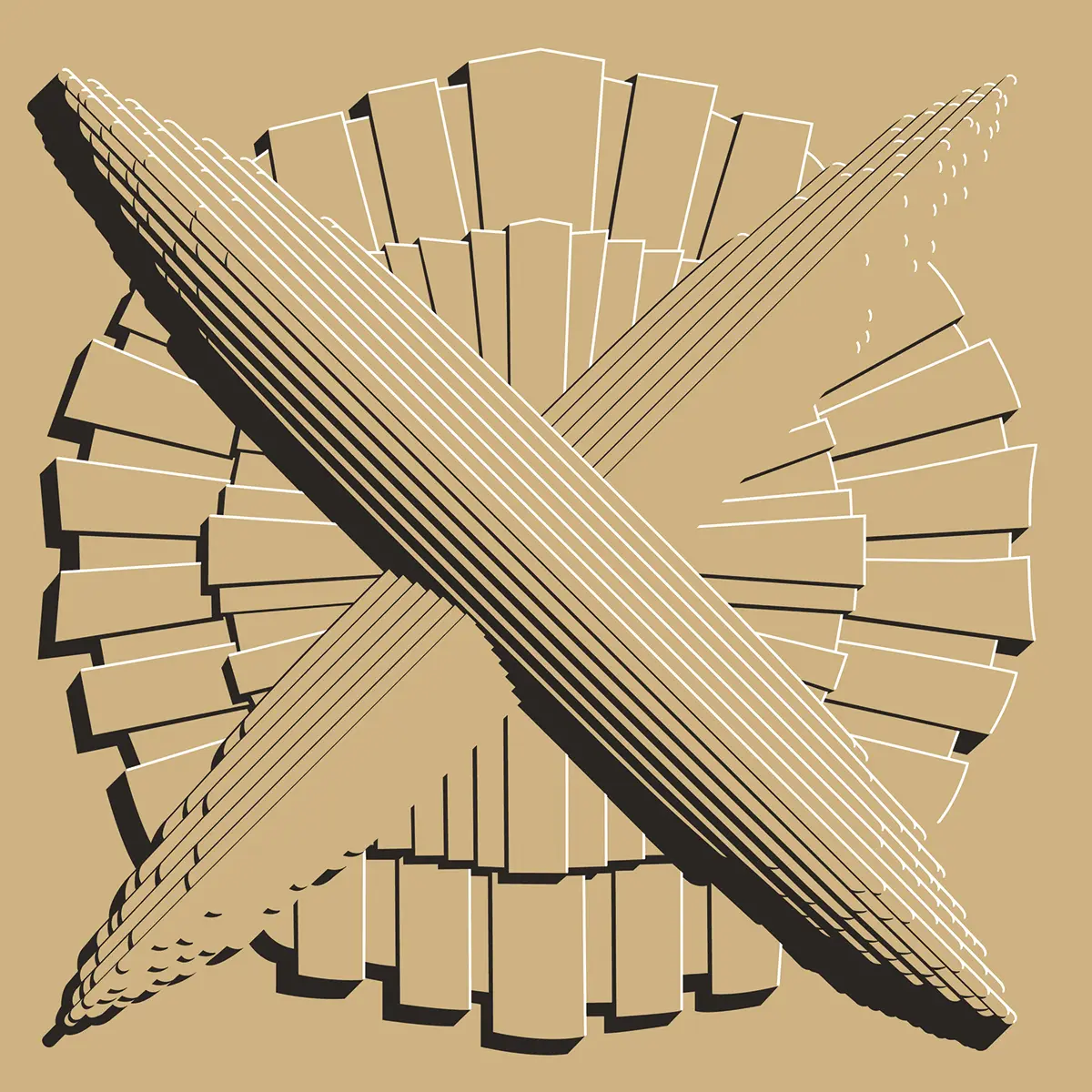
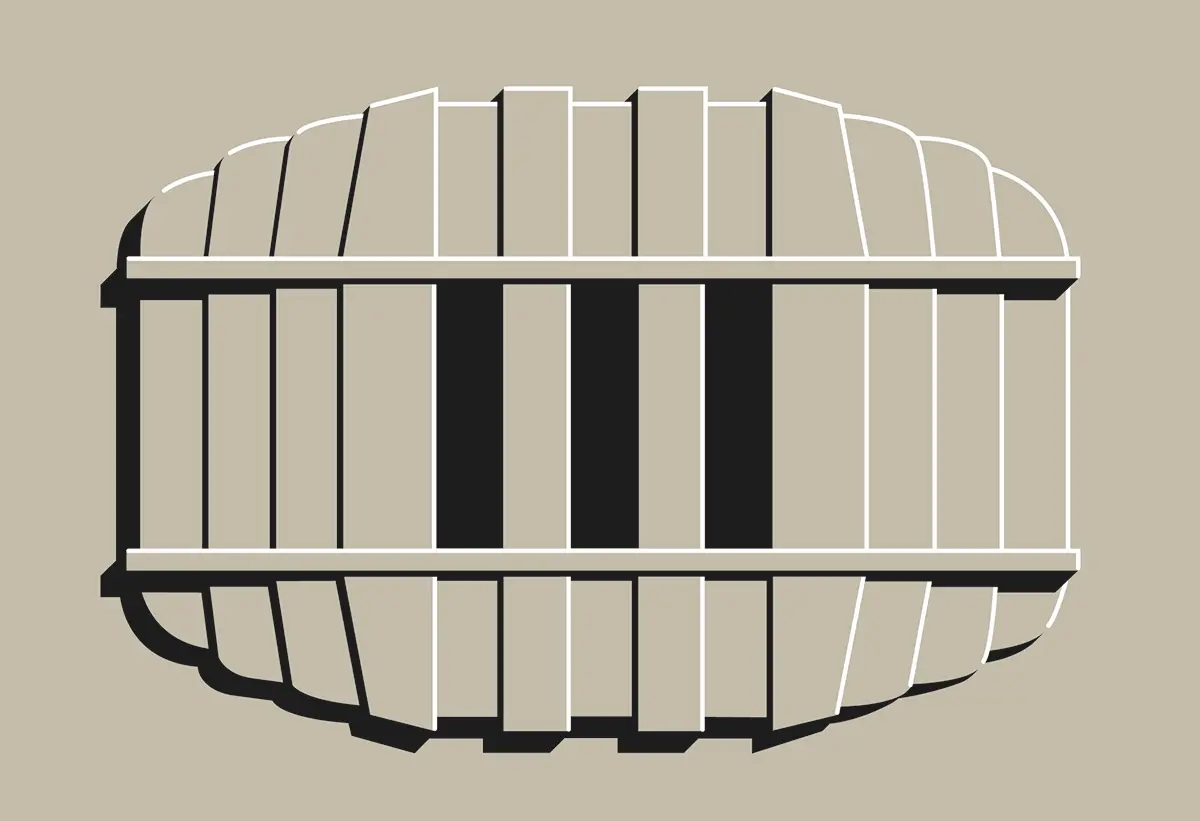
In works belonging to the period between 1989 and 1993, we also encounter an oblique reference to the ornamental and the decorative. In a significant shift, Siquier’s apparent figuration acquires an emblematic character and materializes in rigorous geometrized shapes and a restricted monochrome palette of pinks, grays, or blues. In some cases a central motif, provocatively symmetrical and the same color as the background, suggests Art Deco or modern industrial objects; others are more delirious or soberer. It has been often thought that Siquier refers to architectural ornaments, which could be interpreted from the artist’s interest in the building frontispieces that capture one’s attention in an urban landscape.1
“I have no interest in pondering light in itself, but in using it,” Siquier says. And he does, constructing forms as entities that stand out against their background. The practice of underscoring planes and lines, making them emerge by the action of light, is one of the preeminent features of Siquier’s oeuvre to this day.
Siquier’s visual traps challenge the viewer: the shadows respond to the artist’s intentionality and cannot be always attributed to a precise point of origin; subtle asymmetries secretly animate the image. Behind a façade of severity, this artist has a spirit of playfulness that allows him to adjudicate references that are later swiped, to suggest readings that disconcert and seek a different orientation, to alter a univocal possible order. This process is more noticeable with black-and-white paintings produced after 1993, in which lights and shadows articulate complex compositions of a marked graphical character. Lines become more and more intricate, describing different plots.
Several critics have interpreted these works as urban maps or topographies. Ivo Mesquita connects them to the city of Buenos Aires, and with great sagacity he writes:
The work of Pablo Siquier doesn’t produce or reproduce maps and panoramas; neither does it propose metaphoric evocations of the city. It is above all else a narrative about the city. Like Borges, whose life and identity are closely connected to Buenos Aires, Siquier articulates strategies to give visibility to a specific, personal experience through a visual discourse that involves everything from recognizable forms in local architecture to pure abstractions, and which can be related to the city’s landscape, topography, and modes of representation.2
This coincides with the artist’s own assertion that, with very few exceptions, when he is creating a work of art, he is not thinking of anything specific that he has seen, nor of models of cities, nor of maps. This extraordinarily rigorous and rather cryptic definition, disconcerting in its emotional neutrality, is enhanced by the fact that no trace of the artist’s hand is registered in the work. The images seem to have been produced through mechanical means.
Juan Manuel Bonet also relates these works to the city: they convey man as a prisoner of the city, as in Edward Hopper in New York or George Grosz in Berlin. Pablo Siquier “expresses the Buenos Aires melting pot,” Bonet says. “I cannot see this painting but in connection to the city where it originated, and I can’t see the city but through Siquier’s eyes."3
Bonet alludes to the Kavanagh building, the Rex theatre in Corrientes, the Obelisk, Victoria Ocampo’s white house, and the Safico and Comega buildings.4 To this list, Marcelo Pacheco adds the work of architects like Palanti and Salomone, Andrés Kalnay, and Alejandro Vorasoro.5 And one must not forget the extraordinary series of modern buildings on Avenida Libertador, among other possible examples.
Pablo Siquier believes that the city plays an important role in the formation of the taste and affective charge of many artists. Those of his generation—he was born in 1961—saw fewer shows by Concrete artists and more architecture in an everyday context, as well as modern furniture. The project of modernity was truncated, and its isolated buildings had to pair themselves with buildings in the French or International styles or a hybrid. Siquier says this expresses the idea of stylistic impurity or illness and is a product of the way that information is accessed—indirectly, partially, incomplete, book-bound.
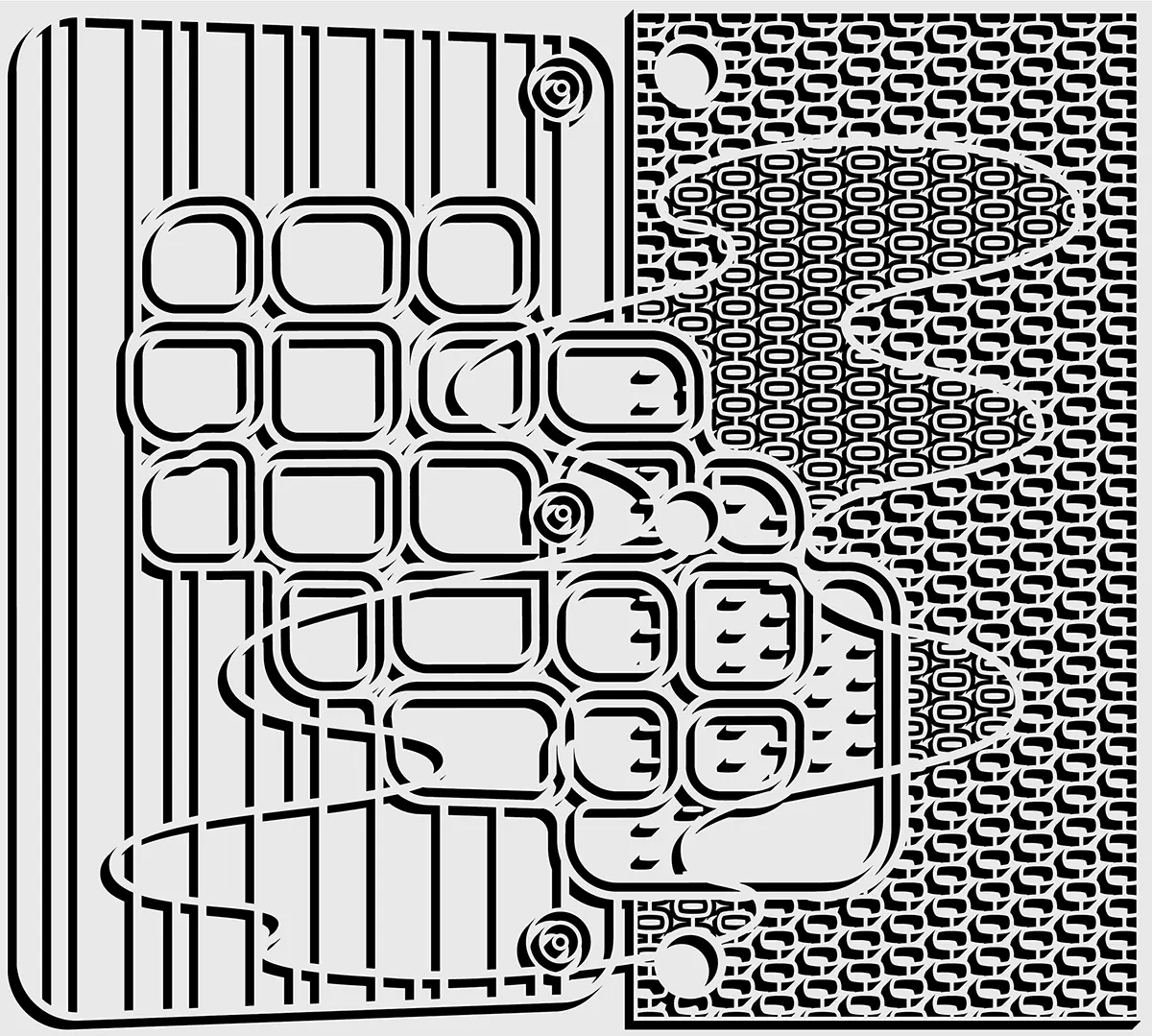
This hybrid nature speaks of a stylistic metastasis, an expression that the artist Nicolás Guagnini asks us to understand through Siquier’s concept of the “style machine” based on his lived experience of Buenos Aires as an imperfect translation of other cities.6 Siquier neutralizes its heterogeneity with flat and continuous surfaces, on which he projects shadows.
In Siquier’s works of this period, in which no longer is a central form against the background and everything seems to assert itself on the basis of geometry, one encounter subtle shifts: parts where the sensation of relief is enhanced or flattened; the scrupulous geometric order disappears; curved lines play a more active role; two- and three-dimensional vision are sometimes altered in an optical play; diagonals often create flight lines. The whole, so stable in appearance, becomes unstable by being observed, as if the artist enjoyed disorganizing and confounding the supposed clarity of the composition.
Pablo Siquier has noted that abstract painting has acquired great freedom, being outside of the discourse of visual art forms connected to social, poetic, minority, or identity issues. Unable to satisfy any of these needs, abstract painting is liberated from responsibility and freed from the greatest demands. And from that place, abstract painting can ponder things in a more oblique way, producing models of reality that are precise and specific yet are widely encompassing rather than simplistic.7
Like the Concrete artists, Siquier uses such freedom and chooses to fill the plane with line and color, differentiating himself from those who prefer the trace or blotch.8 Yet he is removed from Concrete art in several ways. The first great divergence the artist finds between the Concrete art project and his own is that the former was driven by a certain positive idea of art: the modernist utopia regarding mass society. Siquier’s interest leans more toward the inexplicable, the unnamable, and the indecipherable. He feels divested from the possibility of contributing to the construction of a better world. He is also separated from the Concrete artists by his systems of formal interdependencies, especially in his most recent works.
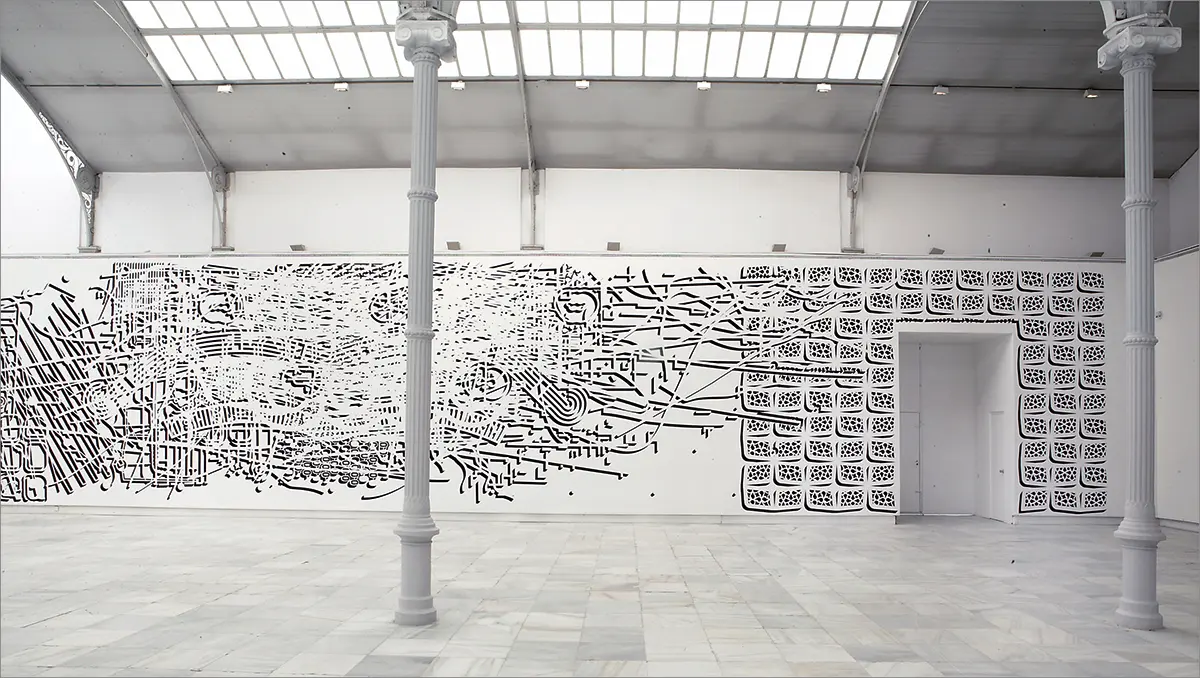
At the 2003 São Paulo Biennial, Siquier presented charcoal works created from digital projections transferred to the walls.9 He is not interested in the digital medium in itself; in the same way he that earlier used ruler and compass, he now uses Adobe Illustrator or an architecture software that is vector-based in three dimensions. The digital medium gives him an infinite range in the possibility of variations and in precision. But these are just geometric tools for his practice. He transfers the digital images with carbon or vinyl and they attain large dimensions: the work at the Reina Sofía is fifty-four by five meters.
When asserted and negated with contradictions, traditional spatial resources produce a sensation of a loss of coordinates. In this connection, Clorindo Testa’s words are illustrative and poetic:
To be standing in the gallery, looking at Siquier’s charcoal lines on the wall are like standing on the floor looking up to the Pantheon’s dome . . . It had been fifty-four years since I had lied down to look at the Pantheon’s dome . . . In 2003 you look at those lines on the wall and you are lying down, although, in reality, you are standing up . . . You are in the air and you look up, then as you exit, you are again standing up.10
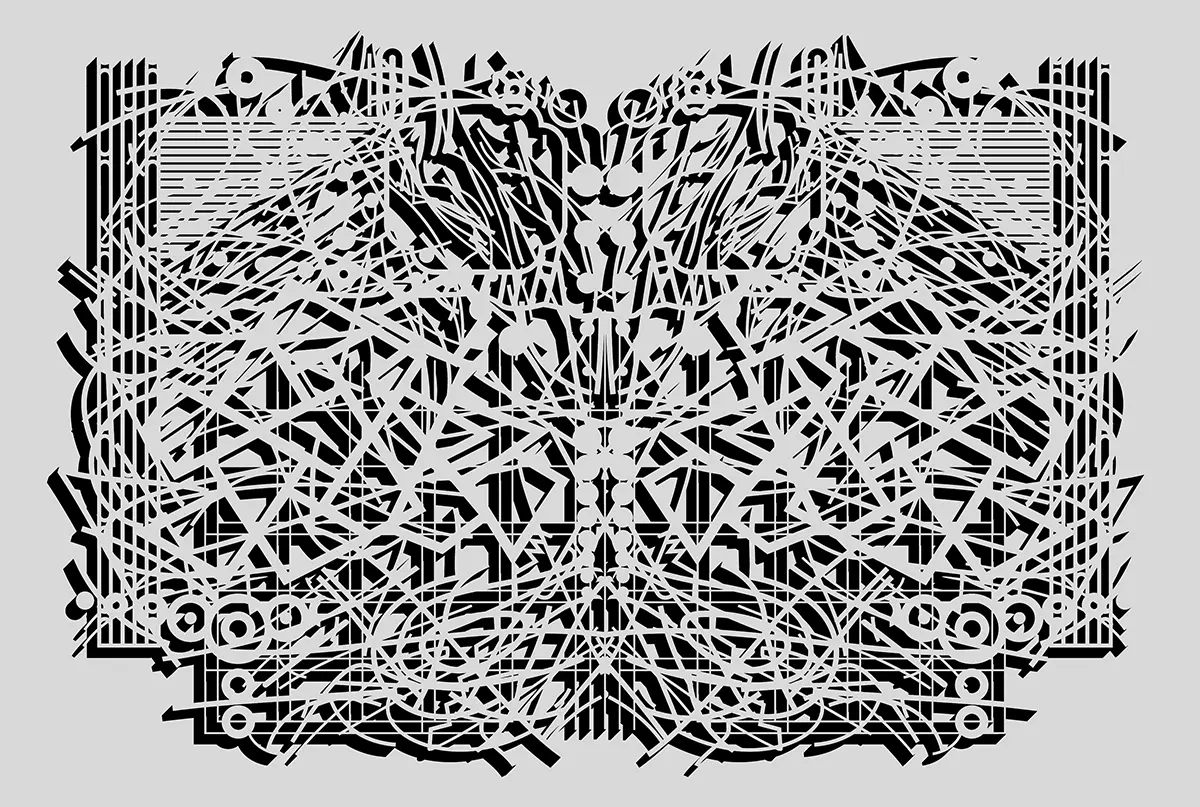
Due to the nature of their execution, these murals fade away, wearing out over time, and they show that their ultimate objective is to reveal precariousness and finitude. Recovered hand traces and gestures traverse the severity of geometry and find their reason for being in that pitiless decay. These murals superimpose plots in indiscernible layers that can be grouped or singular. Those in vinyl respond to the features of Siquier’s work in recent years but bring them to a monumental scale in an imposing dialogue of light and shadow that describes unexpected, profuse, or open trajectories that are increasingly more intricate. In these works, Siquier overlaps structures from previous paintings in an accumulation that makes the plot increasingly dense and impenetrable, generating unpredictable clarities and obscurities. At the dangerous edge of chaos, the artist rescues symmetry as a possible anchor.
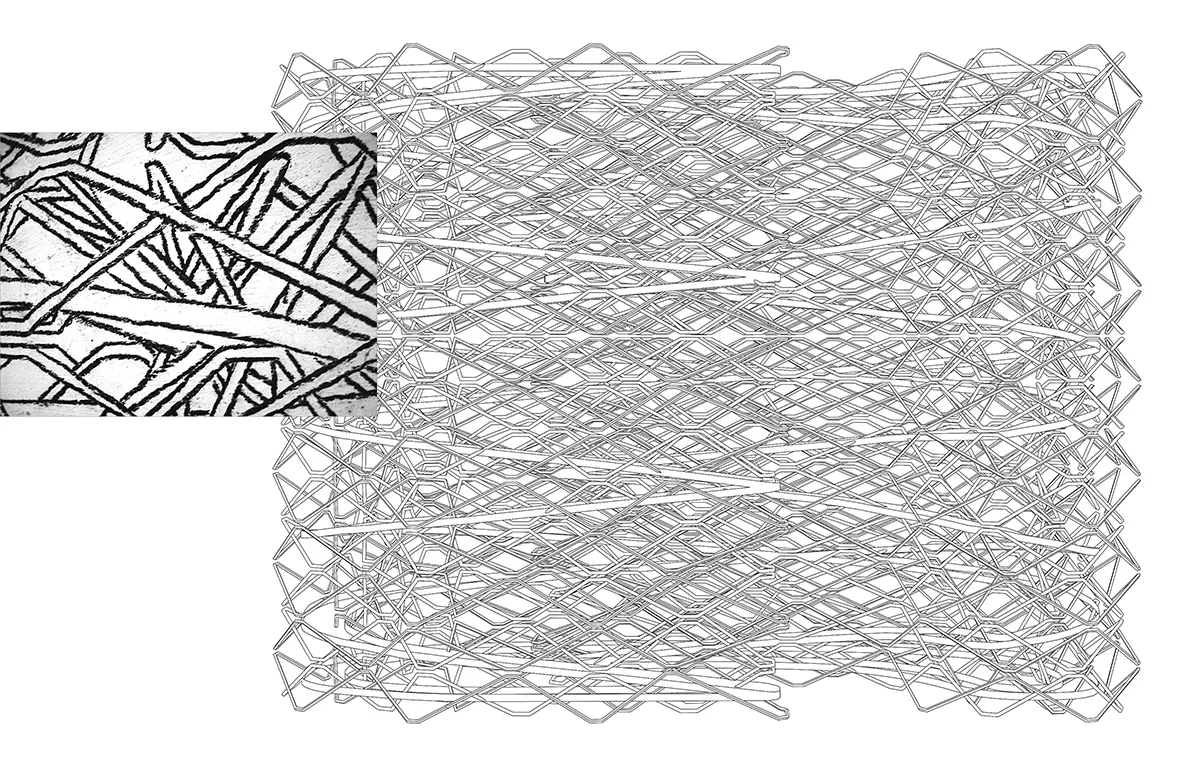
If both the problem of style and the projection of light onto the two-dimensional canvas are constants in Siquier’s work, so is his interest in repetition through rhythm, which is connected to his preference for the music of John Cage and the repetitive minimalism of Steve Reich. “Art does not imitate, it repeats and repeats every repetition using an inner potency,” says Siquier.11
There is also Siquier’s connection to Borges’s universe. Siquier has been associated with Borges through the theme of the labyrinth and through being, like the writer, so closely connected to Buenos Aires. Like Borges, Siquier “maintains with the mystery of the real an oblique and clandestine, poetic and profound relationship.”12 Like Borges, Siquier uses fiction to escape the boundaries of any system. And, beyond the labyrinth, they share a taste for the multiplication of spaces, the exploration of the limits of language, the hidden contradictions behind an apparent order, and an approach to reality that is free from definitive assertions.
Siquier’s work has achieved growing recognition in the local and international art scene. The shifts in the work—subtle flights that may be voluntary but are undoubtedly necessary—appear without stridency and within the boundaries of his characteristic asceticism and severity. To approach the work of this complex artist is to be surprised and to encounter detours that are never simple and always interesting.
NOTES
1. Referring specifically to Buenos Aires, Siquier considers the parceling of city blocks an important factor, with narrow and deep buildings erected between medians. This results in a model in which the expression of the architect’s ideas are limited to the façade (which is ornamental and drawing-like in nature) since the building’s volumetric aspects are so limited. From the Transatlántica: New Trends in Abstraction forum, Alejandro Otero Museum, Caracas, Venezuela.
2. Pablo Siquier vivir la ciudad, from the catalog of the artist’s exhibition at Palacio Velásquez, Museo Nacional Centro de Arte Reina Sofía, Madrid, 2008.
3. From the catalog of the artist’s exhibition at Palacio Velásquez, Museo Nacional Centro de Arte Reina Sofía, Madrid, 2008.
4. The Kavanagh building was designed in 1935 by the architects Sánchez, Lagos, and de la Torre; the Obelisk and the Gran Rex theater was designed in 1936 by Alberto Prebisch; Victoria Ocampo’s house was designed in 1929 by Alfredo Bustillo; the 1935 Safico building was designed by the engineer Walter Moll; and the 1933 Comega building was designed by the architects Alfredo Joselevich and Enrique Douillet.
5. Marcelo Pacheco, from the 2004 São Paulo Biennial catalog.
6. Nicolás Guagnini, from the 2004 São Paulo Biennial catalog.
7. From an interview published in Madrid on the occasion of the Palacio Velásquez exhibition.
8. I take from Deleuze the possibility of fleeing the painting/window by the orientation of the line/color, unlike the trace/blotch. In Pintura: El concepto del diagrama (Buenos Aires: Ed. Cactus, 2007).
9. Also in the Reina Sofía exhibition.
10. From a booklet for the artist’s 2003 individual show at Galería Ruth Benzacar, Buenos Aires.
11. Gilles Deleuze, Diferencia y repetición (Buenos Aires: Ed. Amorrortu, 2002).
12. Quote by María Rosa Lojo, from the prologue to Cristina Bulacio, Los escándalos de la razón en Jorge Luis Borges (Buenos Aires: Ed. Victoria Ocampo, 2003).
NELLY PERAZZO
Art professor and researcher.