
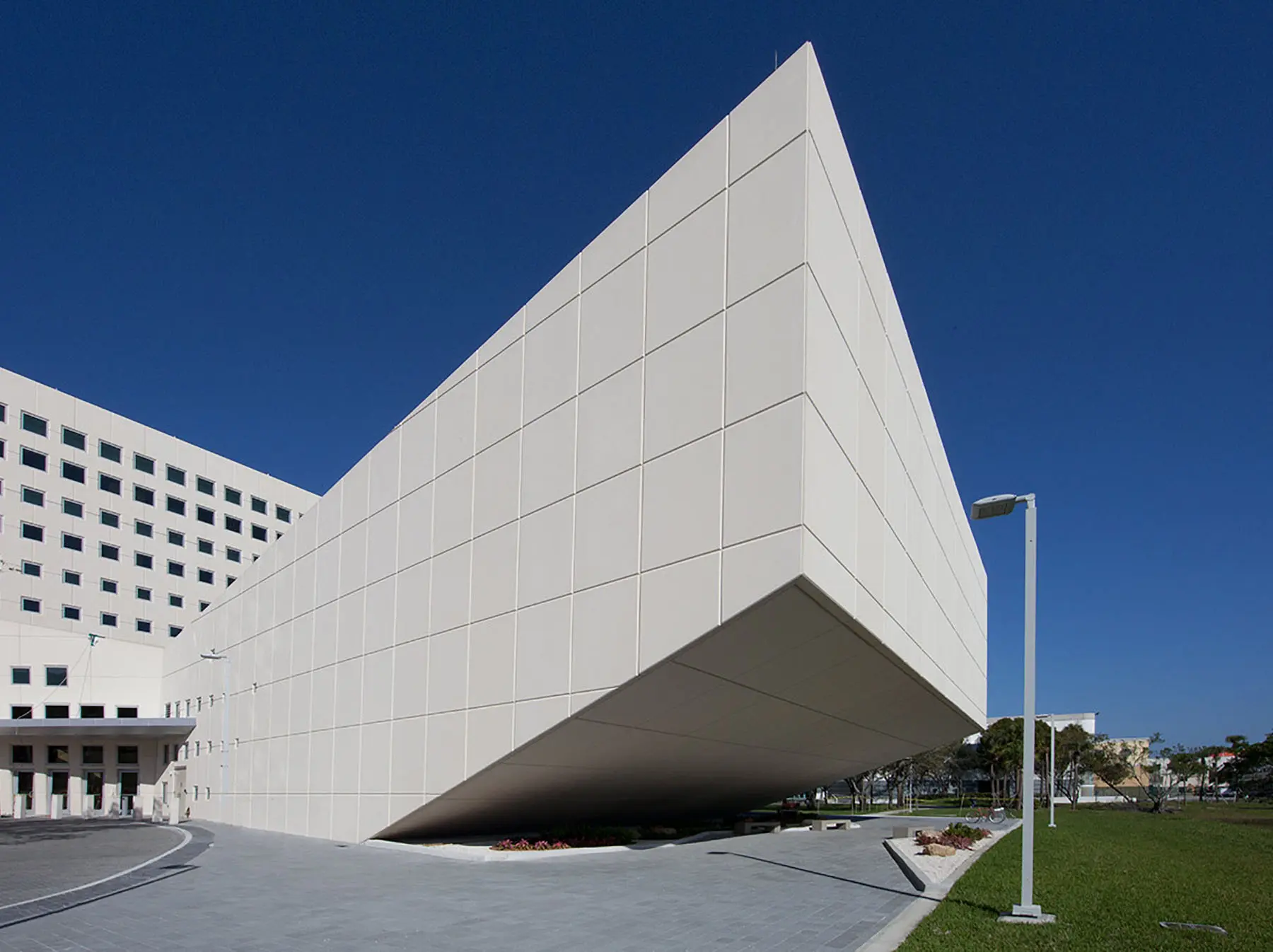
Housed on the University Park campus of Florida International University in Miami, the Patricia & Phillip Frost Art Museum opened to the public on November 29, 2008. Formerly The Art Museum at FIU, it was initially conceived as a gallery where students could view the work of renowned artists, and exhibit their own, and was housed in less than 5,000 interior square feet of an administration building located in the heart of the campus. The small gallery soon grew to become one of South Florida’s key cultural institutions.
Since it opened in 1977, The Art Museum has gained a respected reputation for its exhibitions, lecture series, and educational outreach programs. By the late 1990s, under the leadership of Director Dahlia Morgan, the museum was designated as a Major Cultural Institution by both Miami-Dade County and the State of Florida. Grants from these sources, endowments, membership, and private and corporate giving provided stable funding for annual programs that prompted its accreditation from the American Associations of Museums (AAM) in 1999.
By the end of the twentieth century, it became obvious that a new facility had to be built to fulfill the growing museum’s needs and the university’s commitment to the arts and education. In 2002, the University hired the architectural designer Yann Weymouth, from Hellmuth, Obata & Kassabaum (HOK), to lead the project. Educated at Harvard and the Massachusetts Institute of Technology, Weymouth is best known as I.M. Pei’s chief of design for Paris’s Grand Louvre project, featuring the glass pyramid skylight, and the East Wing of the National Gallery in Washington, D.C. Most recently, he worked on the Ringling Museum of Art in Sarasota, Florida, and designed the Uris Educational Center at the Metropolitan Museum of Art in New York.
Built on the Avenue of the Arts (a mall connecting the museum, the Wertheim Performing Arts Center, and the Graham Student Center), the Patricia & Phillip Frost Art Museum is in itself a work of art. The contemporary façade of glass and grey Chinese granite houses a state-of-the-art facility, featuring a soaring three-story glass atrium entrance with a dramatically suspended staircase that leads to the main exhibition galleries located on the upper floors.
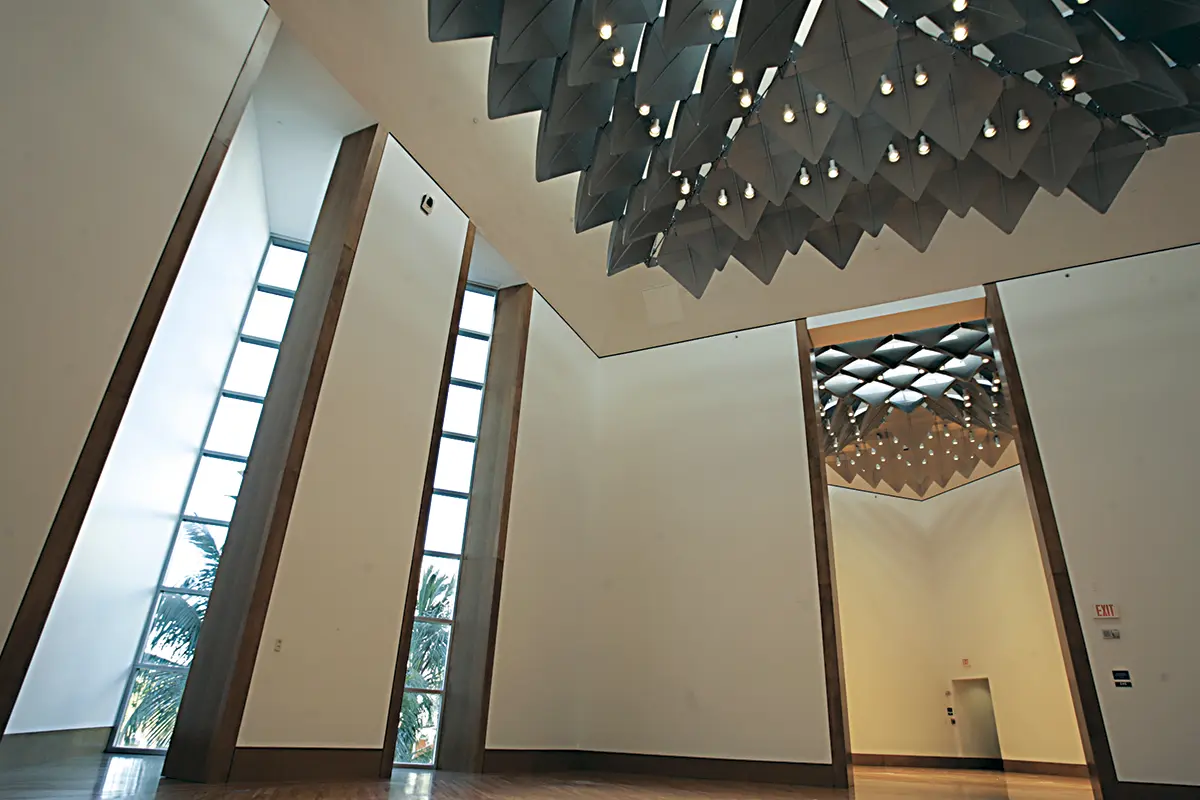
Known as the “architect of light and reflection,” Weymouth created a high-tech design that is enhanced by natural light both inside and out.1 The clean stone façade captures the brightness of Florida’s sunlight, creating an imposing presence on campus. This is particularly striking on the west side of the building, which is reflected in the surrounding lake. In the interior, natural light illuminates the exhibition halls; the unique lighting system, designed in conjunction with Arup Lighting of London, is the first of its kind in Florida. The sun’s ultraviolet radiation is filtered out through a complex system located on the building’s pyramid ceilings. Skylights covered with large leaves or “petals” control the light level and color and scatter the light across the walls. The result is a perfectly lit space that enhances the works exhibited, of which many were meant to be viewed under natural light. This state-of-the-art lighting system creates a unique outdoors feeling inside, making the galleries an extension of the surrounding sculpture park.
The new museum, an impressive freestanding structure of 46,000 square feet, provides more than 10,000 square feet of exhibition space distributed among nine galleries, three dedicated to the permanent collection and six to temporary exhibits. The three grand galleries, with their high ceilings and skylights and walls (measuring twenty-six feet, ten inches tall, with sixteen feet, six inches from the top of the walls to the skylights, for a total of forty-three feet, four inches), were designed to accommodate extremely large works of art. Other areas in the museum include the Kenan-Flagler Family Discovery Gallery, for educational and community outreach programs; a high-tech multi-purpose room and lecture hall; the Dahlia Morgan Member’s Lounge; and a café and museum shop. These facilities will provide a hub for cultural life on campus.
Along with several inaugural events, five exhibitions were planned on the occasion of the opening of the new building: Modern Masters from the Smithsonian American Art Museum, featuring some of the most celebrated artists who came to maturity in the 1950s, including Franz Kline, Michael Goldberg, Hans Hofmann, Sam Francis, Joan Mitchell, Josef Albers, and others now known as Abstract Expressionists; Figures: A Selection of Works from the Permanent Collection, focusing on the diverse representation of the figure as a vision of humanity; Simulacra and Essence: The Paintings of Luisa Basnuevo; Florencio Gelabert: Intersections; and John Henry: Drawing in Space: The Peninsula Project Illustrated.
The Modern Master exhibition comes to Florida as part of FIU’s affiliation program with the Smithsonian Institution. In 2001, Florida International University signed the first university-wide affiliation that the Smithsonian entered into in the continental United States. Previously, similar affiliations had been limited to university museums or art institutes. The agreement with FIU, however, ranges much farther, providing for scholarly use of Smithsonian material, collaboration on national conferences and panels, priority in securing traveling Smithsonian exhibitions, and the establishment of a museum studies program. As a Smithsonian Affiliate, the new Frost Art Museum will be able not only to integrate Smithsonian collections into its exhibitions but also to expand educational initiatives and research programs, as well as having access to Smithsonian staff expertise in areas of conservation, collections, care, and exhibition development.
Figures, curated by the museum’s director Dr. Carol Damian, presents a selection of modern and contemporary works, African bronzes, and Asian objects from the museum’s permanent collection of over 6,000 pieces. The show focuses on the diverse representation of the figure as a vision of humanity, whether earthly or divine, by placing it within an art historical context.
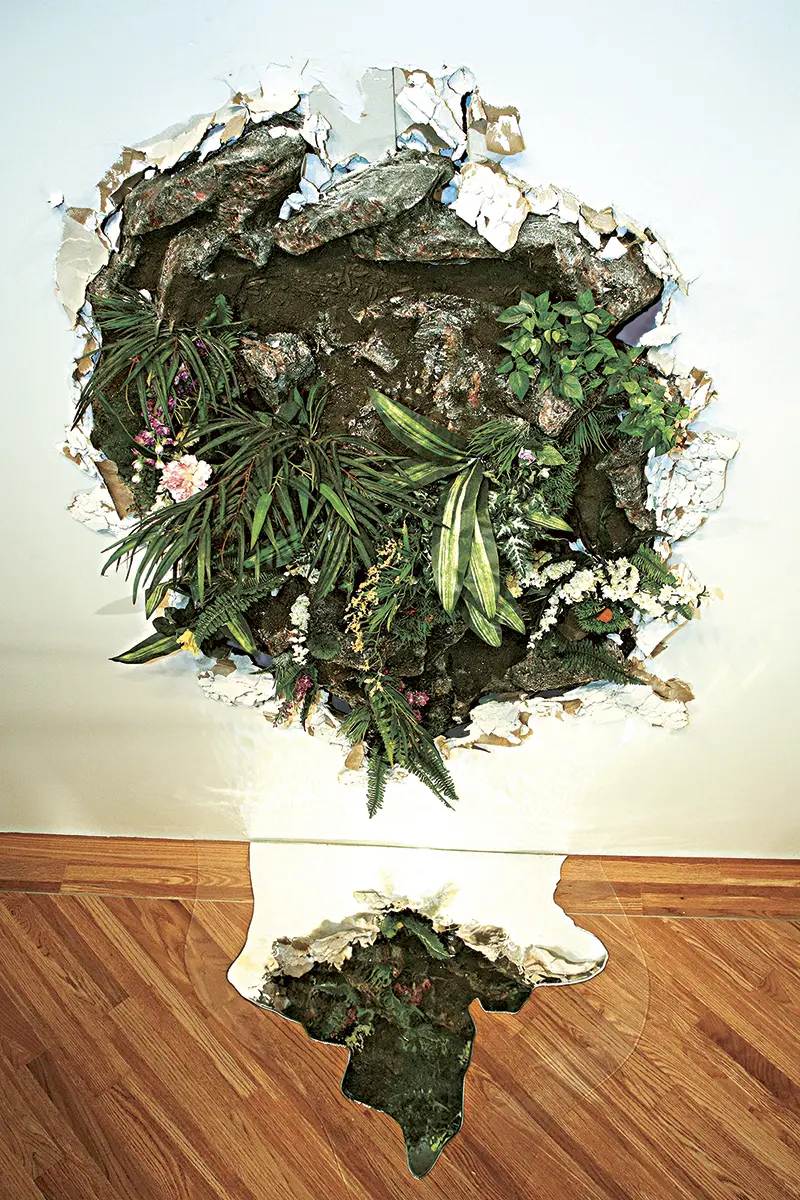
Alumni, student and faculty exhibitions have been an important component of the museum’s academic function. The new museum will continue to present the work of artists who have achieved significant state and national recognition, including recipients of NEA, MacArthur, Guggenheim, and Florida Visual Artist fellowships. As part of the inaugural shows, Florencio Gelabert and Luisa María Basnuevo (the first BFA student to exhibit her work in the old gallery space) present individual exhibits of recent works. Basnuevo shows recent works from her series of paintings inspired by eucalyptus seeds collected in Spain. In this case, her abstract imagery uses gestures, mask making, over-painting, transparent washes, and tonal variations. Gelabert created three site-specific, environmentally-based installations, addressing issues of humankind’s relationship with the natural world and our role in the depletion of natural resources. His pieces combine new technologies with basic materials such as wood, glass, metal, and plaster, which are intimately related to his sculptural work.
The museum will complement its exhibitions with a wide range of educational programs including the Steven and Dorothea Green Critic’s Lecture Series, the Latin American & Caribbean Art Lecture Series, and Wednesday After-Hours, a program designed to give students and visitors the chance to engage with the contemporary art scene and to confront the controversial via gallery talks, films, live music, and performance art.
Located within a large urban educational institution, the new Patricia & Phillip Frost Art Museum will provide a unique resource for scholarly research and interdisciplinary collaboration, increasing the university’s educational mission as both a local and global center of knowledge and culture. Its opening celebrates its status as a cultural beacon for South Florida, with exhibitions and public programs integrated into the life of the community.
note
1. Elizabeth Bettendorf, “Architect of light and reflection: Use of light defines and consumes the work and life of Yann Weymouth from the minute to the unexpected.” February 25, 2005.
FRANCINE BIRBRAGHER
Independent critic and art historian.