
Arizona has had a chance to meet Pedro Vizcaíno and in the best possible way. It has encountered its raucous graffiti insurgency thanks to Figarelli Contemporary, the important East Phoenix stop in the art circuit that facilitated the irruption of this Caribbean enfant terrible. With his usual comic-like causticity, the artist, in collaboration with curator Ted G. Decker, presented the project Wild Child Graffiti, covering floors and walls with works on paper and artifacts on a variety of supports, in the way a graphic provocateur would appropriate the free surfaces of a city. In a tone of subversive, almost underground audacity, he arranged a selection of works dating from 1998 to the present.
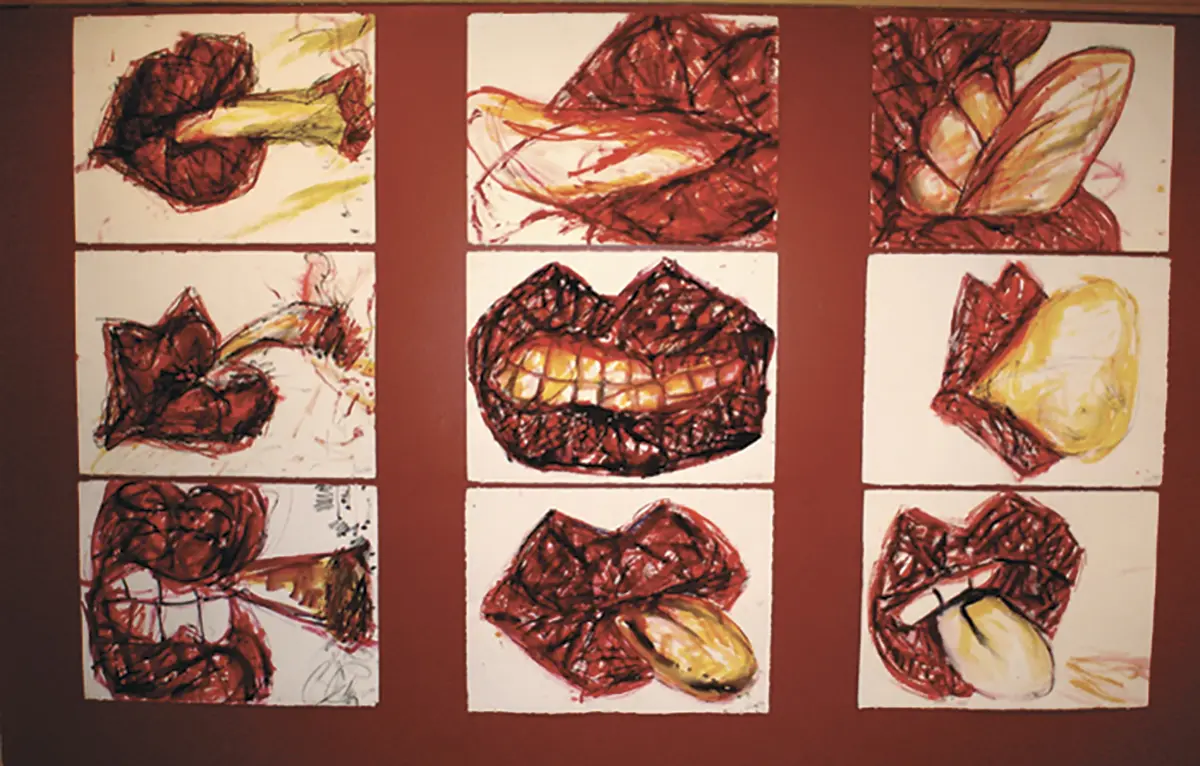
An incandescent unfolding of gang-war weapons, taxicabs, eroticized mouths, and basketball shoes, a whole post-pop paraphernalia that ironizes urban demons, alongside war tanks and flying machines that are a tragicomic counterpoint to the contemporary civilization/barbarism paradox and transpire negotiations with the street imagery of Keith Haring, the Art Brut of Dubuffet, or the spontaneous informalism of the CoBrA group.
The curator took advantage of the spatial fragmentation to recreate a counter-cultural landmark, completed with the eccentric volumetrics often prepared by Vizcaíno with discarded materials, that original woman-car, and pastiches with reminiscences of Rauschenberg, whose aesthetic functionalization comes to revitalize the precepts of late-1960s Arte Povera, which already at the time invited us to reflect about the dangers of excess in industrialization, consumerism, and materialism.
With this show, the artist is debuting in the South West circuit, presenting himself as a recycler of drawing who certainly works with the effects of a premeditated expressionistic fermentation of figures. Behind the schoolboy rusticity of his ideography lays a solid academic foundation. Something that reminds us of Haring’s and Basquiat’s reconfigurative skill. One cannot be as effective in blurring or reneging of conventional images without possessing a hand well-exercised in the sketching of classical shapes and gestures, in order to later engage in their playful dislocation to the point of a childlike primitivism or of the irregular tracing we commonly know as doodling. Yet Vizcaíno pays attention to the sense of a chromatic counterweight and takes care that his representational chaos preserves the aura of the spotlighted motifs.
The artist has declared that his visual play moves between the signs of neo-expressionism and abstraction in order to maneuver with the rugged tone of the anti-Establishment send-up. In other words, his formal rebelliousness is forged intellectually and erupts when engaged with his temperamental intensity and his creative proliferation. As a concept, there is much of a sarcastic chronicle or of cynical controversy in the face of the arbitrary subjections of a contemporary world plagued with anodyne Disney effects, postmodern frivolity, techno-bellicist intimidation, and gang epidemics in the power structure.
Vizcaíno’s counter-cultural vocation is not new. In the 1980s he was one of the key figures in what critics have dubbed the Cuban Renaissance, characterized by its aesthetic revisionism, socio-political critique, and confrontation of institutions. His participation in Arte Calle, an alternative project that intended to rearticulate the traditional artistic event and transform it into an act of emancipation and debate, was among the most active and daring at the time. His profanity finally brought him the unwelcome attention of the most orthodox sectors in Cuba’s official cultural apparatus.
Since resettling to the United States, he has gradually moved towards an incorporation of the most advanced visual thinking in the new context. His specific Miami location has contributed a certain territorial flavor to his work, translated in the frantic warmth of his colors, the divertimento, provincial satire, and the presence of artificial urban elements like taxicabs and the inescapable airplanes of the Miami sky. However, Vizcaíno has persisted, beyond the community boundaries a sense of belonging, in making himself ironic and widely encompassing of such crucial contemporary themes as the expression of violence and the dehumanizing mechanization that are, in turn, concerns of the most sensitive sectors of American society.
In this way Vizcaíno’s art has made a quick anthropological connection with that other existential model and he has resituated himself, like very few Cuban émigré artists, in a discourse that is congruent with the American nation’s socio-cultural universe.
Because of this, it is not a surprise that the Arizona public, viscerally Anglo-American, reacted with openness and receptivity to the un-ideological yet abrasive and convincing the discourse of a natural non-conformist, able to transcend the ghetto with his bursts of delirious ideography.
JESÚS ROSADO