
“On the point of exploding” is the phrase best able to define Eric Colón’s attempt to illustrate the sense of the exhibition by Pepe López, presented July 2008 at the Galería Fernando Zubillaga. In effect, López’s expository proposal was concerned with the relationship between the discourses of art and the globalized world in which we live. There are many thematic axes that can be dealt with in this work—worthwhile questions such as: to what degree does our circumstance permeate and decant the artistic codes? To what extent does this exert an influence on the formation of new rituals based on materials produced from the detritus of our industrialized urbanity? Is the planet—and even the cosmos—at the point of exploding because of the processes of accelerated deterioration that we are guiding? Pepe López contemplated all these themes and more in this exhibit.
From the 1990s, López has insisted upon denouncing the human role in the degradation of the planet, through environmental contamination (such as garbage, toxic waste, and atmospheric pollution) as well as mental contamination, to which we have submitted ourselves, such as alienation produced by a mercantilist society based on disproportionate consumerism. This situation is augmented by the enormous and rapid communications systems—managed by satellites, cellular phones, the Internet, among others—which have given rise to a universe of objects, a way of life, and attitudes that generate more and more trash, to the point that the planet can no longer contain this garbage, and humans appeal to the cosmos to “solve” this problem.
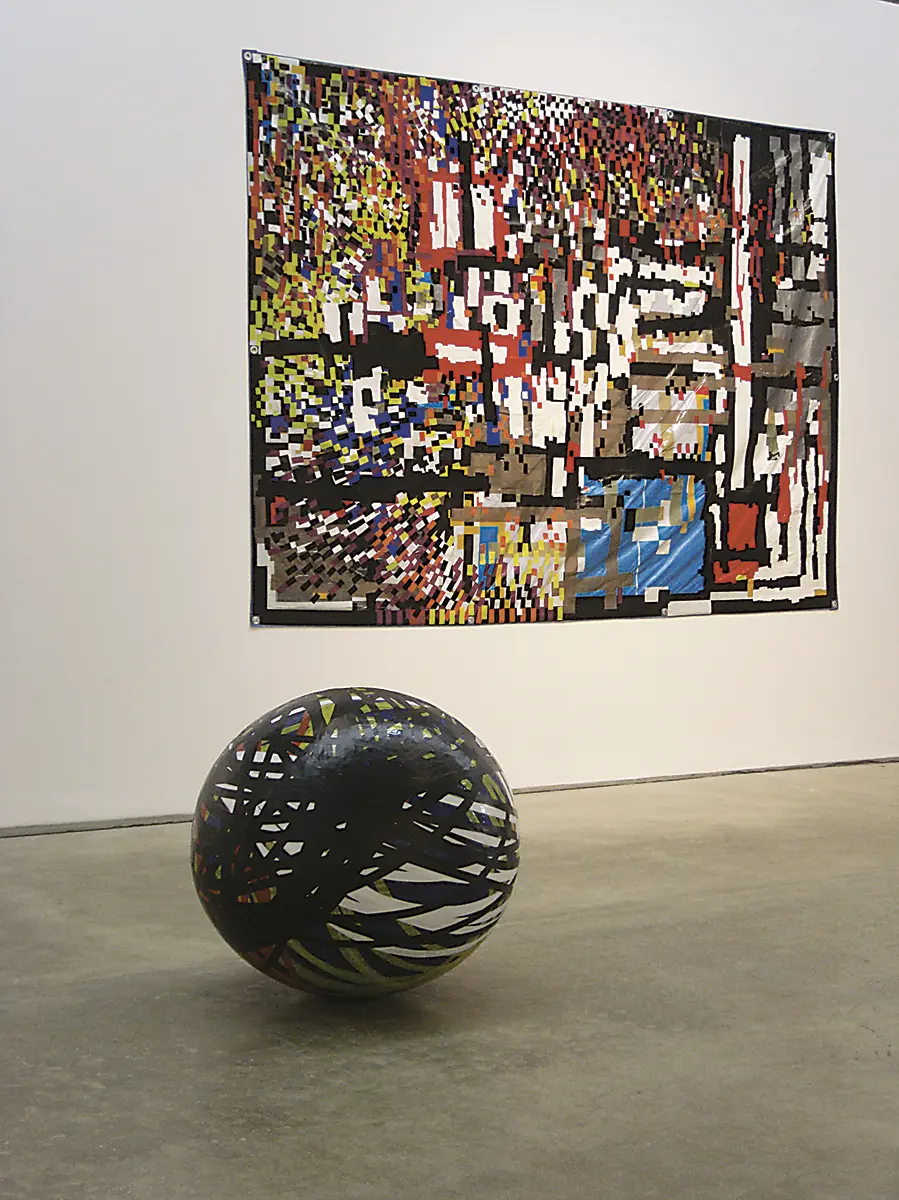
This is the sense of works such as Big, Bang, Boom fiberglass spheres that are metaphors of the planet Earth, in which colored adhesive tapes represent the satellites’ trajectories. López cites: “There are more than 14,000 artificial satellites, of which there are already 6,000 that are junk and that remain in uncontrolled orbits around the planet that are susceptible to producing an impromptu catastrophe at any moment.” Household trash and the mistreatment of the environment are synthesized in Bella Caracas, the latest version of a performance (titled We Love Garbage), in which López travels with a shopping cart through a city: on his route through the streets, he recovers diverse cast-off items, creating a new concept of the readymade in which the action and reactions of the streets, registered on video, compose part of the work. This is the fifth edition of this object-performance; López has performed this work in Paris, San Juan, Miami, New York, and finally Caracas.
In his work, López analyzes the attitude of consumerism through its traits or consequences. Thus, a bar cart synthesizes the contemporary history of Venezuela through the preferred brands of whiskey from the eras of Venezuelan presidents. The bottle is the distinguishing hallmark of a class (a brand), of behavior, and of an era: Something Special (from the time of Pérez Jiménez), Old Parr (Carlos Andrés Pérez), Swing (Jaime Lusinchi), Buchanan’s 18 (Hugo Chávez), etc. All this is the result of the mesh of elements that the artist brings about from observing the world.
If this conceptual background is the underpinning that justifies this work, there is a formal reflection regarding the consequences of these social, political, and ecological implications. We know that the geometric and kinetic tradition lies heavily upon Venezuelan art. But in López’s work, this platform acquires a vanguard twist. His changing and contemporary vision are infused with a tradition that is difficult to evade: artists whose emblematic works resulted from a will to overcome two-dimensionality, who considered movement and transformation as components of the work. Examples are the serialization of the line (Soto), the color scheme and its visual perception (Cruz-Díez), and the mobile work in its urban dimension (Alejandro Otero).
Without being a painter or a kinetic artist, Pepe López is indeed a Venezuelan who assumes his circumstance. He manages the proper pictorial elements (color, value, composition, equilibrium/disequilibrium, texture, transparency, etc.) with discarded materials (bags, adhesive tape, found objects, etc.) and does this with total expressive sense. The resulting images, for example, are the “tapestries” (his urban maps) whose embroidery reveals the visual elements of the plastic tradition. The space that sustains these maps targets the territory in which the artist finds himself. In general, these maps derive from a dynamic process that transfers the video image to the flat representation of space via collages crafted with bags and adhesive tape. The pixelation of the photographs and videos provides the necessary frame of reference for the elaboration of urban maps and the representation of the virtual movements occurring around the planet: the communications that via cell phone or Internet are carried throughout the world (here represented by adhesive tape lines). Could this be a new kinetic art? The tools of work provide their own industrialization, the same one that destroys the planet.
With Pepe López, we are faced with an artist-questioner who is at the same time sarcastic. His work ranges between surpassing the geometric tradition, the objectivism of the Dadaists (l’objet trouvé and the readymade), and a new visuality proceeding from works of un-objective materiality. López’s reflections and actions imply the man and woman of the twenty-first century and, in essence, determine its fate.
SUSANA BENKO