
In the personal exhibit Trace Crop Off, Ramón Williams brings together a terse selection of his most recent work, conforming a project of a structure bordering on the symphonic that strings together, with the same interchangeable fluidity as the hexagrams of the I Ching three different series that is one. Trace Crop Off is the cut, the edition of a line, a trace –or the clipping and reframing of the photograph of that line. In this title, Williams achieves the intertwining, with full naturalness, of the digital image’s technological jargon and the discourse of a certain philosophy of the image –specifically Jean-Luc Nancy and his seminal essay– although he takes care to preserve the ambivalence of enunciation as a phrase (cropping a trace off, clipping a print, or trace), and of each of the three words forming it, such as titles of the three series that embody the Trace Crop Off exhibit, which the artist analyzes separately within the text with which he presents his project: “Trace (imagine) a number of circumstances and media involved in the act of tracing. These marks exhibit their condition as vestiges of a global culture comprised of make-up, surveillance, and recycling, at the same time as they participate in the calligraphic spontaneity of the universe.” Crop proposes “a perceptive edition of a world as ‘figurative text’ whose richness passes by unheeded (…) in the periphery of a retina suckled by the arbiters of the corporate publicity, the religious or political propaganda…” Finally "Off explores the detachment of the referent and its absence as evidence, as well as the manner in which the image of a symbol in ruins can activate the memory of a primordial significance contained in itself…”
The first comment that can be emitted on these works is that they are carriers of an unavoidable beauty that assaults in unison the vision and the mind of the viewer. It is a rare occasion that the eyeballed and the conceptual connive so snugly to conspire in the search for that arduous state of grace that is the esthetic pleasure, which in art is like a many-faceted orgasm –heuristic, ludic, informative, etc.– and that can be reached in slow waves or as a click that kindles an electric light bulb in the middle of darkness, a Neo-conceptualism that without succeeding, in sharing the visually astringent esthetics of the founders fixes it so that it achieves a cogitative discourse that rests on a visual discourse that can come to be read with the self-same fruition and pleasure as the most beautiful piece of Abstraction, Tachism, or Matterism. In these photographs, reality underlies as a token or an ambiguous referent, behind which the allusions– leaping like a magic rabbit– to these veiled referents (historic, artistic, publicity, religious, propagandistic) that the contemporary pupil files in its diary and in its omnivorous gulp.
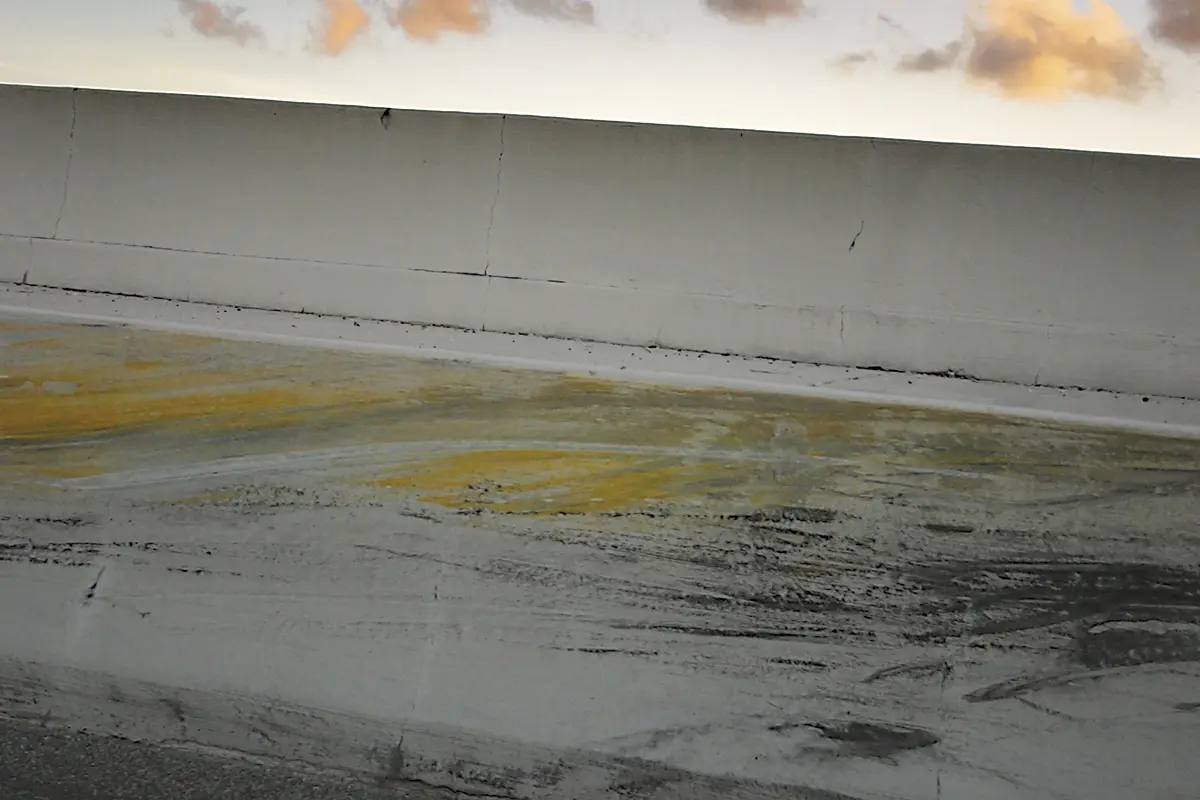
Williams’ photographs document absences (of buildings, of walls, of letters on luminous posters that alter, fatally or jocosely, their sense) and accidental or intentional operations that change the urban face, as print and hint of the chaotic life that boils up within metropolitan confines –the megalopolis as a whale, the citizen as Jonas trapped in its belly for three days and three nights, the time lapse of human life in the chronometry of the Cosmos– and a dreadful sum of prints of automobile accidents inscribed in the central separator of the expressways– that becomes the borderline between life and death– and the pious coats of paint with which the county power brigades cover them clinically, falling somewhere between modesty and the marketing of the local image. One of the pieces of video animation exhibited recreates this scenario with an athlete who runs on this same track, but free of cars.
These photographs are like a blackboard on which the artist inscribes the (bio)graphy of two cities, so near and yet so far, such as Havana and Miami, and it does appear to be eventful that the laying of the project’s foundation has been written during a flight through an air corridor that connects them, a gesture that tends to complete the alchemy of lights and shadows that edify the image. But what Ramón Williams proposes to us goes beyond the geographic punctualities, on tracing a metaphor of life and the world (or life in this world), marked by impermanence and change; this dialectic succession of states through which all living beings pass –and the urbanistic weave of buildings and streets must be necessarily be included– during their existence in the material plane. At the same time that they distill this metaphor, the works of Williams also remind us, along with Jean-Luc Nancy, that “Tracing is the interminable passage of one disappearance into another. (...) The passage is interminable because it never exactly begins: something always remains of the thing and only of the thing…”1
NOTE
1. NANCY, Jean-Luc. Traces, in Specters of the West and the Politics of Translation, edited by Naoki Sakai, Yukiko Hanawa, Hong Kong University Press, 2001. pp. 110-112.
RAFAEL LÓPEZ-RAMOS