
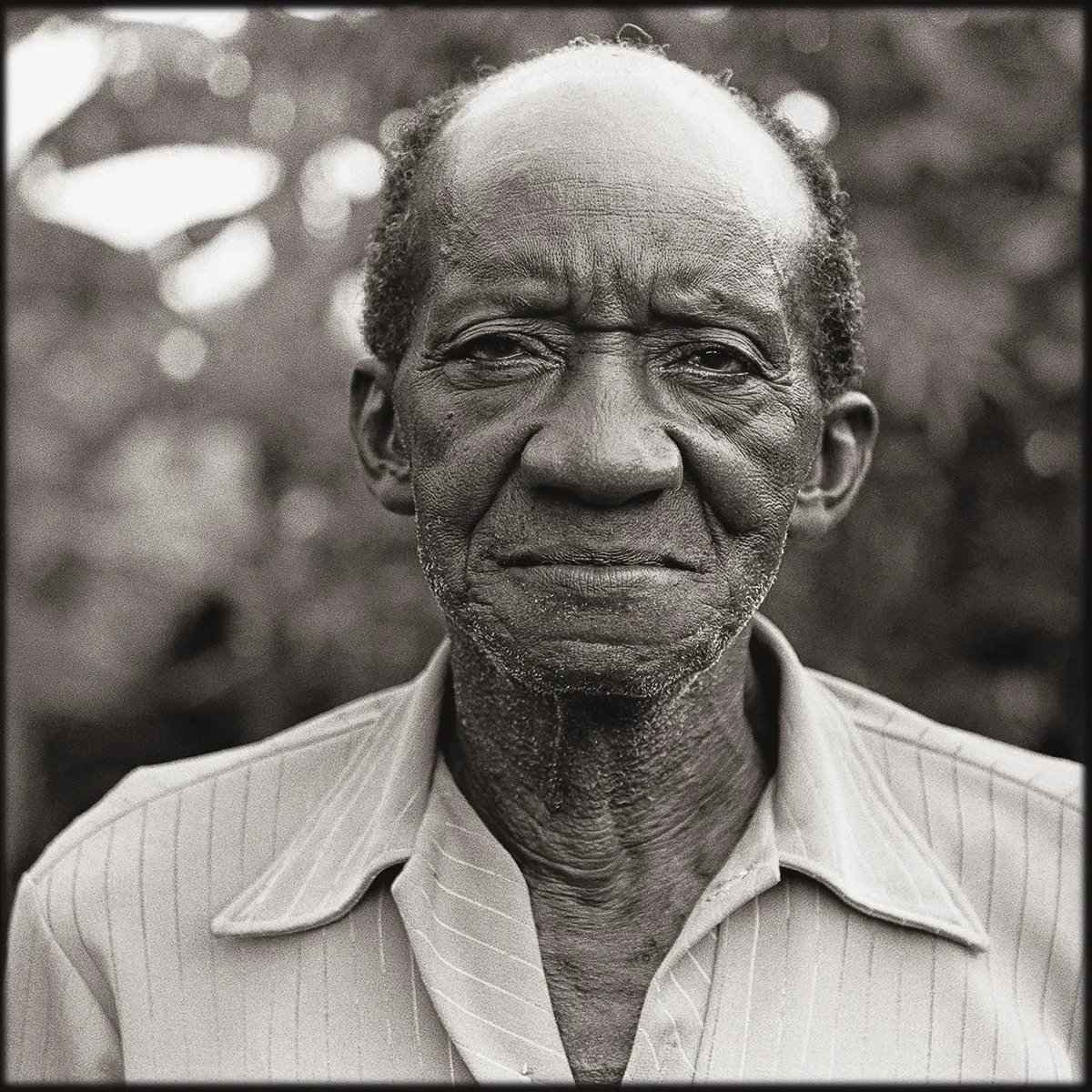
An undercurrent of cynicism marks the entire work of photographer Ricardo Gonzáles-Elías, who researches the historic background, framing his world to build the discourse of his exhibits. This time, he once again sheds light on Cuba’s sugarcane industry with an exhibit titled Oro Seco (Dry Gold), which generates reflections of a psychological nature, but that are also charged with social, political, and economical repercussions. He presents the individual portraits of ten former sugarcane workers at the Central Primero de Mayo (a sugarcane refinery formerly known as Central Perseverancia) in Cienfuegos, Cuba, who became part of a larger collective portrait of people who at one point played a role in the industry that is so important to the Island.
The exhibit also includes a video showing the desolate landscape at that abandoned sugarcane refinery, sharply contrasting with other images from the sugarcane industry’s Golden Age. It is an essay critical in tone in which the faces of the characters articulate the loss of a sense of belonging.
This exhibit continues with the idea already conveyed in Gonzáles-Elías’ previous series El Exceso de Azúcar Produce Amargura I I(An Excess of Sugar Produces Bitterness I, 2005). That series centered on other refineries on the plains of Matanzas, Cienfuegos, and Villa Clara., and consisted of panoramic photographs that presented the landscape left behind after the dismantling of several sugarcane refineries. The call for renovating efforts to increase sugar production by the Cuban government prompted Gonzáles-Elías to create his project titled Propiedades Pasadas (Past Properties) – exhibited together with works by Canadian artist Richard (Dick) Groot – at the Photographic Library of Cuba. Once again, his interest in industrial archeology presented us with an artist preoccupied with showing a clear opportunity for Cuban development. The government of the Island’s decision in 2002 to restructure the sugar industry was sour news for all those whose livelihood depended on this industry. El exceso de azúcar…II (The Excess of Sugar…II) focuses on the structure of these colossal dismantled structures as if pursuing signs of life, for a pulse, for any vital signs, solely to confirm that these are indeed gone.
In earlier works, Gonzáles-Elías had shown an interest mainly in landscapes at the sites of these former refineries, but on this occasion, his eyes focus on the human aspect. He confesses his susceptibility to specific catchphrases promoting sugar production, such as “Without Sugar There is No Country” or “Sugar to Grow” within the current reality, slogans have now been rephrased to promote the development of tourism. Under the current circumstances, the Cuban government advocates pushing its developmental agenda for the benefit of the people. As a result, the exhibit addresses the loneliness and hopelessness of persons dedicated to the development of the sugar industry. To create the portraits, the artist held conversations with the workers, in which these volunteered substantial anecdotes related to the history of the refinery. At present, the sugarcane harvests of the past have turned into a prevailing void. The workers have lost their motivation because this was fueled by the activity that was formerly at the center of their lives.
Gonzáles-Elías’ proposals are characteristically weighty. He demonstrates a persistent absorption that can never be accused of being banal, and this seriousness prompts him always to question through his art. In each of the ten portraits (digital photographs) he took of the former workers, the subjects are presented frontally with the batey (sugar mill) landscape in the background. The faces speak to the spectator and make him/her part of the anguish and vulnerability the subjects experience. In the video (divided into three parts) that gives the exhibit its title, there is a loop of the main dismantled area where a chimney emerges as a symbol of the colossus presence. A still and silent environment envelopes the scene that leads to the next segment of the video; here, Gonzáles-Elías chose to present snapshots witnessing the activity of the sugar refinery during the Sixties and Seventies, back in the Twentieth Century. These images sharply contrast due to their dynamism and fleetingness – also because they are black & white – with the ghostly images shown earlier. Last, the video focuses on the refinery’s dilapidated machinery, allegorically pointing to the extinction of one of the most important sources of income for the country, and simultaneously, to the neglect of thousands of people dependent on this industry. The soundtrack accompanying the video is the Oro Seco drumbeat dedicated to Ochún, a goddess of Yoruba mythology. Ochún’s followers bestow upon her offerings of honey that are derived from the production of sugar.
More than anything else, these former sugarcane workers wonder why the refinery installations had to be dismantled. Many things have occurred as a consequence of the closing and abandonment of the installations and machinery, for when functional, the place served to unite many communities around this agro-industry, which now cannot find many things in common. The commitment of these people was much greater than just a social; they had an emotional investment in the sugar mills. The expressions on the faces of these workers are shaped by all the barely contained questions; these are faces that transmit such a surfeit of sensations that one longs to know more about their difficult lives.
Therefore, Oro Seco sheds a light on the tragedy that has resulted from closing an industry that for so many years was essential to the development of Cuba. Gonzáles-Elías has no interest in approaching that story in a faint-hearted fashion.
AMALINA BOMNIN