
New-technology visual production, by its common-sense definition, leaves behind traditional supports and opts for digital media as the form of the final presentation of the work of art. In an inverse process, the work of Santiago Lozano uses digital media as a tool to produce results in conventional formats. Specifically, we are talking about paintings that are the result of a process in which computers and design software are used as brushes and pigment in order to “paint” virtually and then, by means of large-format printouts, to “stamp” the canvas with impeccable results.
Given his professional work in the fields of design and advertising, Lozano’s creative trajectory moves intentionally away from the easel painter’s interaction with his materials. By composing and de-composing, trying out one stroke and another, one texture and another, the artist exercise an almost obsessive control over his creative process and distills to the maximum the error margin of a wrong line, or a color that got contaminated with excess, of plastering with volume in the middle of the canvas, and establishes what are almost posters and, at the same time, pictorial explorations. Using this technique he combines real, physical elements, such as pencil tracings, charcoal, pastels, acrylic, and watercolor, with photographic elements and real objects. All these elements are digitalized in a high-definition scanner, often dramatically increasing their size and texture. Later, the computer functions as a factotum of collage, combining, giving color, and composing the different elements. Once the image on the screen is satisfactory to the artist, the digital file is sent to a printer for what is known as giclée, in high resolution (4000 dpi) and with 12 inks (4 cyan, 4 magenta, 3 yellows, and black.) This “digital painting” is only justified by the practicality of combining many tools for direct manufacture on the canvas with mutually complementary technological effects.
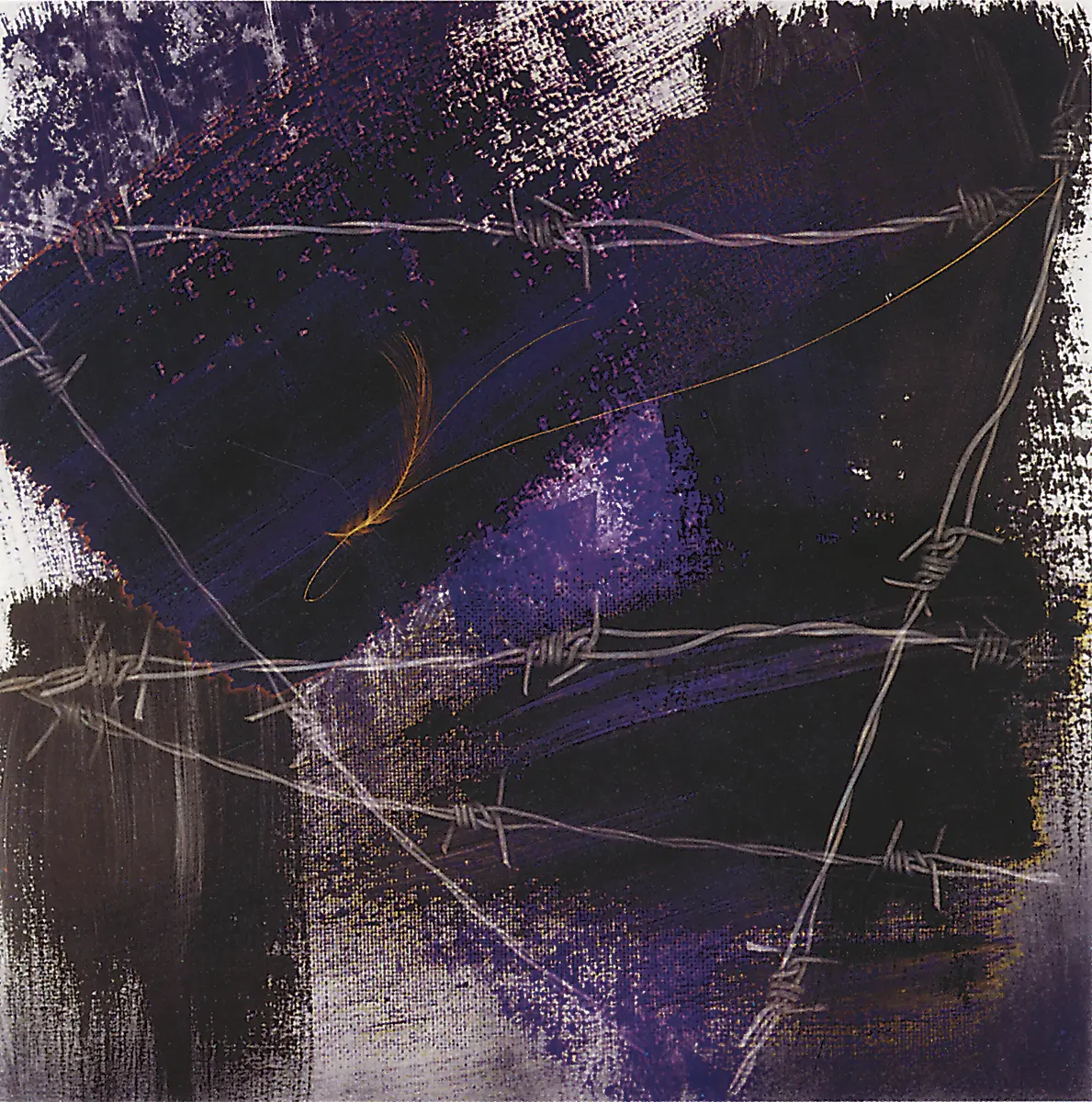
In this his first individual exhibition, Lozano gathers 16 works developed during the last three years, around the topic of human moods, under the title of Catarsis. Here, he allows himself to externalize moments and reflections from a private, very personal point of view, referencing his own experiences at the level of a relationship with others, musings about the immediate environment, and human behavior in general. This conceptual art evokes emotions and thoughts that are translated by the artist in visual terms —wide and raw brushstrokes; loose, almost childish tracings in pencil and pastel, breakages, twine, and points—, each one of them possesses a clear rational and/or emotional meaning. “That catharsis of my soul is completed by what the viewer is able to infer or feel in each painting.” This is why he didn’t place the titles of the works on the walls, seeking for viewers to appropriate each painting in a personal way, with intuitive appropriations. “Almost like those Rorschach tests used in psychology, where the viewer sees a blotch and, depending on their emotional state, infer something from it.”
One of the most compelling works in the show is comprised of a large ring on a 150 x 150 m canvas, in browns and reddish hues with strokes of different textures of pastel, charcoal, and watercolor. A segment of the circumference is traversed by barbed wire. The ring symbolizes the unending cycle of the routine, like the entrance to a tunnel with no light at the end reflected on the loneliness of a person trapped and tortured by his or her own loneliness, who can’t find a way to break with such a situation.
Another interesting work is a horizontal/rectangular format with a background of ochre, pallid textures, like the pages of an ancient book. On the bottom, the diffuse image of a rope that slowly comes apart is a swipe away by a brushstroke in several shades of red. For the author, it represents the painful, almost imperceptible process of the distancing of two people. Where the lack of communication and the fact that each pulls in their own direction inevitably break even the ties that seemed most solid.
In this way, Lozano begins to claim as his own some elements that become recursive in his work. Such as constricting and piercing objects (rope and barbed wire) and others that denote unease and a tortured spirit (thumbtacks, repetitive spirals, blunt splotches that highlight those minimalist objects against abstract backgrounds.) It is important to note that the stiffness of such a “clean” and the controlled technique produces a special contrast with the sensitive temperament of an artist very intent on understanding his psyche and the psyche of others, and who constantly wonders about our existence.
MARÍA JOSÉ RAMÍREZ