
As it has done for several years, Alcuadrado gallery selected an abandoned building as exhibition space and this time around invited Mariangela Méndez, a professor at the Universidad de los Andes’ Art Department, to curate the show. The site chosen was the old Santa Rosa clinic in Bogotá, recently donated to the Universidad Nacional to be transformed into a University hospital. The show made me think of two circumstances in contemporary art: the dynamic established between the work of art and the exhibition site —something that has been a recurrent motif in Alcuadrado’s shows— and the role of the curator.
A few days ago, Karen Cordero gave a lecture in Bogotá where she spoke of the emergence of new discourses in art and alluded to curatorship as discourse. Curatorship has a sui generis element, as it adopts tactics that are close to artistic work. I want to explore some aspects in the case of Sin remedio, which in turn will bring to the fore the relationship between the work of art and the site of exhibition.
Curatorship, in accordance with the procedures of contemporary art, acts in the field of meaning, in the field of the signified; one and the other are pointing things out. The former about the works and the problems of art, the latter about the world. Like art, curatorship operates in spatial, physical, objectual interventions; they are fully aware that the site of the exhibition isn’t always neutral, and in the case of this show, it certainly is not. In Sin remedio we encounter an art gallery that has been characterized for using spaces other than museums or galleries. The grand hall of a blighted hotel, an abandoned theater, or an unfinished museum on the verge of collapsing, all of them loaded with memory, have been among the sites chosen for Alcuadrado for its exhibitions. In contact with the art objects or interventions, these sites generate a relationship that says something about the place, and in turn, the place makes manifest something that is already in the work.
Mulling these, I approach the hospital selected by gallery and curator, which functions as exhibition site and also, we can say, as “conceptual framework” and framework for reference. Last year, María Elvira Escallón presented at the Museo de Bogotá her work En estado de coma, where she used photographic and video registers to reveal the conditions in San Juan de Dios, a perfectly functional hospital, considered part of the national patrimony and with all its resources complete, that was nevertheless closed and is now in disuse. A paradoxical situation in a country like Colombia, where thousands die for lack of medical attention. Sin remedio follows along with the same lines, with some important variations. As the curator notes, this situation generates doubt because the increase in the number of affiliates to the social security system is proportional to the number of hospital closings, due to bankruptcy, in the last decade. (…) Sin remedio is the display of this failed equation and the equivalence of two expressions: that suggested by a group of works of art that constitute themselves as an autonomous sphere of resistance, and that insinuated by the exhibition space: a quarantined hospital with all its furniture and equipment inside, a space loaded with history, a victim of a political illness, corruption, mismanagement, indolence; a symbolic space, suspended in time, waiting for a better future as University hospital."1
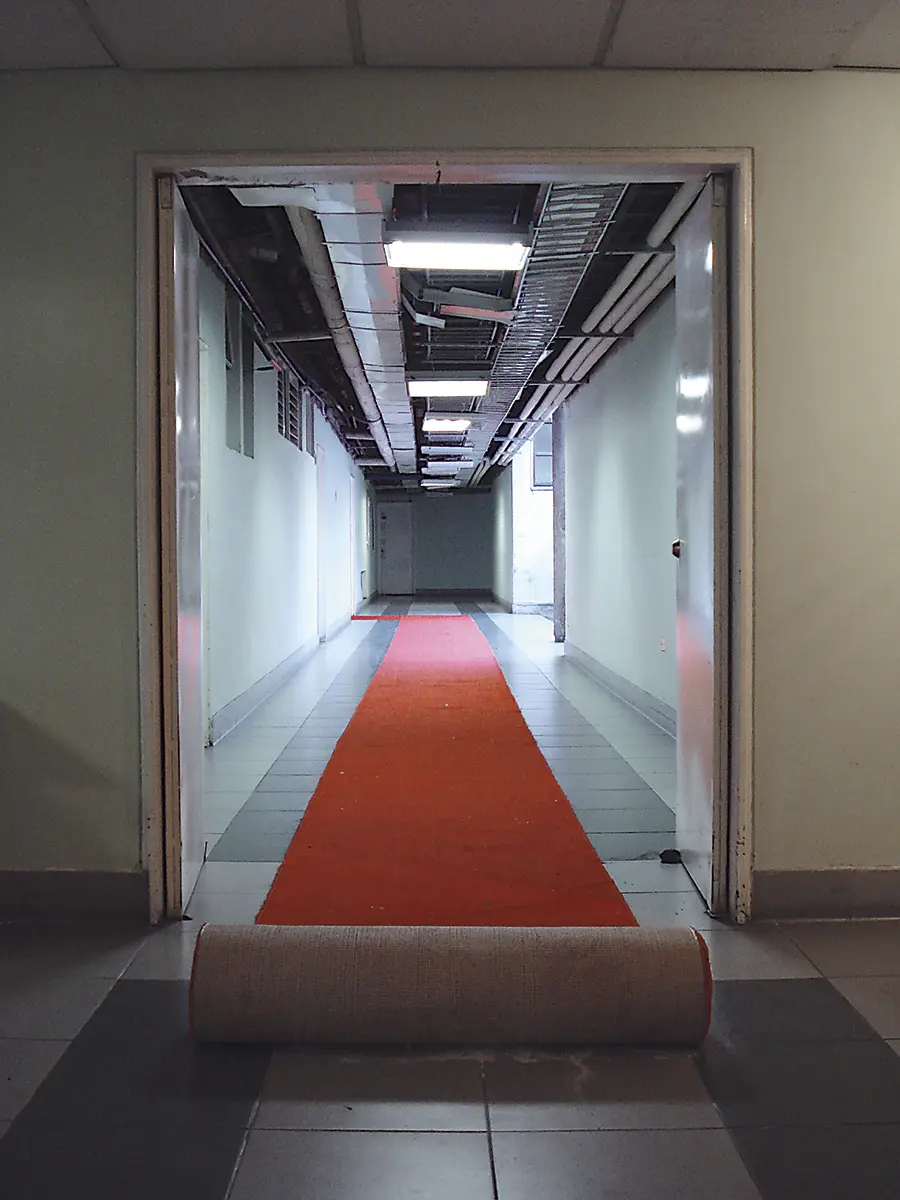
Most of the works presented predate the exhibition and behave, beyond the site, as “resistance to and critique of the current social and political situation.” Others were created on-site, but their placement was decided by the curator, who thus produced a path through a place that already had the meaning derived from Estado de coma. The first thing I saw when I entered this solitary hospital filled with wide, well-lit spaces and light-colored walls, clean but uninhabited, was Wilfredo Prieto’s red carpet leading to the room with the hospital’s water tanks, and I wondered about the subtle procedures of today’s art. This work, Alfombra y polvo, shows a ceremonious object. But this carpet is located in an alien place, an abandoned hospital, and within the context of art. As the curator says, with the artist’s gesture the carpet becomes a “metaphor for the superficiality of makeup and the rot that accompanies any power structure.” Besides the artist’s gesture, there is the gesture of Mariangela Meléndez, who greets us with this dusty red carpet. The water tanks, apparently intact, appeared as the inner parts of a temporarily paralyzed body.
Throughout my trajectory through the building’s four floors, I encountered the works one by one, among them Miguel Ángel Rojas’ video titled Borde de pánico (2003). This video had already been shown by Alcuadrado in a decayed site. This time, the curator chose a wall located at the end of a staircase leading to a basement; the size of the image and the darkened staircase gave it particular force; its dramatic and mysterious tone became all the more evident. The video shows a glove-clad hand that seems to trace on the pavement the remains of a body that expired on the street.
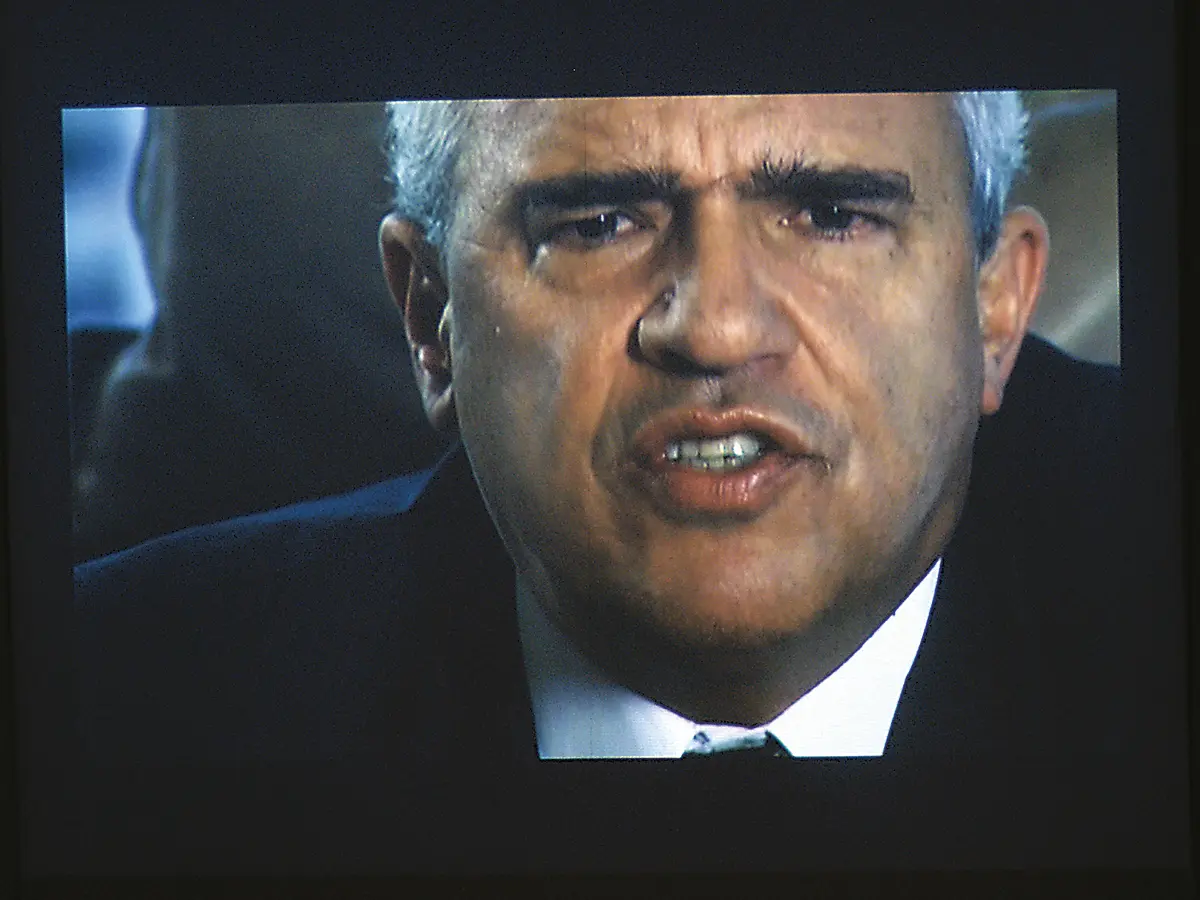
On a different floor was François Bucher’s La Raíz de la Raíz (Todo pueblo tiene su historia). This video, one of the show’s most lucid and pertinent inclusions, displayed former president Ernesto Samper giving a speech in 1978 when the issue of drug trafficking was first coming to the fore and the United States sought to eradicate marihuana plantations. As the curator note, Samper “prophesized with extraordinary clarity what was to happen to the country if the taboo of legalization wasn’t broken. (…) he pointed out at the time, with all precision, the lost cause of confronting the problem as if it were a ‘war.’ All the arguments he made in his lucid discourse remain irrefutable. (…) What has changed is the progressive sanitization of the topic. The paradoxes of life forced Samper himself to have to deal with the consequences of what he had glimpsed on the horizon.” The resonances of this work are dual, in what we just said and in the fact that Ernesto Samper received medical attention at the Santa Rosa clinic after an attack that took the life of José Antequera, presidential candidate for the UP.
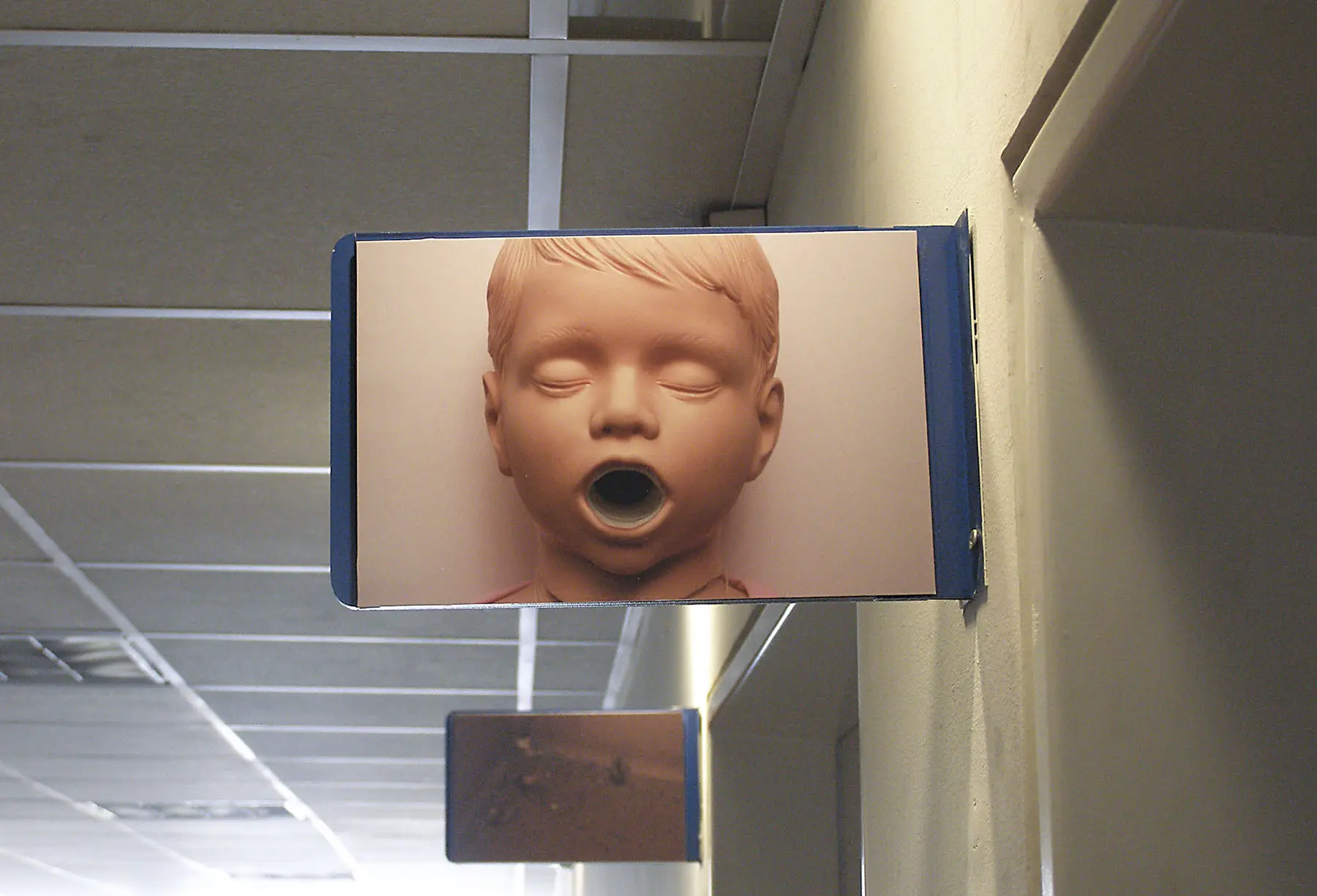
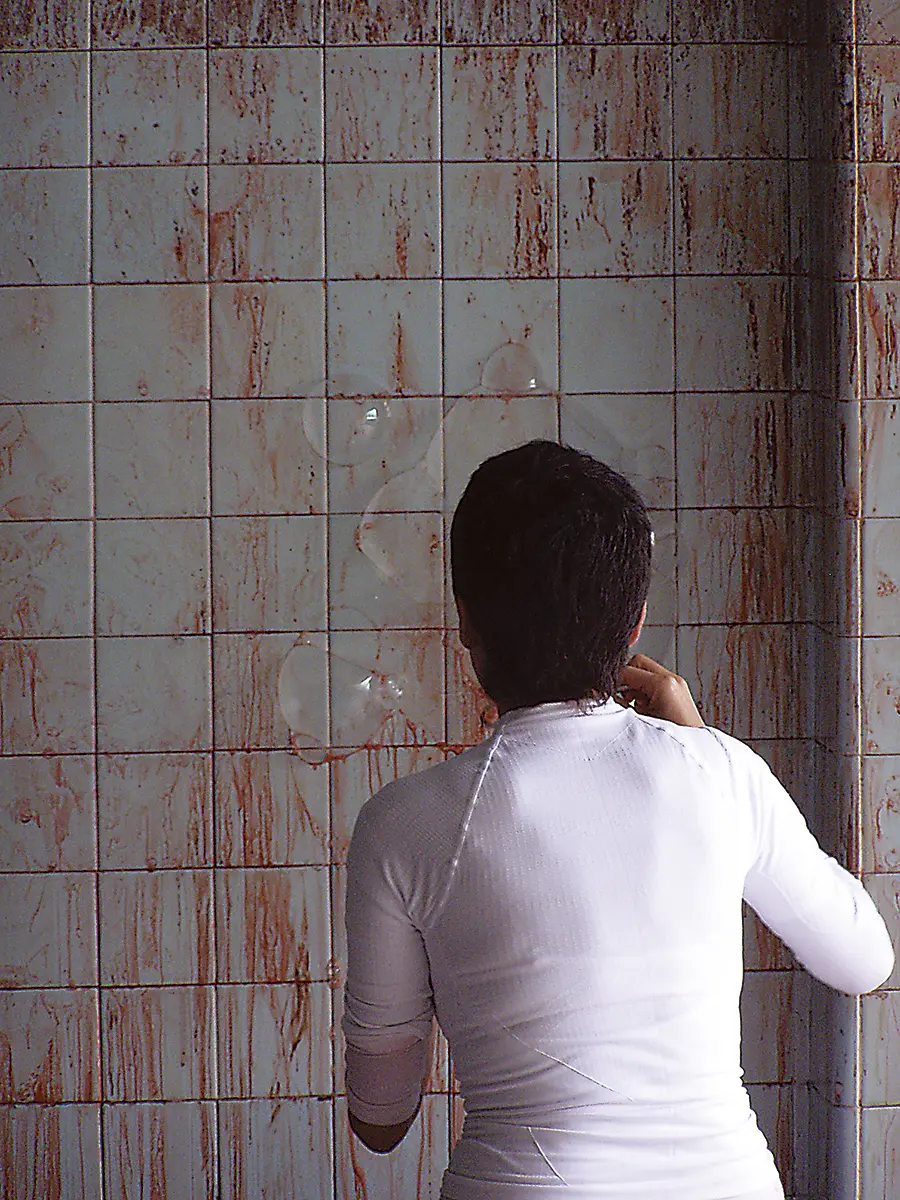
I also encountered Alberto Baraya’s Árbol de Látex, a print on latex that gathers the traces of a giant rubber tree that, like a body wounded by the abuses of the rubber industry’s big concerns, attaches itself to the hospital’s walls. In one hall we heard the sounds of the city, the peddlers offering a Remedio (Remedy), the title of one of Jaime Ávila’s works; advice against unhappiness sold in the form of a CD. On a hallway were Juan Fernando Herrán’s photographs, Itinerario, showing an impressive handcrafted staircase used by the inhabitants of marginal areas located in Bogotá’s cold hills. In one room I found myself before a column of archival paper, unusable but adorned with gilded edges, and with the pieces of a bed that is never set up, by Néstor Gutiérrez. Reaching one of the site’s floors, in another hallway I found an enormous fractured glass, Óscar Muñoz’s Ambulatorio. On a different spot, on the hospital’s greenish wall, a drawing also by Muñoz insists on making a vanishing face appear; it is titled Proyecto para un memorial. On the third floor, on each door, instead of plaques identifying the room number, I found a child riding a tricycle through a place filled with discarded furniture: Buro, by Miguel Ángel Rojas, made specifically for that site. At a different point, I found myself inside an operating room; a red liquid dripped down its greenish majolica walls, giving the space a macabre aspect. After a while I saw María José Arjona, dressed in white, cleaning those stains with soap bubbles. Her work, titled Retorno, initially emphasized drawing with those bubbles, but was adapted especially for the site and acquired a particular meaning. “The blood that enters the heart is blood as it exits so that the colorless soap bubbles will erase the drawing, while the white dress, a metaphor for the body, absorbs it. This second stage of the action is a state of clarity and health where the color red coming down the walls, and which is symbolically blood, returns to the body to allow healing.”
A special path was determined by María Elvira Escallón site-specific installation Recelaron del cielo que no se divisaba por ninguna parte, a particularly meaningful work because the artist and curator generated an act of memory that closes the show and gives it, along with Escallón’s oeuvre, a especial meaning. This work occupied the stairs leading to the fourth floor, and its walls were painted in an intense shade of red that determined a precise trajectory through the body of the building. “Metaphor of an organic duct,” the curator says, “that functions as a circulatory system, connecting the pulchritude and order of the first, second, and third floors with the chaos and disrepair of the fourth.” On each floor, we found quotes taken from José Eustasio Rivera’s La Vorágine, from which the title of the show also comes.
In the installation, as in the novel, directionlessness, despair and anguish grow as one moves forward. On the first floor, we read: “Clemente led the way, breaking branches in the underbrush to signal the route, as is the custom among hunters.” The start of this journey is filled with hope, as one begins on a trail that offers the possibility of returning. In the first three floors, the hospital atmosphere is strange due to its loneliness; on one of its impeccable walls we saw María Elvira Escallón’s video Señales para caminantes, where an invisible hand carves, with a chisel, the well-known dictum: “You are dust, and dust you will become.” One floor up there is another work by the same artist, from Estado de Coma. Its title is Tejido blando, an image built on the basis of photographic segments of close-ups of bedsheets and mattresses that preserve the traces of bodies that rested on them. In the same way, in the intact, desolate hallways one missed the steps of doctors and nurses; instead of them, what we had were the artist’s works, making the silence more audible.
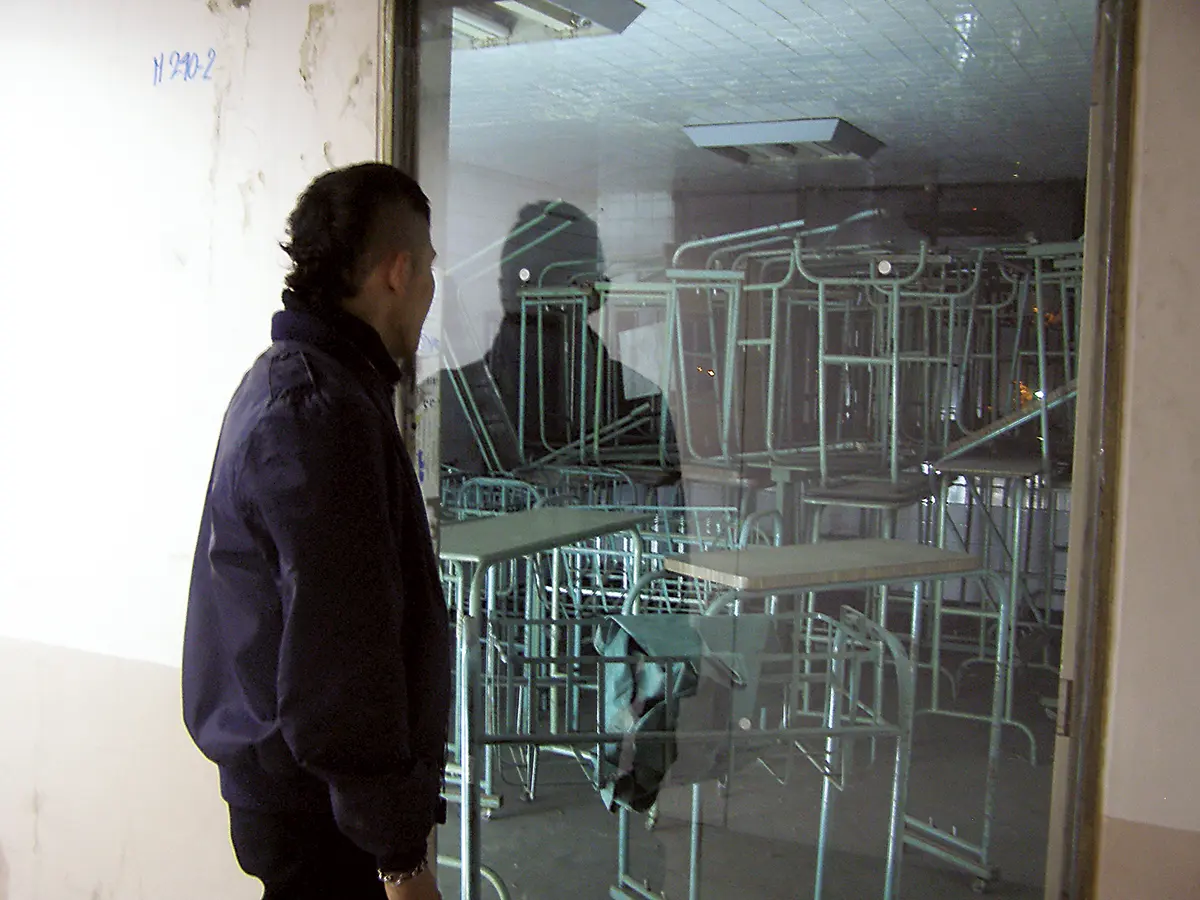
But at a certain point, when the men are in the middle of the jungle, the confusion is total: “Three times in one hour he came to the same swamp, but his comrades didn’t recognize the route. Focusing all of his being in his power of recollection, looking inside his brain, he remembered the map he had studied so many times in the Naranjal house and saw those winding lines resembling a network of veins… How great the difference between a region and the charts that reduce it! Who could have told him that that piece of paper, which his own open hands covered almost completely, contained such infinite spaces, such dark jungles, such lethal quagmires!” We have reached the hospital’s fourth floor, where the chaos is complete. The walls are not clean, and there are large amounts of medical equipment piled up everywhere. Cradles, bedframes, surgical equipment, tables, chairs are covered in dust. Neglect and disorder reveal a “dark and lethal” universe. It is at this point that María Elvira Escallón, encouraged by the curator, goes back to a gesture she first developed with her In vitro for the 7th Regional Artists Salon in 1977, held in the old savannah train station. It was and remains an effective gesture. On that occasion, Escallón placed a glass sheet in place of a door, pointing out the disorder, the state of ruin of a train station that, like many, is beautiful and evocative; that place had been selected by the Salon’s organizers as a site of memory.
This time around, María Elvira Escallón proposes an identical gesture, and with the same intention places a piece of glass at the entrance to these rooms, transformed today into densely packed warehouses. Memory is immediately activated, we remember that the story is not new, that it is like an endemic ailment coursing through our institutions. There is no judgment in this gesture; it is a silent, neutral yet effective act that allows us, as spectators, to see. This timely and clarifying return was a forceful closing for the show, which started on a red carpet and ended with a precise statement and makes us understand with greater clarity that Sin remedio speaks of the many sicknesses afflicting this country, Colombia.
NOTES
1. This and all other quotes from Mariangela Méndez were taken from the texts that accompanied the show.
MARTA RODRÍGUEZ