
During July and August the Y Gallery in Jackson Heights, Queens presented a new project by Mexico City-based artist Teresa Margolles titled Operativo. Installed in two consecutive parts, part one consisted of a series of texts about drug violence in Mexico inscribed inside and outside of the gallery and part two of an abstract painting made by soaking a canvas in the blood of a murder victim. Like most of Margolles’ work, Operativo deals with the physical residues of death. In this case, Margolles specifically addresses the violence that afflicts communities in Mexico caught in the grip of drug trafficking. As is often the case in her work, much of the power of Operativo hinges on seducing her viewers with the beauty of minimalist forms and then, upon closer inspection, shocking us by revealing the gory sources that have generated these forms.
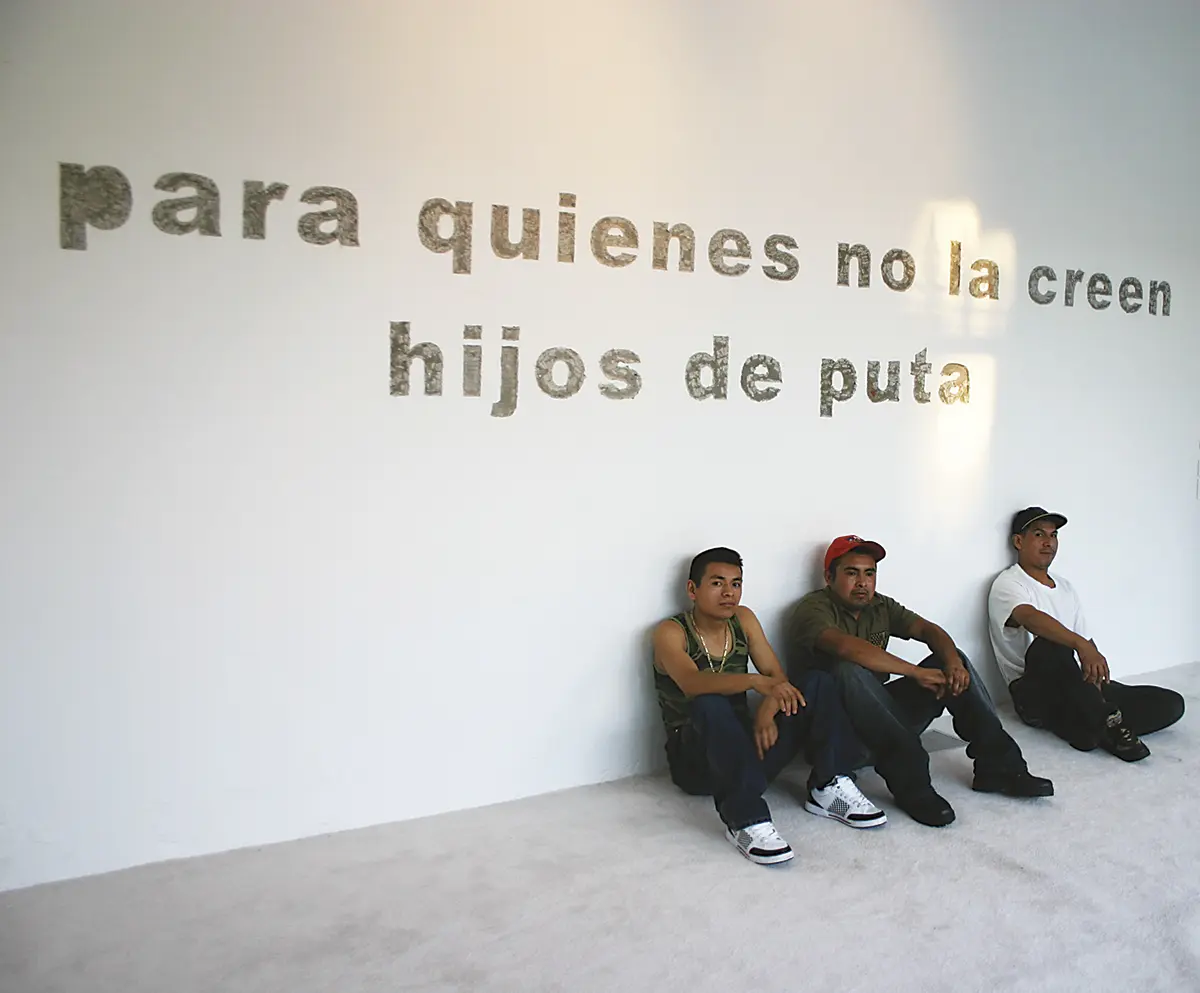
In the first installment of Operativo, two groups of texts were installed both inside and outside of the gallery. Outside, Margolles affixed quotes from the media about the rise in drug-related killings since President Felipe Calderón’s election to the surface of the gallery’s large plate glass window. In white vinyl letters, one quote from a May 2008 article in the Mexico City paper La Jornada read, “Within 18 months of management under Felipe Calderón Hinojosa, there have been 4,400 executions committed: 2,794 from January to December 2007, 1,250 from the first of January until the twentieth of May of this year.” Through the plate-glass window, the entire gallery is visible. Margolles painted its walls and ceiling a pristine, clean white and covered the floor in plus white, wall-to-wall carpeting. Through the window, we can also read a phrase that has been inscribed, inside, onto the back wall of the gallery: “para quienes no la creen hijos de puta.” The English translation, “those who don’t believe are sons of bitches,” doesn’t really convey how provocative the phrase “hijos de puta”—boldly visible through the gallery’s window—would be to Spanish-speakers passing by the gallery. Designed, in effect, to pull people into the gallery space. When we enter the clean white interior, we learn that the text has actually been chiseled into the wall and that it is the “message” that drug dealers left on a murdered corpse found in the Ecatepec neighborhood of Mexico City.
For the second installment of the exhibition, Margolles removed the texts from the window and gallery wall, replacing them with a single painting. Placed on the center of the back wall of the white gallery, the perfectly square, approximately 5 by 5-feet canvas was also clearly visible from the street through the large plate glass window. Viewed from a distance, the painting looks like an abstract modernist composition; diagonal shading, expressive marks, and subtly graduated lights and darks endow the painting with a sense of movement and depth. These effects bring to mind the sublime beauty of J.M.W. Turner’s ocean scenes or nineteenth-century landscapes. But upon closer inspection--by reading the wall text and looking more carefully at the surface of the canvas—we realize that we are looking at a canvas that has been soaked in the blood of a murdered body. Pintura de Sangre (Painting of Blood), we are told by the wall text, is a “canvas submerged in a pool of blood” from a murder that occurred on a street corner in Cuilacán in Sinaloa, Mexico. With this information, the painting assumes a gory character: the canvas begins to look like the color of skin, and we realize that the painting’s beautiful abstract effects are made by bits of clotted blood on the surface of the canvas. The painting itself also takes on a corporeal quality. The bits of string Margolles decided to leave hanging from the center of the bottom edge begin to look like entrails or a tail. It is creepy and disquieting.
Operativo is, in many ways, tougher and more overtly political than the other major work by Margolles that has been shown in New York: Vaporization, an installation in which Margolles filled the gallery with a mist made from water used to wash corpses the Mexico City morgue, which appeared in PS1’s group show Mexico City: An Exhibition about the Exchange Rates of Bodes and Values in 2002. In Operativo, the United States and its endorsement of Calderón’s presidency is implicated in the violence, and, in one text, Margolles specifically reminds us that most of the weapons used in these murders come from the United States. Though, as in Vaporization, Margolles also seduces us with a beautiful aesthetic experience. But, the politics of death are more apparent here, as we are asked to consider how politics and corruption contribute to the astounding accumulation of bodies that have recently died drug-related deaths in Mexico.
HARPER MONTGOMERY