
For five weeks, the splendid main space of the recently opened Patricia Ready Gallery, in Santiago de Chile, presented twenty works by Colombian sculptor Teresa Sánchez (Santa Marta, 1957.)
With a solid trajectory behind her, this sculptor uses wood as her material. In the nation’s visual arts, sculpture in wood is not too common. Teresa Sánchez started painting flat colors on agglutinated wood, using a strict geometric language. Her education had been directed more towards painting than towards three-dimensional expressions. She now works the wood as a whole: shape, color, texture, content, and meaning. Her woods come from tropical or sub-tropical forests: walnut, cedar, marble tree, mahogany, amarillo, each with their own characteristics of hardness, fiber, and color. And her language is connected to organic forms, non-representational, non-mimetic but suggestive of the plant world. Wood, coming from that world, responds magnificently to those preferences and determinations.
From the original drawing to the final work, the chosen plank is gradually configured thanks to a painstaking work of direct carving using chisels and planes. Feeling the wood in process, touching the evolution of the progressive cuts, is indispensable to her. Her hands are the “eyes” that develop the idea through its final materialization.
On the basis of their spatial disposition, the works in this show, titled Volúmenes lineales, can be grouped into three sets: mural relieves ungrounded sculptures and suspended sculptures. As soon as these categories are established, we realize that, as a whole, these sculptures refer to and determine the entirety of the exhibition space: walls, floor, and ceiling, the planes that constitute it. Perhaps because of this, the show’s spatial coherence is out of the ordinary. A well-aired arrangement, capable of giving each work value without losing the thread of the whole, successfully combines with the gallery’s volume in a dialog that resolves as mutually beneficial: the sculptures live, and the exhibition space is magnified. The large parallelepiped contains Teresa Sanchez’s delicate carved works like a jewel case. Works that simulate a graphism, spatial writing, qualifying the space and giving it its own vital energy.
Perhaps the most unusual sculptures are those suspended from the ceiling. With over five meters in height in the gallery’s generous volume, the artifice of suspension almost disappears. The sculptor calls them Péndolas, and they are comprised of three elements or singular pieces. They are longitudinal, vertical volumes ending on a fuller shape that contains the sculpture’s weight and (visual) fall. More or less clear referents in the art field: Calder or Soto. In the natural world, some seeds, such as those of the mangrove. Referents, yes, but a language entirely of her own, where the dedication to molding and polishing wood produces results of stirring beauty. Teresa Sánchez seeks a formal essence that will connect us to the transcendent. And this is her magnificent achievement.
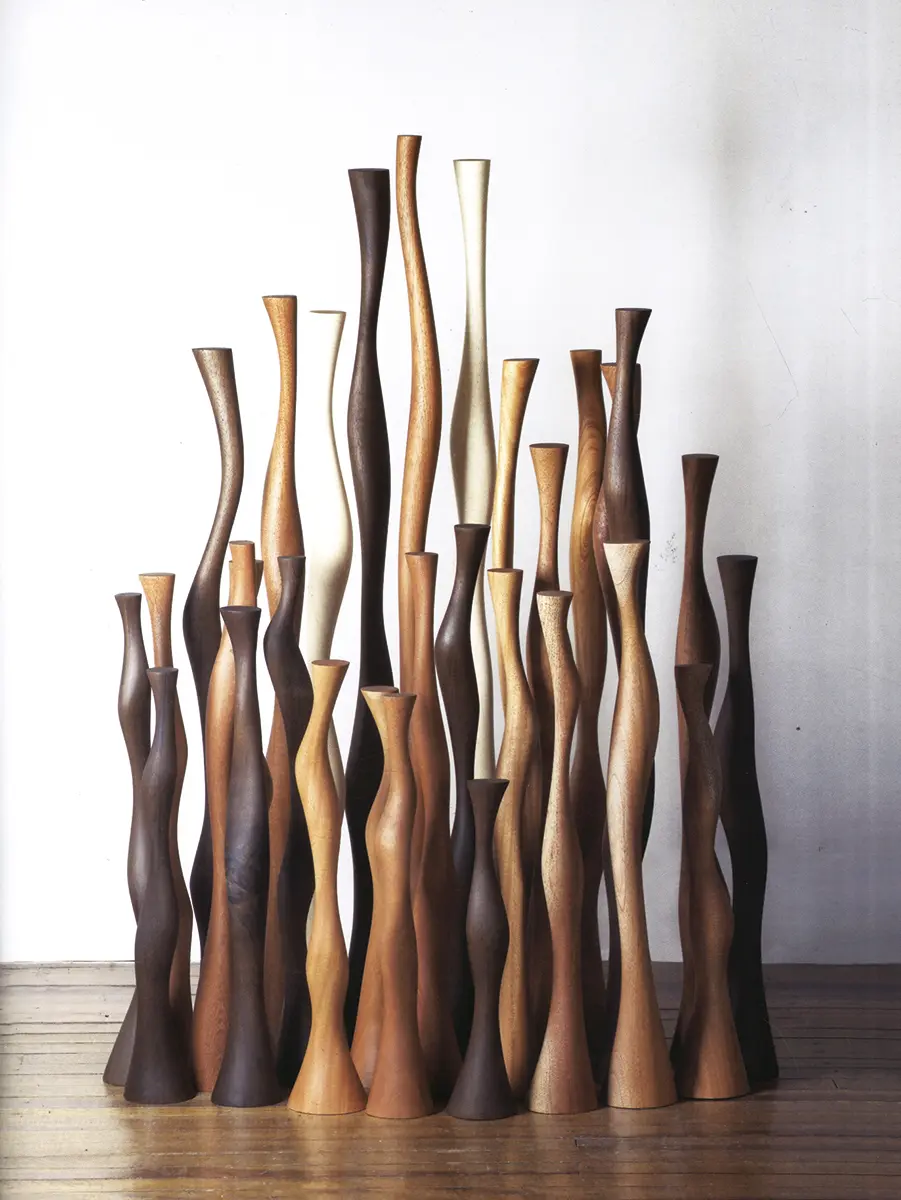
The groundless works rise from the floor, without a base. They rise because they really seem to emerge, like some sea algae do, from a bottom towards open space.
The undulate as they grow, but never lose their balance. Two sets, one very rich (some thirty elements) and another one comprised of three pieces, exemplify this category. If the Péndolas hang, emphasizing a descending verticality, these works surge in the opposite direction, generating a sweeping visual dialog.
The mural works also present a variety of morphologies. They can be a single element, like a large stroke barely attached to the supporting wall. They can be the result of a coupling of several, perfectly adjusted elements (Acoplamientos and Ríos belong in this category,) or they can comprise several related yet differentiated elements.
Every so often, the artists combine two kinds of wood, adding unexpected chromatism to her works. The lightest one, marblewood, opens of closes works like the triptych Agujas, or focalizes a point of equilibrium in an untitled piece formed by five elements carved in walnut.
Sanchez’s mural works sustain an active dialog with the suspended ones and with those that rise from the floor. The common trace is the curve, single or multiple, in an arch or in a multiplicity of waves.
The single works, almost all of them arranged horizontally, come the closest to expressive calligraphy. It is tempting to see them as close to a linguistic structure: a subject and a predicate. Everything contained between the punctuation signs we know in grammar. a large arch or a wavering line builds the phrase. A beginning and an end appear, depending on the viewer’s gaze, with a thicker volume in the same wood or in a different one, coupled to it. Some works signal their extension in space. Others complete their message by creating a circular reading.
The composite works suggest, in an almost natural way, music. A diptych, with two wavering lines, takes us to the idea of duets. The Ríos, to polyphony. Teresa Sánchez is able to tame her material, wood —so rigid in itself—, to achieve an incredible subtlety of perfectly coupled curves. The exhibition leaves us with profound aesthetic emotion.
MARÍA ELVIRA IRIARTE