
There are few artists working today who combine conceptual rigor, dry wit, art historical commentary, and meticulous devotion to the purely visual with the same degree of sophistication as Vik Muniz. His current exhibition at Sikkema Jenkins demonstrates a continuation of thematic preoccupations that have been present throughout his career while also revealing a new direction in his art.
Titled Verso, this exhibition relies heavily upon the practice of appropriation, which is more limited or cynical hands can easily become an overworked strategy. In this show, Muniz presents a series of quotations of well-known masterpieces. The twist, in this case, is that the reproductions are the backs of each work of art. Working in cooperation with the conservation departments of The Museum of Modern Art, the Guggenheim Museum, and The Art Institute of Chicago, Muniz and a team of craftsmen, conservators, restorers, and self-professed “forgers” fabricated a collection of authentic reproductions of the backs of such works as Les Demoiselles D’Avignon, Starry Night, and Sunday Afternoon on the Island of La Grande Jatte. Theoretically, paintings but in fact mixed-media sculptural objects, these works (which have also been referred to as “three-dimensional trompe l’oeils”) confound the viewer’s expectations despite their seemingly straightforward natures.
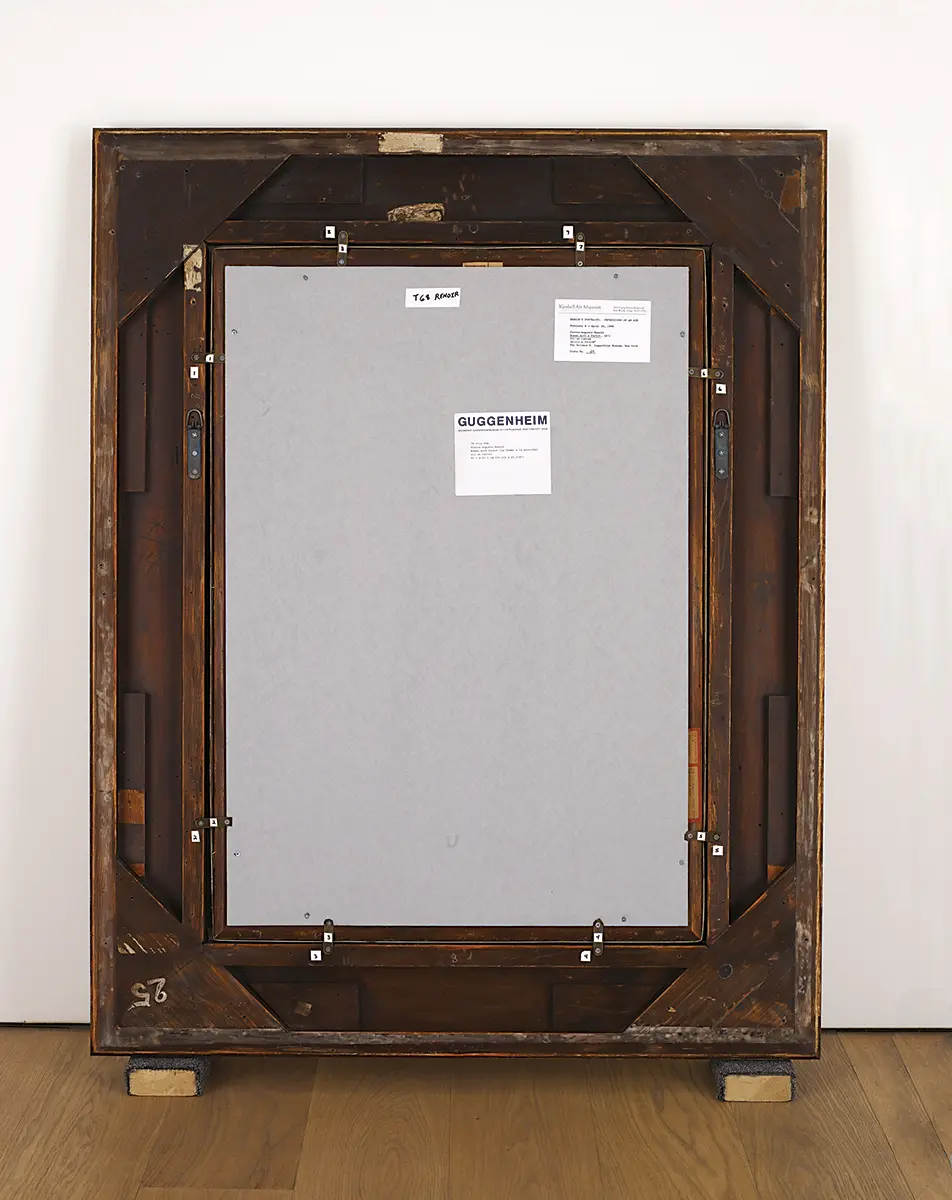
These works were created at a 1:1 scale and are faithful to the last detail. Faded labels, torn bits of tape, chalk and ink marks, and little nicks in the wood are all present and accounted for. These works show the parts of the paintings seen by the rare few: the art professionals whose jobs are to catalog, conserve, or tell the history of each piece. The difference between the way the institution or professional looks at the work of art and the way the general public sees it is thus brought into sharp relief. The illusionism evident in this show is utterly compelling, and even the manner of installation adds to the illusion: the works are propped against the wall, sitting on wood blocks on the floor, as if about to be hung or recently taken down. A visitor could swear that there is an actual painting on the other side of each canvas, and the tease of a possible glimpse of that painting suggested by the slight space between the work and the wall verges on the frustrating.
Seeing Muniz's work in a three-dimensional, object-oriented format may seem unusual to viewers who have been following his career in recent years when his artistic output has relied on a more graphic mode of presentation. In fact, with this new endeavor, Muniz revisits some of his works from the past, such as the early neo-realistic sculptures or the institution-based works like his photographs of the floor of the old MoMA building that was cropped and titled to resemble and reference Steiglitz’s Equivalents series.
Muniz is not the first artist to make art about art or to reveal the (infra-) structure “behind” the masterpiece. Roy Lichtenstein, among others, has made paintings of the back of paintings, Richard Artschwager has fabricated a series of sculptures that look like art packing crates, and Jeff Wall has made a mural-sized photo lightbox of a diorama undergoing restoration. However, Muniz is a rare example of an artist who invests as much time in the craft of the object as in its concept. This fact is often overlooked when one considers his art, particularly since so much of it has relied upon photography as its main vehicle of conveyance, which creates a sense of detachment or removal from the object that was created in the first place (a chocolate drawing, a spilled-sugar relief). In a perverse twist, by overstating the objectness of each artwork, he evokes a kind of romanticism as we conjure the “missing” image and reflect on each painting’s history, travels, and age, and our own histories in relation to it. By exposing the backside of each work, Muniz manages to reify its iconic status (oddly enough, only the Grande Jatte seems somewhat diminished—literally smaller—by this process). We are also forced to look at a set of visual elements that we would ordinarily disregard as inconsequential minutiae. These minutiae are now the subject matter of the work and reveal how each object lives on.
Muniz performed a similar process with a set of photographs from the New York Times archive at MoMA, reproducing the backs of the photos. As objects, these are less engaging than the backs of the paintings since they all hang on the wall and have uniform frames and dimensions. However, the network of stamps and labels that occupy these “backs” give the photographs entirely new identities as collages—all the more intriguing, perhaps, due to their unintentional nature.
JOHN ANGELINE