
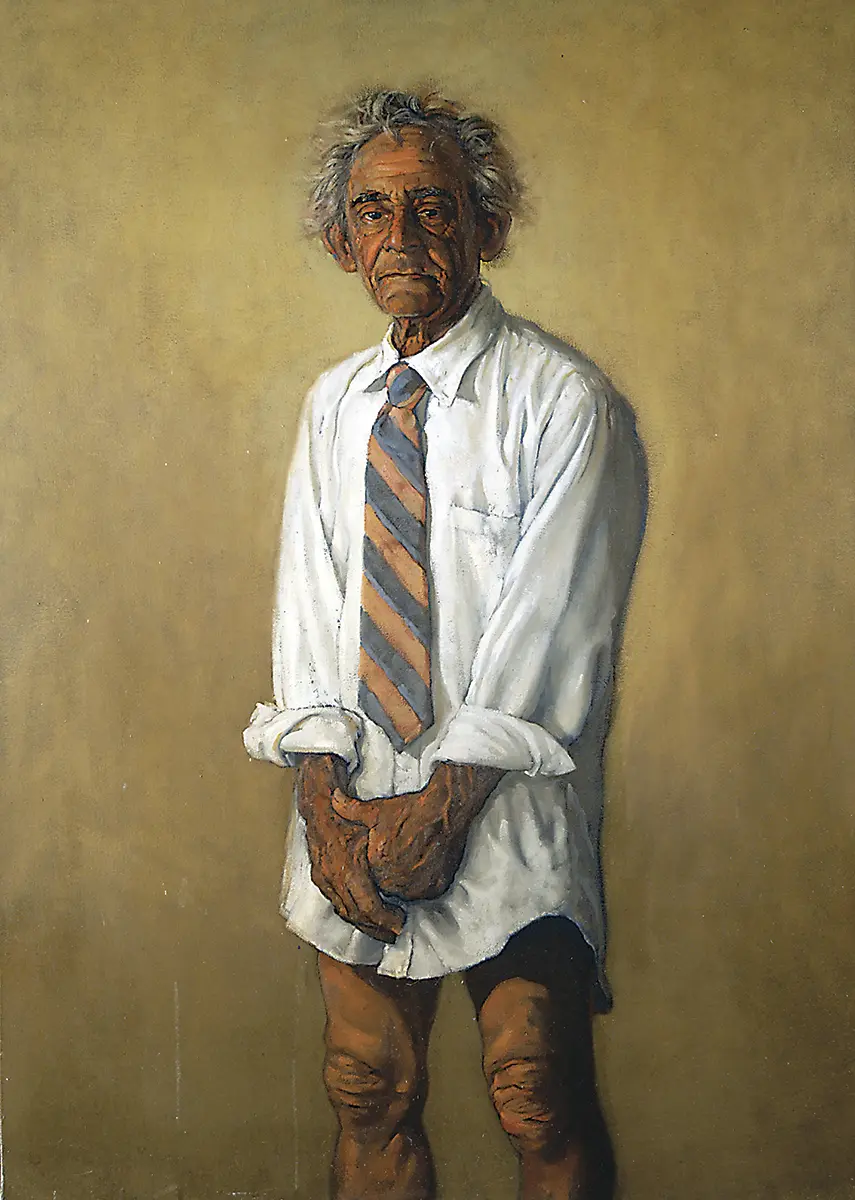
The directors of the Eighth Panama Art Biennial, Walo Araújo and Monica Kupfer, wanted to “bring the biennial out of the museum.” To achieve that, they organized an impressive program of exhibitions and parallel activities in different parts of the city, including a film series, a photographic exhibit, and academic events around the central topic, as well as an exhibition of works by the Panamanian artist Brooke Alfaro, who has returned to painting after almost a decade.
The central exhibition presented novel experiences. Magali Arriola, the curator of “El dulce olor a quemado de la historia,” the only thematic show presented so far by the Panama Biennial, wrote in the exhibition text:
The old Canal Zone, at once a military preserve and a colonial settlement managed by a private enterprise exists today as an apocryphal memory, filled with nostalgia for those who occupied its land, and also as a geographic phantasm embodying the vestiges of Panama’s colonial and postcolonial history. Ten years after sovereignty in the Zone and the Canal’s operation reverted to Panama, the Eighth Panama Art Biennial will have as its thematic axis just that demarcation, hoping to promote an exchange between the country’s recent history and contemporary artistic practices.
It is well known that General Omar Torrijos used to say, “I don’t want to enter history; I want to enter the Canal Zone.” What is perhaps less well known is that, after the historic signing of the Torrijos-Carter treaty, the General refused to join the official delegation that entered the just-reverted Zone territories on the night of October 1, 1979. He was convinced that there was still much to do to liberate Panama from the yoke of the American presence on its soil. A man of conviction who, according to Graham Greene, who possessed the charisma of desperation, Torrijos was rumored to have planned a covert operation codenamed “Burning Smell” to blow up the Canal if the treaties were not ratified. They were ratified, however, and today, from the reverted area, “the burning smell of history” gives way to an investigation of the conditions under which Panama’s political history and its cultural imagination have infiltrated the territories of the old Zone, and, in turn, to an evaluation of the way in which the echoes of its vanishing can be felt beyond Panama’s history and society.
Thanks to Arriola’s apt selections, this complex, transcendent, and delicate topic was returned with renewed strength to the domain of art. And not only local art; another novelty for this eighth biennial was the inclusion of artists who are neither Panamanian nationals nor residents. Moreover, most of the artists were foreigners (ten out of seventeen invited); the objective was to position the political and aesthetic debate and the biennial itself in the international arena, as well as underscore Panama’s condition as a crossroads.
In her text, the Mexican curator suggests that the old U.S. enclave and military complex still preserves its boundaries in the collective subconscious, like a specter that refuses to disappear. This is true. At the same time, the challenge of integrating huge rainforest expanses and vastly different architectural groups into the chaotic Panamanian metropolis persists, especially now that the city is suffering a vertiginous process of development.
Regarding the show’s title, it seems that Arriola limited herself to reading the mythographers of the dictator Omar Torrijos. That “man of conviction,” who was devoted to sacking the country along with his accomplices and squashing any dissidence, was a notorious coward before his rise to power. He loved to party in the Canal Zone; that’s where he was found, drunk and panicked, on October 11, 1968, the day of the military coup that he didn’t have the courage to lead but ended up perpetuating. On the other hand, it was not a rumor that he planned to destroy the Canal if the treaties were not ratified: it was one of Torrijo’s many boasts, launched on the national airwaves no less. It is no secret that Torrijos enjoyed the economic and political support of the United States, like so many of the period’s tyrants. Also, the return of the Canal was an urgent need, and thanks to the dictatorship, the treaties were more favorable to the United States. It might smell like burning, but that part of our nation’s history is not sweet in the least.
These central notions of the curatorial premise did not force the content of the show, however. In fact, the best work on exhibit put these notions on the table and, in a way, contradicted them.
One such work was Introducción a la teoría de la probabilidad by the New Zealand artist Michael Stevenson, an ironic video filled with double entendres and brilliant, unexpected associations. Its narrative and conceptual poles were two books by the extravagant and paradoxical José de Jesús Martínez, a poet, essayist, airplane pilot, college professor, mathematician, and devoted bodyguard to Torrijos.
The plot of Stevenson’s video had multiple angles, but it centered on a chapter of Martínez’s panegyric Mi general Torrijos that tells, with equal doses of cunning and candor, the petite histoire of the asylum given the Shah of Iran by the Panamanian dictator and the Shah’s brief sojourn on the island of Contadora between 1979 and 1980. (The Shah has been a recurring obsession for Stevenson and the source of some extraordinary works in recent years.)
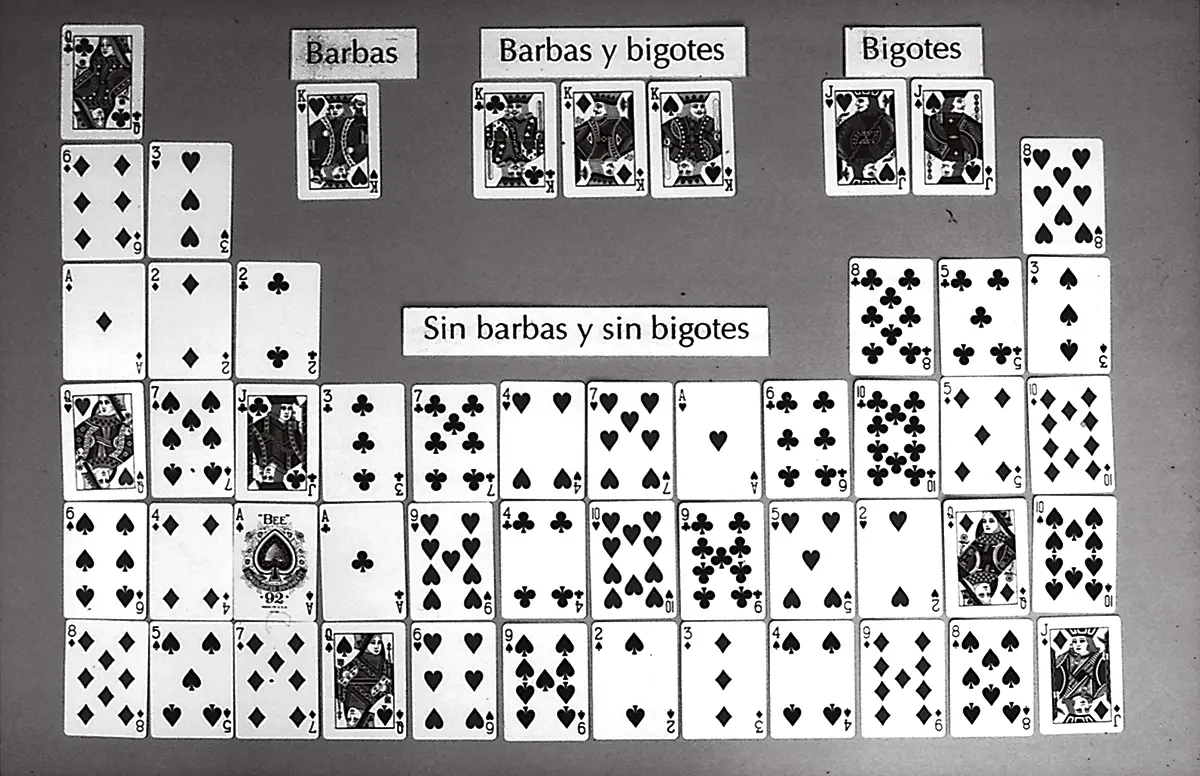
The second book by Martínez, from which Stevenson took the title for his video, explains the law of probability, and constitutes a kind of meta-narrative, establishing “logical” symmetries between the events told and the mathematical principles of probability. It also formed the visual the skeleton of the video: the mise en scène (basic black-and-white and a bit unsteady) was a loop that began and ended with the first and last pages of the book, intercutting sections with scenes of hands distributing several decks of playing cards.
For almost a half-hour (which passed quickly), a smooth, off-camera female voice wove history, legend, anecdote, mathematics, conspiracies, and geopolitics. As usual in works by Stevenson, known as “the anthropologist of the avant-garde,” the complex range of historical, socio-economic, symbolic, and even random relationships around polemic characters and events was built on the basis of painstaking research. His installations and videos open a wide array of interpretive possibilities for the viewer.
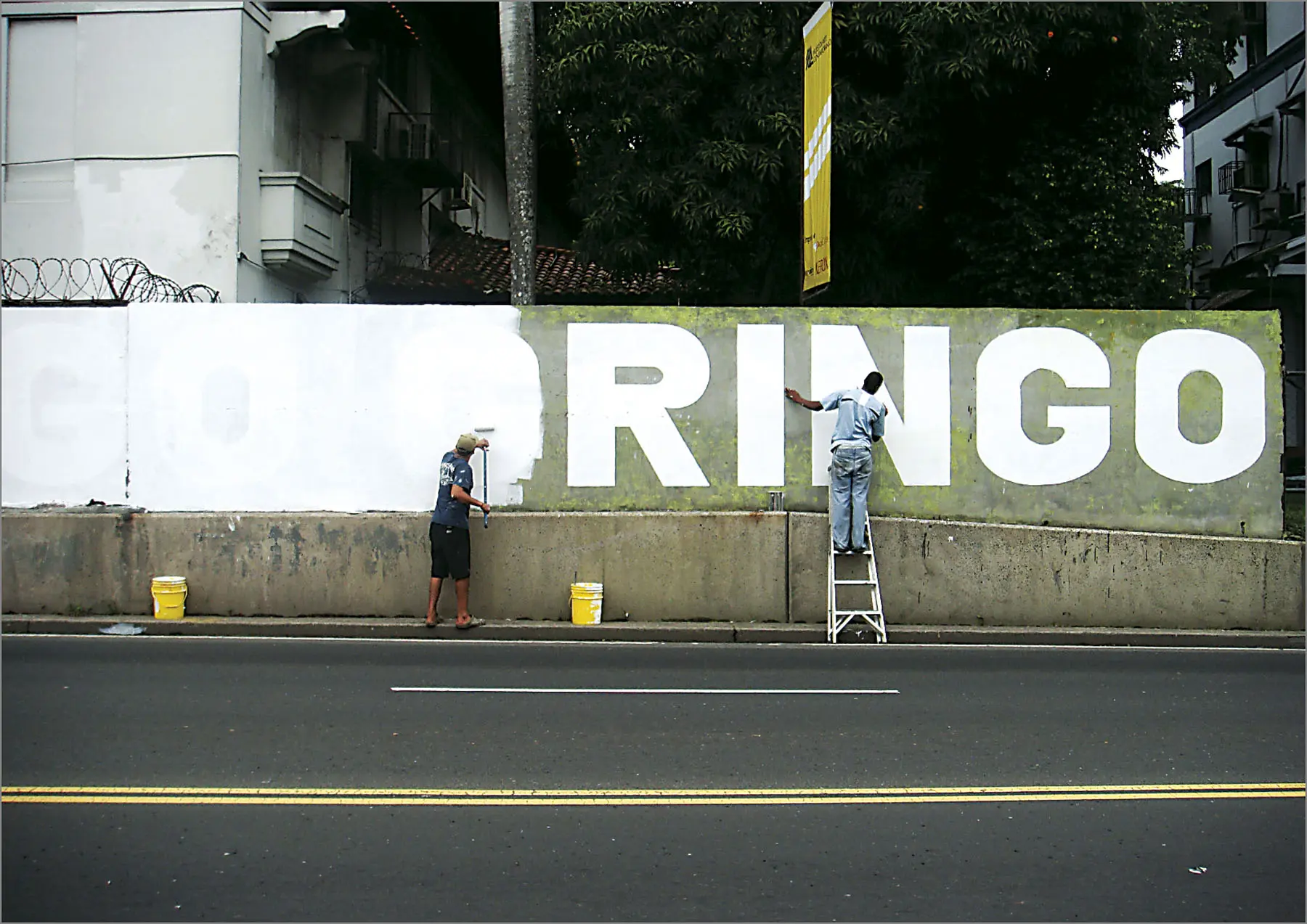
The remainder of the exhibition had bright moments here and there. Not too far from the Museo de Arte Contemporáneo, precisely at the border that separated the Zone from Panama City, Jonathan Harker painted a wall with the phrase “Home Go Gringo,” an inversion of the famous slogan. He covered the phrase entirely with a layer of more ephemeral paint, which allowed it to be read-only with difficulty and at certain times of the day but progressively faded to reveal the words underneath. It was “a phantasmagoric touch that [fit] well with the memory of the Zonians that inhabited [the Zone] and with the collective imagination of the Panamanian people, who until not too long ago lived on the other side of their borders,” explained the artist. Harker was not the only one to build a work of art beyond the exhibition’s site and calendar. The celebrated Belgian artist Francis Alÿs, who for many years has been fascinated with the past and present of the Canal, confirmed his visit to Panama in late October. Moreover, Aurélien Froment from France and Joachim Koester from Denmark conceived works exclusively for the catalog.
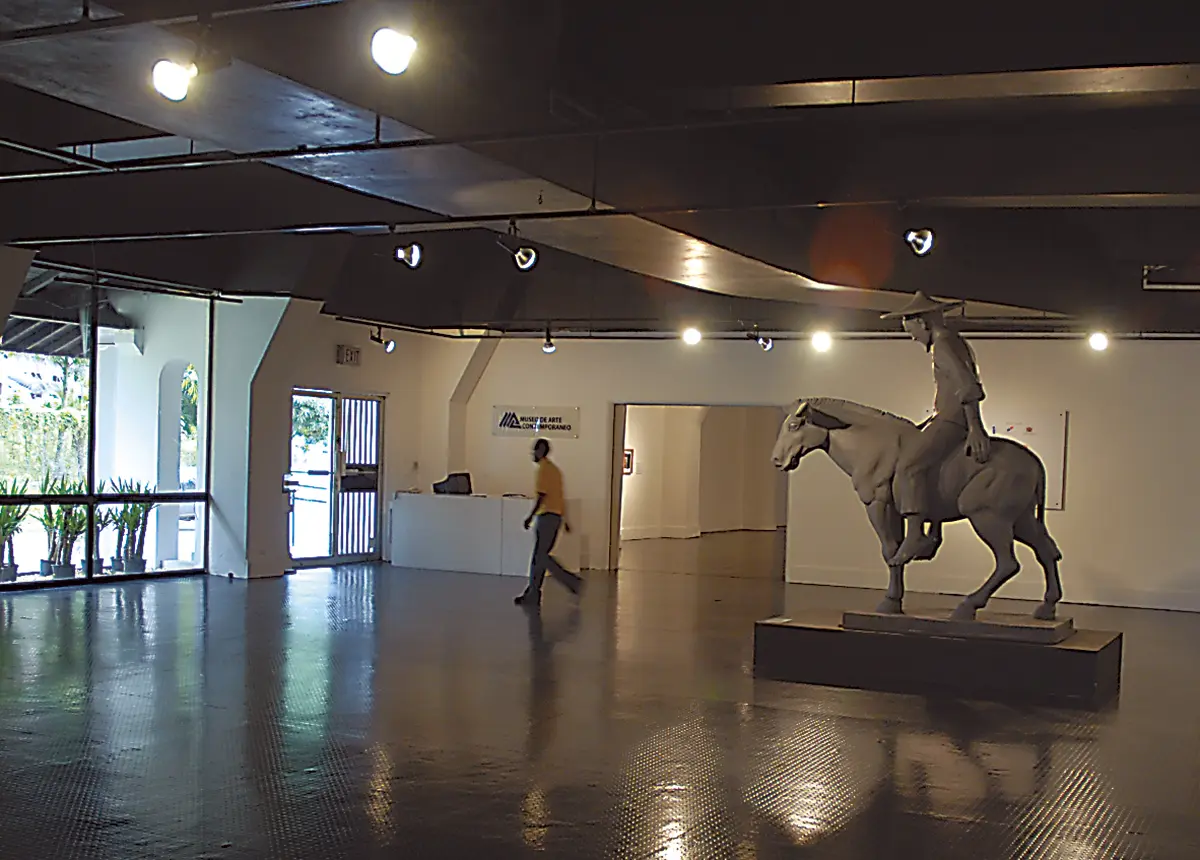
Entering the museum, one encountered the great “monument to the peasant and the donkey” that Abner Benaim commissioned as a tribute to the sole victims of Panama’s independence. This work rendered ironic our idiosyncrasy and the simultaneous proliferation of pompous statues in Latin America.
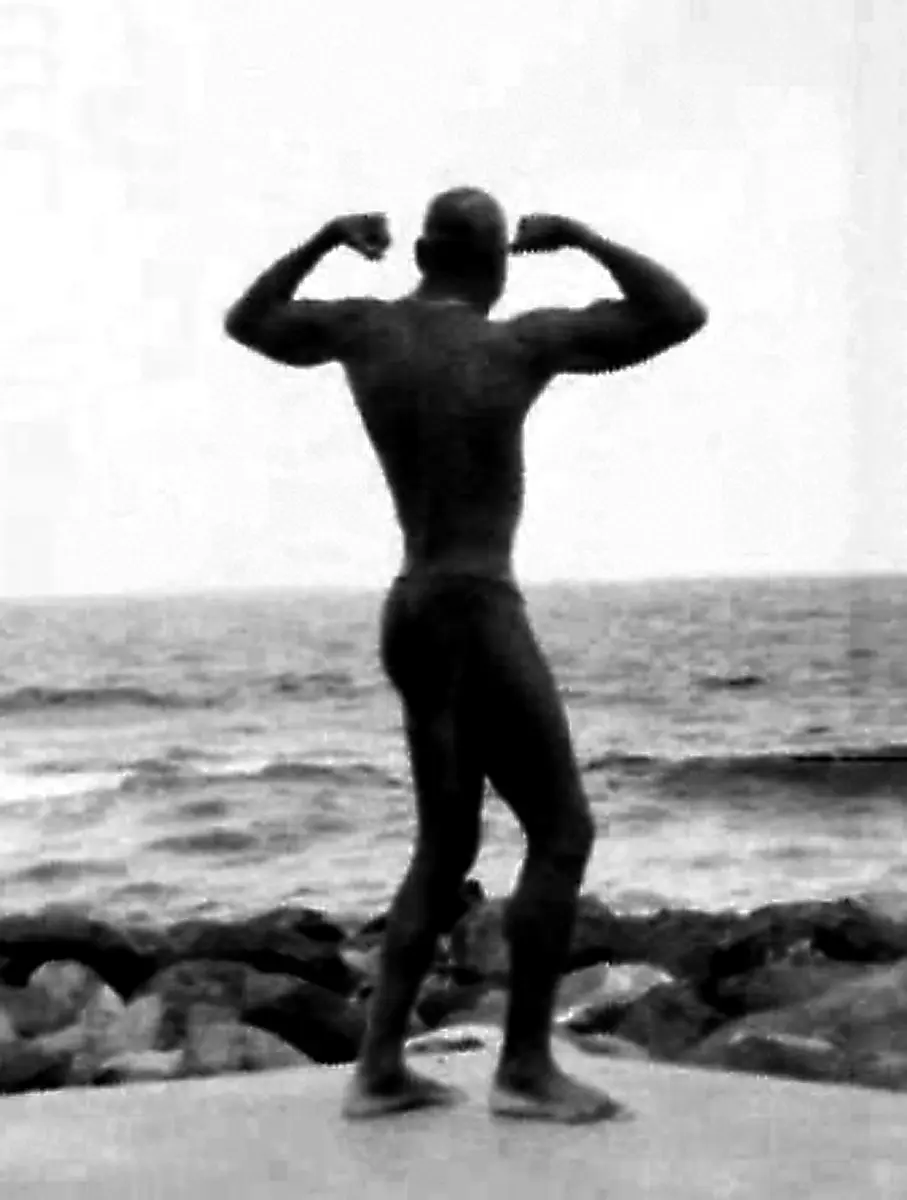
For The Last Builder, Humberto Vélez appropriated a short, decades-old, eight-millimeter film. It showed a man on a sea-facing promontory; he smiled and displayed his chiseled body despite his advanced age. Vélez said that it was a Jamaican who worked on the construction of the Canal and afterward became a bodybuilder. The dual-title and the intimate musical composition by Nikolas Wodjabasuta completed the work.
Ramón Zafrani also used appropriation in his work, with a symbolic twist. Zafrani extracted two-by-fours and columns from some of the many demolished wooden houses in the Zone neighborhoods and transformed them into sculptural objects. These referred to the commercial real-estate projects that threaten the area’s landscape and architectural legacy.
But in general, the exhibition seemed to dissolve in gestures that were visually sterile or fleeting: images of the entrance to a military base in Japan, by Sean Snyder; maps collected by Sam Durant; a coin by Enrique Castro and posters by Jonathan Monk (both sold out on the first day); the futile attempts of Roman Ondák—he and some volunteers tried to bounce pebbles from one Canal bank to the other—and Mario García Torres, who showed two empty frames for white paintings that he placed, along with the museum’s postal address, inside bottles launched in different parts of the world.
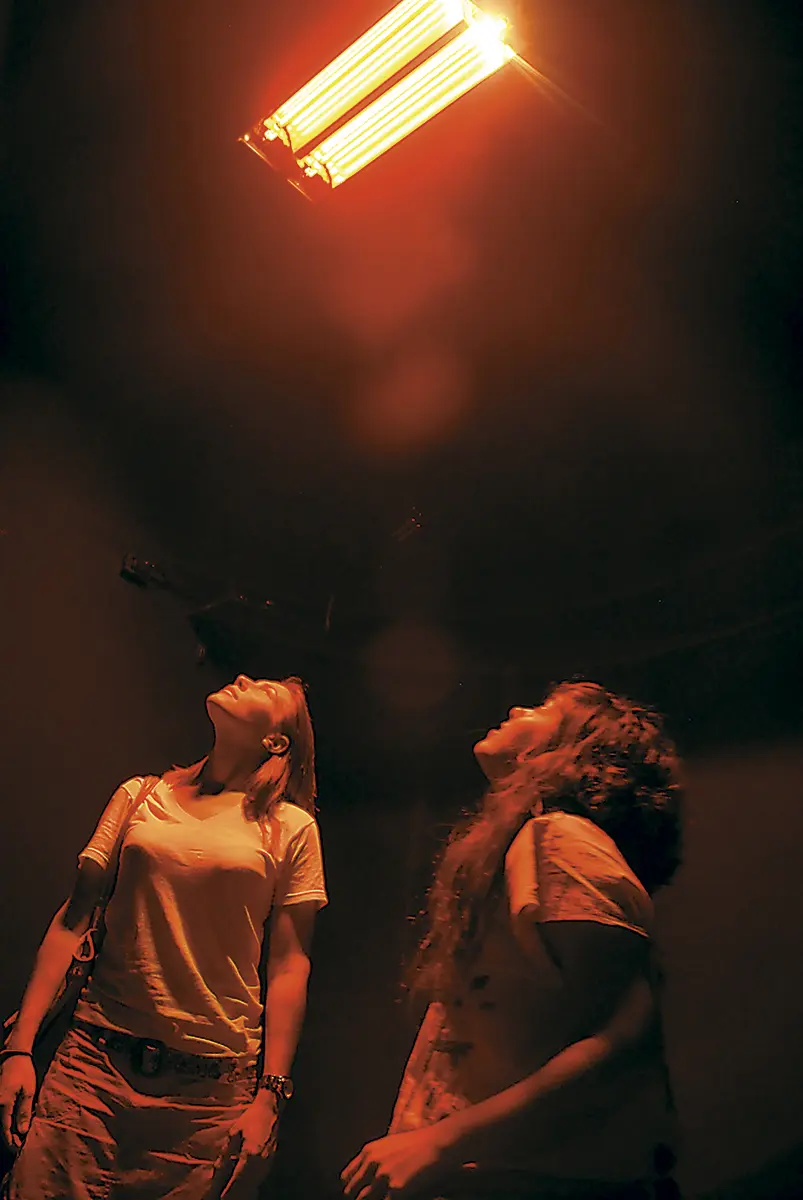
More than formal or conceptual dialogues in the exhibition design, the visitor intuited strange connections between the sounds of the exhibit, which made possible a recontextualization of some of these delicate works. The hallucinating audio of Donna Conlon’s Fiebre (produced by manipulating the recording of hundreds of mosquitoes, with assistance from the audio engineer Iñaki Iriberri) filtered into the gallery displaying Sean Snyder’s projections, giving them an ominous air. The nostalgic and eclectic music of The Last Builder connected with the babbling of waves and the conversation between an American surfer and a Panamanian taxi driver in Rich Potter’s video. With Mungo Thomson’s bell (which included some notes from Van Halen’s Panama), visitors were able to create random music to accompany the female narrator of Stevenson’s work.
Arriola conceded in her text that the show was of a “deliberately modest scale” in order to question the spectacular nature of the majority of biennials, their roles as vehicles for the visibility of art and its circulation and to “rearticulate the modes of access and experimentation of a work of art.” Thus, the Panama Biennial joined the still scarcely advanced attempts to transform the traditional model of a biennial. In other words, modesty was an instrument for transgression.
ADRIENNE SAMOS