
This is about
men of diverse pedigrees, who profess diverse religions, and who speak in
diverse languages.
They have embraced the strange resolution to be reasonable.
They have resolved to forget their differences and to emphasize their affinities.
—Jorge Luis Borges, Los conjurados (The Conspirators)
From primogenital oxidation to cyberspace, the footprints in stardust that are photographs make up a vast constellation of images—capturing our cultural imagery, charting ephemeral images in silver, mirroring the Lacanian unconscious, superimposing our ephemeralness. Manipulated icons abound. Many designers reinterpret stereotypes. Artists call this intervention, and through it, they seek to question identity models and official palaver. But this is not the case in the portraits of Alberto Tovalín-Ahumada (born 1961, México), the author of the photographic exhibit titled Los conjurados (The Conspirators), in which Mexican writers—journalists as well as novelists—appear. But light dawns upon us when the stars have died.
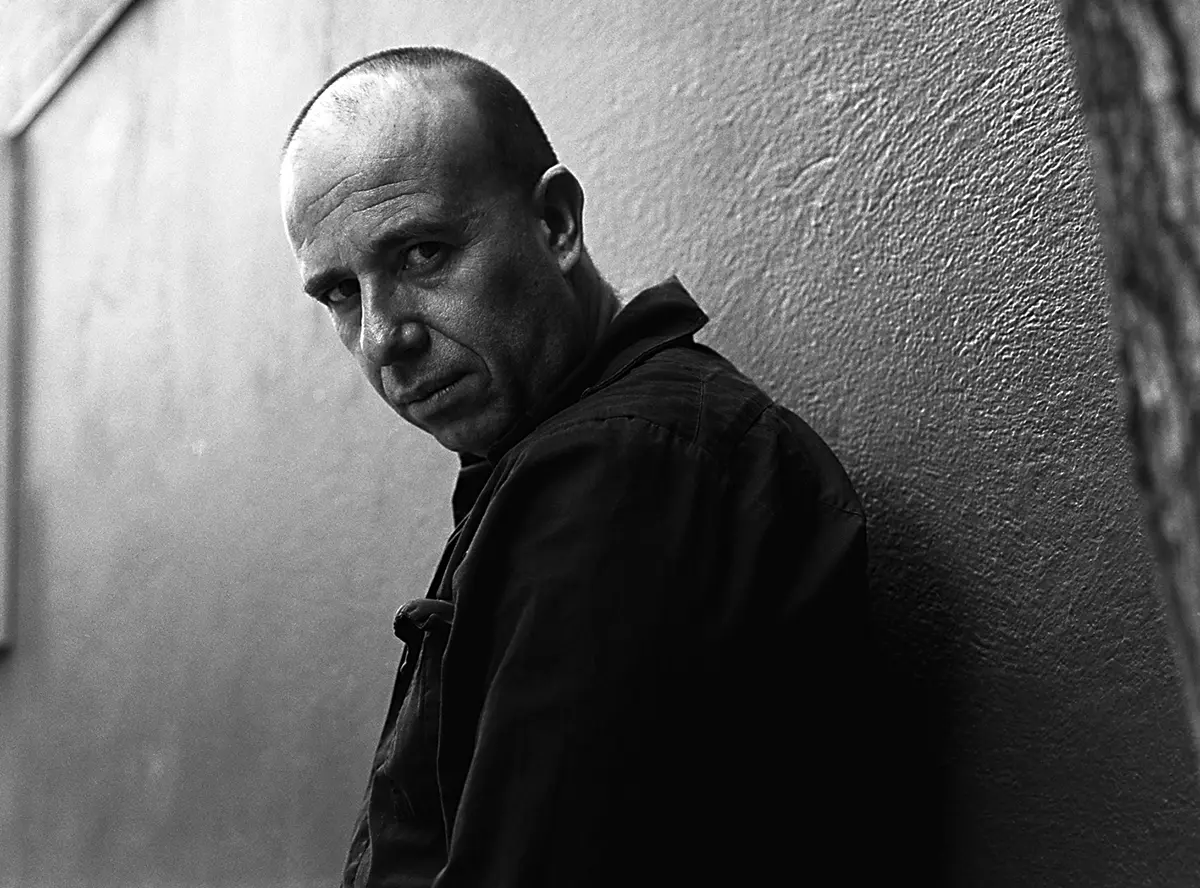
From the daguerreotype to today, not only some native peoples but also a number of Westerners still deny to pose for the camera, as they fear that the lens of another reduces their soul, or their identity, or the image that they themselves have fabricated. Perhaps because of this, the self-portrait genre has seen unusual growth—one is apparently the most amply authorized individual to address oneself—as if documenting the experience was sufficient to legitimize our becoming. However, registering ourselves has liberated the autobiographic composition, generating aesthetic impressions ranging from the multitudinous instantaneous (and with it anonymity, profile-like personages, and silhouettes) to the imposition of a perspective (the supposed search to elude the construct).
Roland Barthes affirmed that photography should not be comical because humor necessitates movement, while it also causes the error to be repeated. Susan Sontag, on considering the struggle against the passing of time, took umbrage at the reification of the subject. If Jeff Wall exacerbates an effect in exaggerating characters and scenarios, Joel-Peter Witkin deploys irony via shock tactics, goading us with ambiguous still-lifes. In this regard, Alberto Tovalín achieves portraits of Mexican literati that are infused with the humor that distinguishes him. Here, the authors are not objectified; on the contrary, by divesting them of the backdrops where the literati are commonly positioned, these authors appear without the pens or libraries that humanize them. Better still, they are images stripped of affectation, countenances that appear as if behind the eye of a phantasm—as Javier Marías would say about the writer, “He speaks and exerts an influence, but does not always allow himself to be seen; he sometimes disappears or is silent for a long time; on other occasions, he arms great uproars with their accompanying fictitious bonds or attempts to flee with his white sheet of intangible words.” Thus, Tovalín undermines the passive reception of what the camera captures.
“To swear” is to affirm or deny, investing God or authority as the witness. And “to conspire” (conjurar) is to exorcize, to dialogue with the Other, whether demon, canon, or author, in his version of self-critiques. To represent the word or its speaker, the artist is obliged to safeguard as well as sublimate the subject, which at the least slips into representing the personage. This occurs in Los conjurados, in which Tovalín procures the abduction of—in the sense of making off with, if only for an instant—the ephemeral soul, the consciousness. Tovalín’s lens slowly assimilates and captures the Mexican literati, depriving them of their arms and their letters, sidewinding around them to affect a conversation with the camera.
If for Luis Felipe Fabré, literature is the ghost, some of the specters star in four generations devoted to letters; in this photographic show, they appear without editorial leavening, without scripted lapels, or starched snoods. In the company of his choosing, Tovalín captures writers with unconventional, marginally accepted compositions; his portraits sidestep the traditional portrait frame without entering into the black-and-white of the retro-composition experiment so in vogue, or into the straightforward pseudo-conceptual intervention. If it was feared that photography would purloin the spirit, Tovalín utilizes the empirical author and his fantastical power, he of the magical and shamanic profile capable of gagging solely with his tongue. He imprisons the face, the death that laughs inside the crania of mortal literati.
As Tovalín says, “The exhibit is an x-ray of Mexican writers . . . My grooming as a linguist was developed equally with that of photography . . . The face, the head—that thinking part of the body that is the head, that expressive part of the head that is the face—concentrate, in the manner of a gravitational force. The human presences are almost earthly accidents, thinking apparitions that shatter the premeditated texture of the surroundings.”
An author of rare images, a mentor of stances that challenge unforeseeable faces and bodies, Tovalín conspires with the authors to demystify them. He lowers them from the scripted pedestal in order to attain access to a worldlier image, terrorizing another face of the letters in Los conjurados. He profiles those of us who conspire with St. Jerome, enticing us away with a hypnotic, documentarian, encyclopedic, and superb lens.
MAYRA INZUNZA