
Multiplicity and plurality are all the rage in contemporary Cuban art. In other sectors of our country’s society, and in the past, this phenomenon would have been dubbed jack of all trades, thus responding to the official argot made paradoxically fashionable as the times demanded, at both the local and global levels, ever greater specialization to confront the many challenges in knowledge and in innumerable human activities.
Very few artists are content today with a single means of expression or with expressions made familiar by their support or technique, which in general tend to identify them within the complex territories of a given visual culture: he is a painter, a draftsman; she is a sculptor, a printmaker. These days, very few like such 500-year-old labels: the most recalcitrant don’t even want to be called artists. And, as a curiosity, there are those who reject any allusion to their nationality, their place of origin, their culture: they are art’s fundamentalists; the contemporaries, as a matter of fact, of many other lines of extreme thought and action that abound in today’s world, even if not fully aware of such connection or, who even knows, perhaps intending to be a part of them or of a new one still to find its best definition.
The current trend is to explore new pathways, new structures and forms, new languages, and to try to dominate them. It is a difficult operation since artists need to change stereotypes and codes that originated at a different time and place in the history of art, or in their own personal history, which they have made their own and which have nourished them in many ways and shaped their work over many years. Great doses of audacity, willpower and tolerance for risk are required, as is a change-fostering attitude, a pervasive curiosity, the desire to learn heretofore unknown things, and continued trials over long periods. If after confronting all of this the results are not valid works of art, capable of making a degree of difference or proposing new elements in any of art’s domains, or at least of giving visibility to previously hidden events or phenomena, what is needed then are great doses of honesty in order to abandon or redirect the exploration, return to the starting point, close this ambitious period in their work… and start again somewhere else.
Among the artists who have moved from planimetry to volume in recent years, and who have been exhibiting their work together for the first time at Galería Habana in our capital in a show titled Del trazo al volumen, Agustín Bejarano is the least experienced in this period filled with surprising referents; Roberto Fabelo and Roberto Diago have delved in objects, objectual painting, sculpture, as well as photography, installation, video, and video-installation.
To a greater or lesser extent, these three artists carry out operations of transfer from plane to volume on the basis of their own codes and symbols. We can “identify” them almost immediately when confronted with these new constructions created in the space of a modern gallery characterized for hosting indistinct explorations by singular contemporary Cuban artists, without concern for generational provenance, tendency, or expressive mode. This work is by Fabelo, that one by Diago, the one over there by Bejarano.
In concrete terms, this does not contribute substantial elements for a deep assessment of their respective craft and trajectories but says plenty about a new attitude among artists that are beginning to leave deep marks, to the point that it might be suspected of being a modus operandi with elements not of provisionality, of épater la bourgeoisie in the French way, but of permanence and continuity, especially among artists who are 40 or older, motivated it seems by the energy, vitality, and versatility of the youngest generations, who direct their proposals from one technique to another, one support to another, one expressive medium to another.
It is the artists of the 1970s, 1980s, and 1990s who are changing because the youngest ones are already born with a total predisposition for change devoid of bias or inhibition, similar to their predisposition —it can be said to be innate— for handling gadgets and the latest technology in the field of informatics, video, computation, telephone communications, and digitalization.
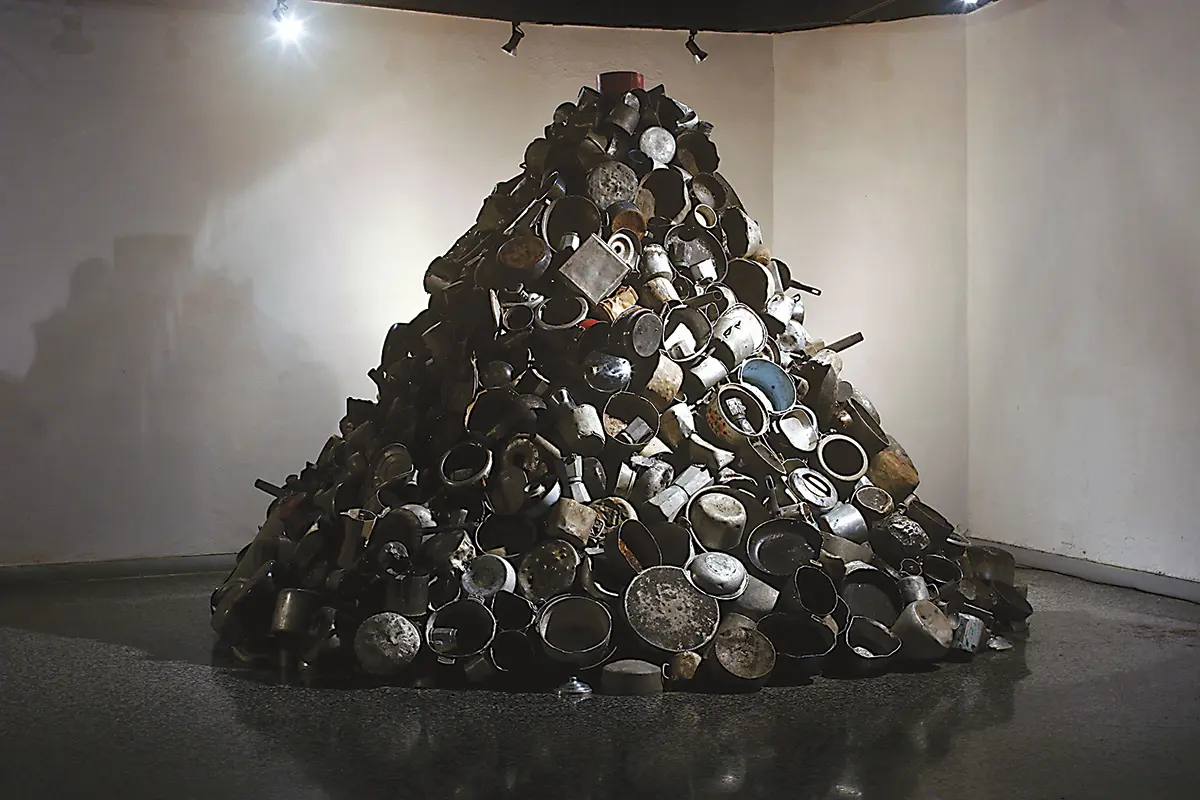
Roberto Fabelo, the “oldest” of the three, appears as the most mature in his handling of the found object, the traditional ready-made, almost always with an air of domesticity, associated with everyday life, to the economic, social, and political context in which he lives. Not in vain does his work have an epochal title: Volcán, best understood among us when we take into account that it belongs to a series with an even more clear and blunt generic title: Calentamiento local. It comprises pots, pans, lids, frying pans, pitchers, coffee pots, teapots, all in a deplorable state, worn by use and time, some of them blackened and intervened by the artist when he deemed it necessary, piled one on top of the other up to a height of two meters on a conical three-meter diameter.
Here Fabelo returns, now in a single, large work comprised of innumerable small objects, to what he attempted and showed in one zone of his solo shows Un Poco de mí and Mundos, years back. He appropriates his own pictorial work, particularly the magnification of pots overflowing with a dense liquid on which there occasionally float small ships, desolate or containing people, nude women on the verge of a panic attack, hovels in the middle of their spectral extension. In this way he summarizes and synthesizes, at the level of a personal discourse,, many of his ethical and aesthetic concerns, transformed a long time ago into obsessions for someone submerged in the flow of a difficult, controversial, anguished, convulsive time. Among all the possible causes for this epoch to manifest itself in this way, hunger is the most important, the worst along with money, and both of them, when conjoined, constitute an explosive mixture that, against all logic, results in great pleasure and delectation for the powerful managers of the military-industrial complex, who set in motion the infernal machinery of war. But let’s be careful, let’s not forget that popular expression that tempts Fabelo every day: hunger is a bad advisor.
The pots, pans, and pitchers are heated, be it because they are full or empty, but one of those altered states is more dangerous than the other. The so-called Third World offers constant examples of this, no doubt. The artists and his work once again warn us, grab our attention in the midst of so much banal spectacle, so much frivolity and vainglory that day and day out builds bridges to oblivion with their overproduction and their overflow of cultural products and material consumption. Fabelo wants us not to forget what can be wrought by a lit fire in a desolate, inert kitchen. Overflowing pots on one side, empty pots on the other: the dramatic and grotesque paradox of our times.
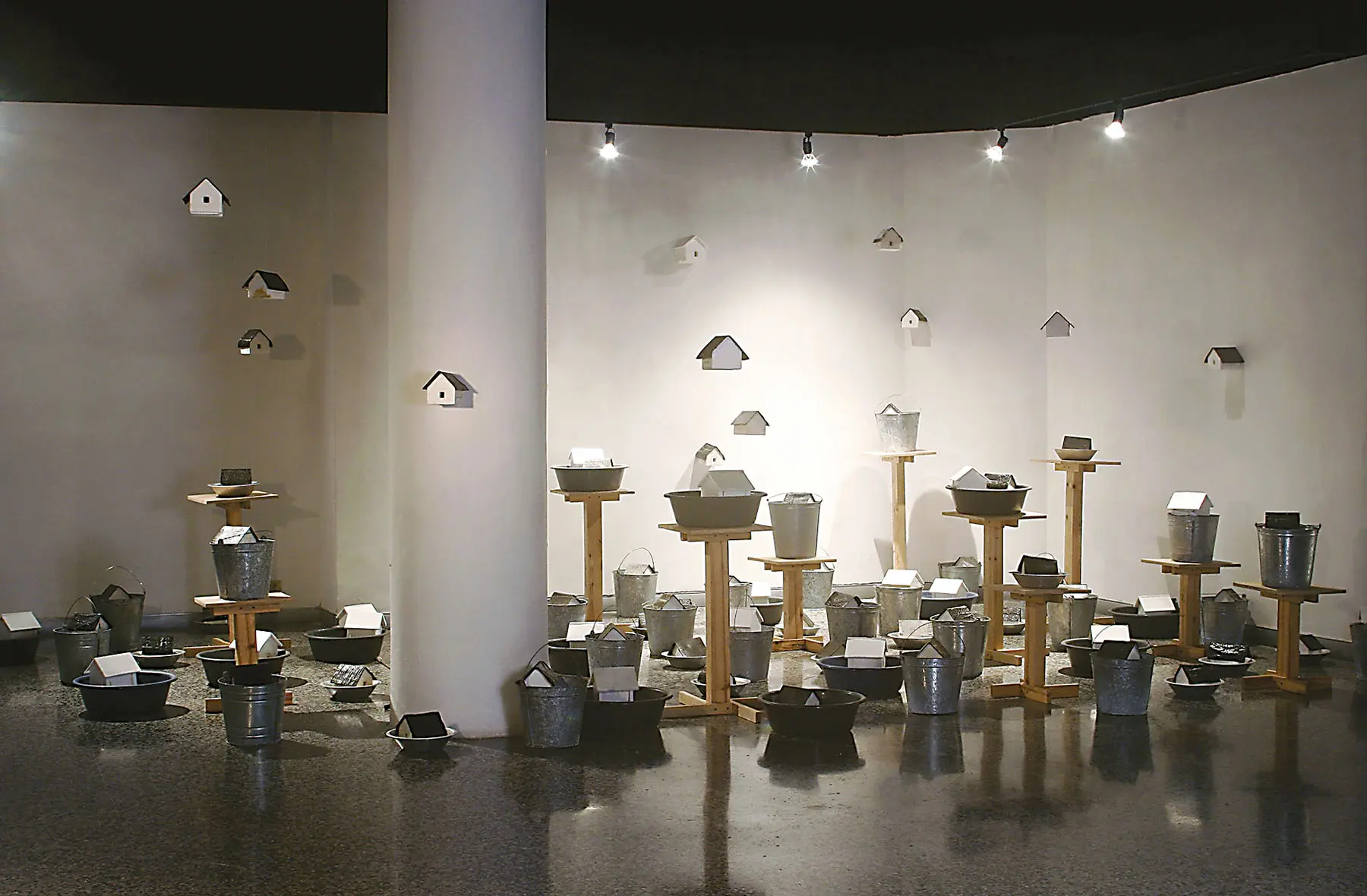
Diago, the other Roberto in this show, plays subtly with certain materials of precariousness: water, metal buckets, humble shacks, in order to challenge their very nature and re-signify them in the space of an installation that nevertheless doesn’t reach the levels of protest, satire, and parody seen in other works by him, but those of calm reflection, of covert meditation on fiery contemporary problems, which in a way connects him to Fabelo.
In his painting, Diago had already displayed a certain aestheticization of the difficult conditions of some sectors of our society, of poverty, which he effectively balanced between expressions of a 1970s arte povera and the objet trouvé that permeated almost the entirety of the Twentieth Century. A conscious manipulator of his expressive instruments and his materials, this time Diago builds his installation Utopía as dominated by the discourse of the ephemeral nature of life, its flimsiness: he does not represent a social and urban group, as he so dramatically did for the 9th Havana Biennial in 2006, but individuality, the isolation we suffer even in the midst of precariousness.
Utopía would seem, then, an ironic title, or perhaps a prophetic one, since in principle the artist suggests a model of social and urban relationships, of coexistence for people under the appearance of individual dwellings, most of them isolated in waters that mark their own territories (territorial waters?), defined by a cube in question. Other houses/objects hang from the gallery ceiling, even more, isolated, confirming the possibility of the extremes that can be reached.
Ambiguity takes control of the installation and subjects us to constant doubt, to reflection, which constitutes, surely, one of its greatest virtues. Is that the artist’s dream on a summer night? Or everybody’s dream? The harsh reality that Diago shows us in paintings, photographs, videos, and installations from previous years has shifted here into prognostication, into matteric speculation in Havana, bordering many significations and reasserting the validity of and the role played by the social, economic, and political context in contemporary Cuban art from the 1960s to the present.
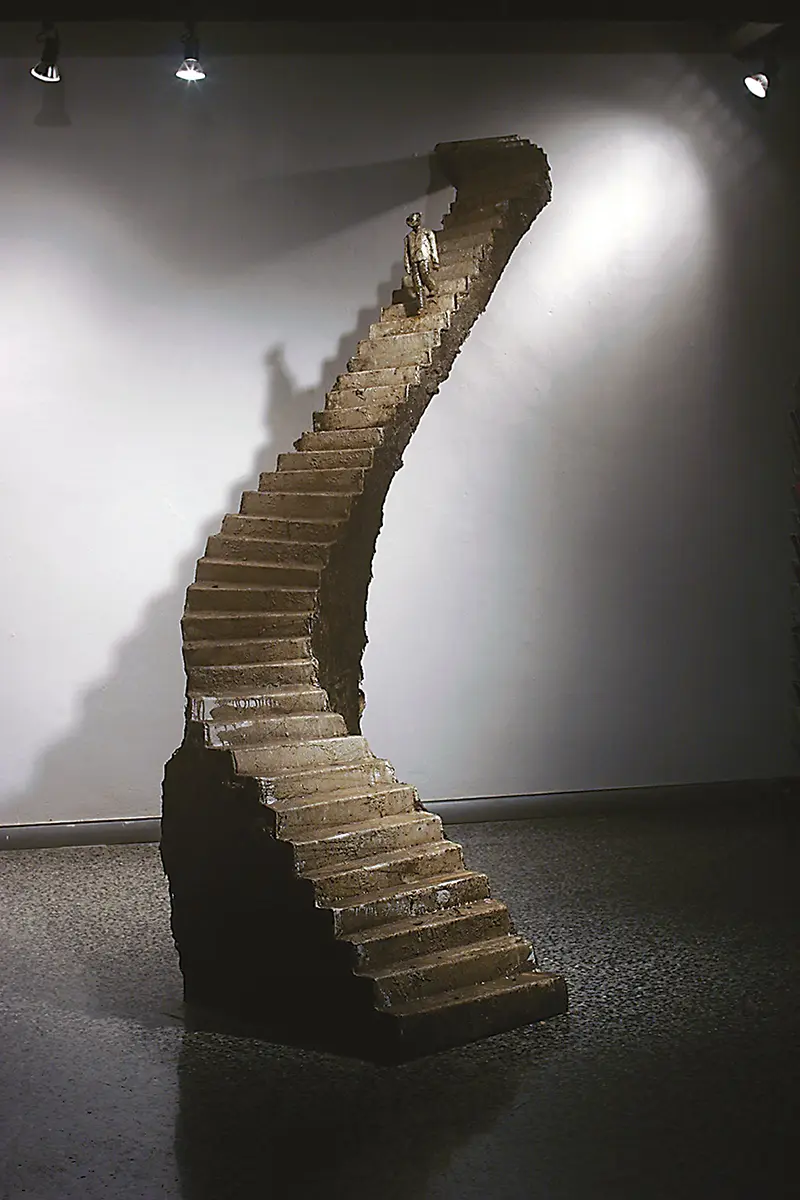
Agustín Bejarano, like his companions in the adventure of this show, gives bodily shape to essential themes of his pictorial work by placing the issue of man’s destiny front and center. Where are we going? How many steps must we take? Are we ascending, or descending? We must move, yes, but, in what direction? Under the title De regreso, sculptural work in the shape of a variable-dimension ladder affixed to the floor and a wall in the gallery, with a small human figure descending, Bejarano uses the metaphor of the path to be traversed. Where is that man coming from? Did he decide to return, or did others decide that he should?
If memory serves, two years ago Bejarano had shown a group of works among which one stood clearly out: a man, not nude, coming down the ladder. An objectual work in finished and polished wood, no larger than one meter and encased on the wall, with clear allusions to that region of his painting where a man alone communes with himself, accompanied by his own, profound loneliness. We find variations of this theme in those matteric paintings, crackled at times, in which we see a long, huge table with a man sitting at one end, or in those wooden docks where we also find a man sitting at the end, his head almost always lowered, and an ocean or river flowing underneath, indifferent to what occurs, or is it that nothing occurs and this is only a man sitting there?
Scant colors, generally all within the same range, tending towards gray, in other cases towards brown, Bejarano moves away from chromatic stridency or formal juxtapositions that could link him to a Cuban tradition in painting, while the ghost of Fidelio Ponce de León rears his head behind his works, a hat in his head and a cigar between his lips: the same loneliness, the same desolation the Camagüey artists threw at our faces?
Bejarano’s work appears as a sculpture drawn in space: it comes from all sides, and it goes everywhere, to paraphrase the famous poem. A sculpture that displays its innards to the public, because just by walking around it we discover its structure, its materials; Bejarano is not concerned with the mystery implicit in many works of art, but with their discourse: what does it say, what does it want to say?
This work is the only of the three that presents a beginning and an end: time is there, above space and form, in the same way, it is in his paintings. The relationship between both modes of expression is intimate, essential because it not a matter of complementariness or additions: it is not a matter of how, but of what.
The exhibition, as a whole, takes as its point of departure an idea that deserves greater investigation and reflection: that of shifts within the career of many artists already recognized for a personal, distinctive poetics, and threatened perhaps, in the deepest recesses of their creation, by it.
Adventuresomeness has come to govern these artists. One belongs to the 1970s generation, projected today over the social and political context with mature works that are willing to dialog about reality at the same level as the more unencumbered, irreverent, and controversial works of younger artists emerged at the dawn of the Twenty-First Century. The other two became known in the 1990s, amidst a whirlwind of passion and analysis about the aesthetic paradigm, distanced from the critical paradigm that was the rage in the 1980s.
Without resorting to a frankly pendulum-like attitude, so dear to our idiosyncrasy as a people and a nation, these artists situate themselves in an intermediate region, which is not in any way a no man’s land: on the contrary, it is their land, the land of many artists who work beyond classifications and groupings, located in more fertile plains in order to think and ponder. They have something of the former and something of the latter, as they know in great depth the “craft of art” as well as the primacy of a concept in a unique moment.
They are not situated at any of Cuban art’s passionate extremes that so much debate and polemic generate among critics. Their steps are slow, like the steps of that mule in the Lezamian abyss, because they are in no hurry to get anywhere. Where is it that one should be getting? like Bejarano’s little man could ask as he descends that ladder and fuses himself, in a hypothetical decision, with the public in the gallery. To live in Roberto Diago’s Utopian city? To encounter Fabelo’s volcano in our home, our city, in the middle of the island, without knowing what to do?
Galería Habana thus joins the heat of a time that someday will be called ancient.
NELSON HERRERA YSLA