
The aroma was already different in the street in front of the building housing the Museo d’Arte Contemporanea. From the sidewalk, an enveloping fragrance different from the warm smell of Rome in the summer became a prelude to the monumental installation placed by Ernesto Neto inside the museum’s lobby. Within the bounds of MACRO Hall, a program that commissions site-specific works, Neto presented While Nothing Happens.
Despite the monumental scale of the installation, Neto once again utilized lycra tulle to achieve transparency that reveals subtle surfaces. The sculpture occupies nearly the entirety of the immense hall, above which the museum’s two levels hold several exhibit rooms. While Nothing Happens is attached to the museum’s tri-level glass-roof trusses. Suspended in equilibrium, the work is sustained by a pulley anchored in the glass dome’s metal frames. The lycra passes through this cord; there are three sandbags at one of its two extremities used to counterweigh the remaining extremity, which opens like a flower as it reveals dozens of smaller bags replete with ground spices: pepper; cumin; cloves; ginger, and turmeric. In an internal drama, the lycra expands practically to its breaking point, the gravitational force pulling at its side is neutralized as the sculpture is suspended and floats on air approximately one meter above the gallery floor. Frailty underscores this precise system of formal tensions, even as a vaporous and aromatic beauty hides this subtle nature. As the title suggests, the work will remain sustained in this manner as nothing happens.
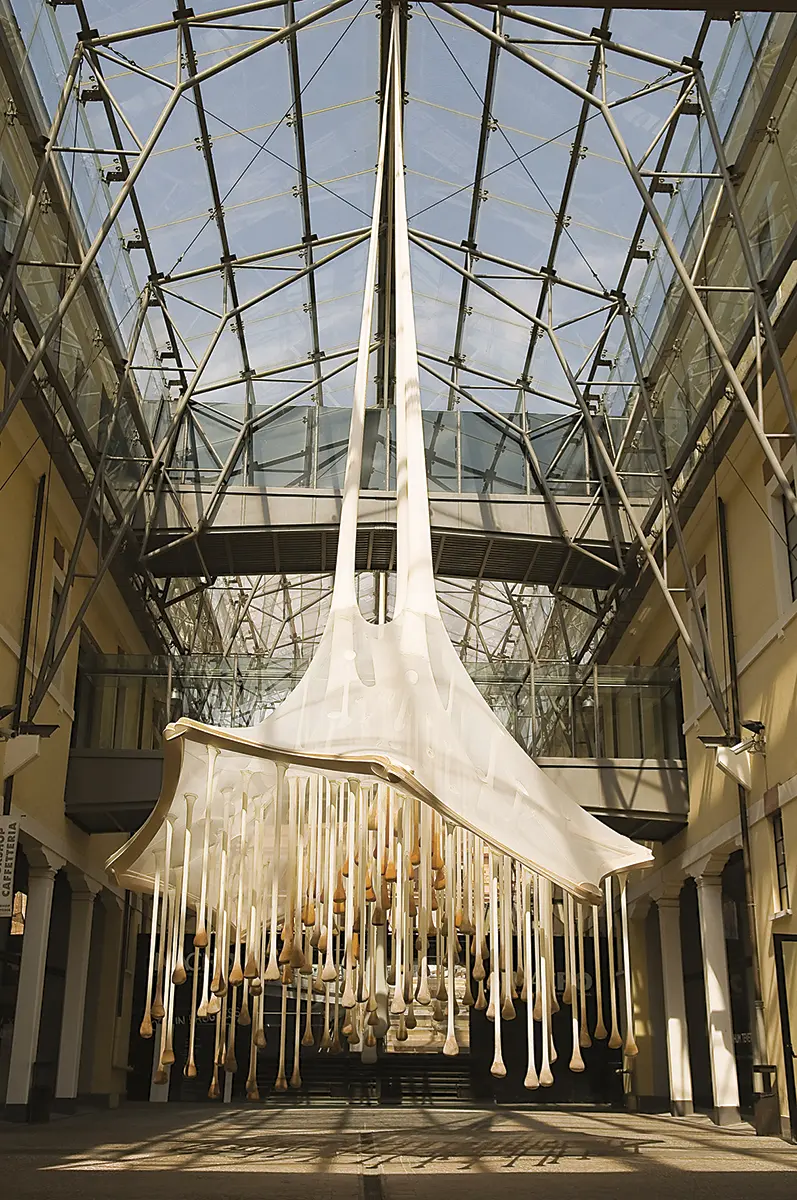
According to Neto’s artistic language, the spice bags are called copulas, a denomination that suggests the notion of unity. The cópula binds one thing with another, as occurs in sexual intercourse (copulation). And a flower is nothing more than the reproductive sprouting of plants. In this sort of upside-down flower created here by Neto, the filaments terminate in cavities containing condiments that replace pollen for perpetuating the species. The tulle petals are fastened to curved wooden beams that are linked together to define and broaden the flower’s corolla. Neto supported this comparison when he affirmed that “think of this sculpture as if it were a flower: it must have petals, color, and also a fragrance”. These words convey the artist’s interest in organic forms and perception, as well as his desire to create works for the public to touch, observe, enjoy, and smell.
While Nothing Happens takes place in space, it floats in the air. Therefore, closer to the image of a flower, this piece draws from another inevitable model: the mobiles by Alexander Calder. In fact, Neto conceived of this sculpture after the works he created during his stay at the Atelier Calder. Neto lived in Sache, France, during the second half of 2007, where the great Calder studio is located and where artists with a recognized artistic trajectory are welcome to stay and develop their sculpture projects. Although Calder is not the only important influence for Neto (also influential are Brazilians Lygia Clark, Hélio Oiticica, Richard Serra, Giovanni Anselmo, and Constantin Brancusi, among others), their shared refined sensibility cannot be denied. Calder took Twentieth Century sculpture to a state of weightlessness and grace, and Neto has undoubtedly ventured along that same path.
Calder Mobiles transformed sculpture – traditionally associated with weight and bound to the floor – into a graceful, ductile, and kinetic art form. The articulated structure that is the mobile completely expunges the concept of mass by means of a delicate system of balance and counterbalance that renders weightlessness possible. Neto makes the exploration of swinging and gravity his own, and the lightness he inherited from Calder becomes more complicated in Neto’s work because of the transparency of the fabric he uses. Calder worked with iron, while Neto employs opalescent Lycra to achieve an even lighter result as he exchanges the forging of Calder for the art of needlework. One cannot ignore the political element implicit in the use of such material. While iron and scrap metal speak to the out-of-control industrialization experienced during defining periods in history, cloth materials can be associated with postmodern vindications that allowed the inclusion of practices such as sewing and weaving, the considered marginal.
Calder and Neto both possess a great ability to understand architecture and its spatial relationships, which could be attributed to their backgrounds in engineering: Calder was an engineer, and Neto took engineering courses prior to working exclusively as a visual artist. Nevertheless, notwithstanding this shared formal syntax, both artists also have similar preoccupations. Both artists layout their spatial coordinates to achieve a merging of architecture and biology. Neto proposes a habitat associated with the body, an “animal architecture,” in his own words. Geometry and organic forms are also part of the work of Calder, who believed that fluidity and intuition could bring life to inert matter. These two artists are in search of art that is directly connected to the universe; an art that cannot be rigid or static, for the world is always changing despite the forces that maintain its cohesiveness. Calder belongs to a group of artists such as Joán Miró or Jean Arp, who propose a more organic type of art. It is precisely this kind of abstraction on which Neto bases his work. In the work of these artists, he finds clear non-figurative allusions to life: flowers; fruits; organs, sexuality.
In holding a weight in the air, While Nothing Happens exploits the legacy found in Monument Pendu by Calder. In the former work, Neto pushes the boundaries – not only due to the oscillation between tension and gravity, but also because there is a fine line between the visual pleasure of seeing this sculpture suspended and the danger that it may fall.
FLORENCIA MALBRÁN