
La obra sin fin. Cuerpos y Objetos en Cajas Obsesivas (The Never Ending Work. Bodies and Objects in Obsessive Boxes) is the title of the exhibition held at the Durban Segnini Gallery, between June and August of this year. In a sober and measured montage that includes fifteen pieces of various sizes, Felipe Herrera presents a group of works created over the past seven years. Throughout the show, it is possible to appreciate a depurged thematic selection that stems from a continuous and sustained process of reflection and cleansing. Through combining disciplines and technical inventions on the staging and format utilized, this exhibits tallies the tendencies and abilities to which this artist has resorted throughout his artistic trajectory: drawing, painting, collage, modeling, and sculpture are ingeniously combined to fashion eloquent assemblies in which many techniques are applied.
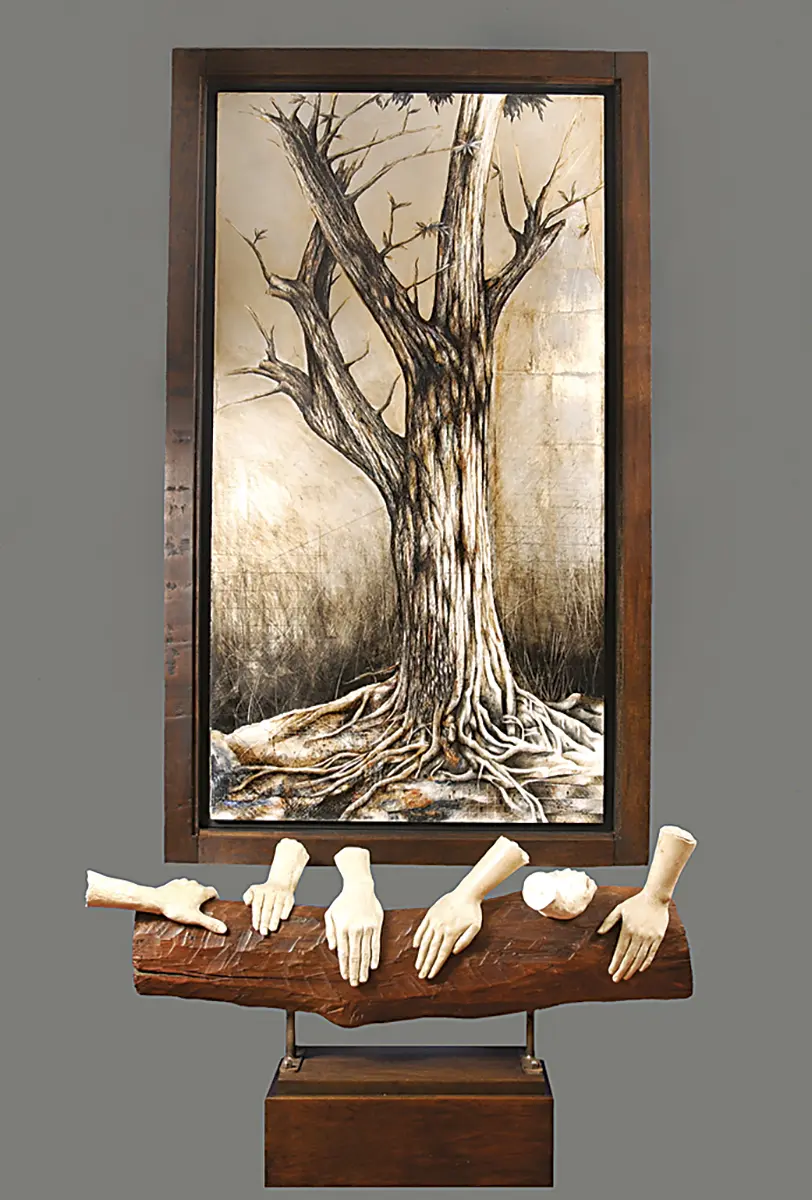
At the beginning of his career, Herrera became interested in sculpture, and then welded iron to create geometric and stylized constructions. At the end of the decade of the Seventies and the beginning of the eighties, the artist demonstrated a particular interest in drawing as a way of investigating the plane, perspective, volume, textures, and contrasts, which he was able to obtain through the handling of chiaroscuro. Throughout these years, his mastery of this artistic discipline made him one of the representatives of the boom of drawing artists in Venezuela. During that time, he found inspiration in fantasy literature, which nourished his overflowing imagination as a creator and producer of images: Would this habit mark his discourse in the years to come? Actually, pictorial, metaphorical, and extraordinary elements would eventually become more relevant in his work, prominent because of the beauty and perfection of the brushstroke. From that point on, he constructed an iconography that incorporated human bodies, horses, muscles, tendons, trees, chessboards and chess pieces, playing cards, and architectonic components, among other elements. Subsequently, he attempted to leave the plane behind and created what he coined Dibujos-Relieves (Drawings- Relief’s), followed by his ámbitos (Domains), an installation of sorts that included characters and fragmented elements. Herrera explored the scenographic aspects of these creations to conjugate the flat surface and the volumes in his compositions, revealing a tendency toward Barroquism. At the beginning of the Nineties, he began his series Dibujos-Cajas (Drawings-Boxes), experimented with plaster, wood, resin, iron, and glass, among other materials, and would add to these industrial elements. The juxtaposition of real or represented objects and the intervention of spaces and their fictitious projection onto its supporting structure give the visual experience a dimension that blurs the line between the real and the fictional.
This exhibit includes the various periods that have marked Herrera’s artistic career. These periods are implicit in the bodies and treasured objects inside these “obsessive boxes”’. He is able to integrate reality with the world of dreams, art with practical elements; he crisscrosses meanings and generates incongruent associations that range from the physical to the metaphysical. 13 Cajas Obsesivas (13 Obsessive Boxes), for instance, is an installation made up of thirteen small-scale modules that underscore the interaction between the flat image (drawn, painted, or glued) and the solid and voluminous bodily image that includes molded figures such as hands, apples, and hearts, and everyday instruments such as watches, knives, sinkers for fishing, etc. Arranged as a traveling suitcase, open book, or as just a plain box, these modules are often containers of remembrances, they appear to be part of memories that materialize to welcome past, present, or future experiences. Mujer-Planta (Woman-Plant) (2008) is a piece with a rectangular base, a suitcase-box containing the representation of a female face, sculpted on one of its sides and sketched with graphite on the other; it includes the root of a tree that expands, like the modeled arm, outside the limits of the frame; in this way, its interior and exterior spaces establish a dialog that casts a haze on the line between art and life, or between art and reality. The curator of this exhibit, Bélgica Rodríguez, affirms that “Felipe Herrera’s works are visual entities ruled by strict notions regarding the spatial distribution of objects, whether painted or sculpted on support, due to the close connection between their two- and three-dimensional elements, the absence of color, and the ciphered message infused in them. They simultaneously represent the artist’s individual internal life, as well as collective life. As in Morse code, each object, and element interacts with that next to it; as an extension of sight, the public delves into the interior of these messages in an attempt to decipher them, while simultaneously they [the public] paradoxically become both spectators and protagonists. As a consequence, an associative relationship of personal sentiments and affections are established between the viewer and the artist…”.
GLADYS YUNES