
With this first solo exhibit in Madrid of Fernando Montiel-Klint (Mexico City, 1978), the Fernando Pradilla Gallery is gambling on photographs contrary to the predominating trend in the most recent version of PhotoEspaña, which was closer to the German School and to the documentary tradition. Montiel-Klint takes refuge in another vertex of the beginnings of photography, that of the pictorial tradition in the portrait genre, in which the subject was photographed in a watery atmosphere, with a landscape as the backdrop, or surrounded by symbols that identify the social or intellectual status of the person sitting for the portrait. The series Nirvana presents a gallery of personages in hypnotic states, lost in their own scenography, which invades and annuls them.
If we assent to Baudrillard’s vision of the way objects displace the portrait’s subject in their seduction, and that the latter, in turn, feels more and more trapped in the material world – –an argument that the French philosopher develops in Las estrategias fatales (The Fatal Strategies)– then the Montiel-Klint series of photographs titled Nirvana could indeed illustrate this pessimistic view. Here, subjects have lost their sense of “being”. The subjects offer us no clue in the schizophrenic world that envelopes them, that is, if as the subjects, they are the carriers of some knowing, some history or power. Annulled by the surrealistic context in which the senselessness of things is primary, the individual represented is part of the scenario that the subjects themselves construct, derived from the notion of merchandise. The objects that surround the subject has come to identify the individual whose portrait is being taken, in that their objects are more fascinating than the subject, more attractive and desirable, Even when it could be said that the objects have no value other than that which the buyer or market confers, without these, the individual would be nothing more than hollow.
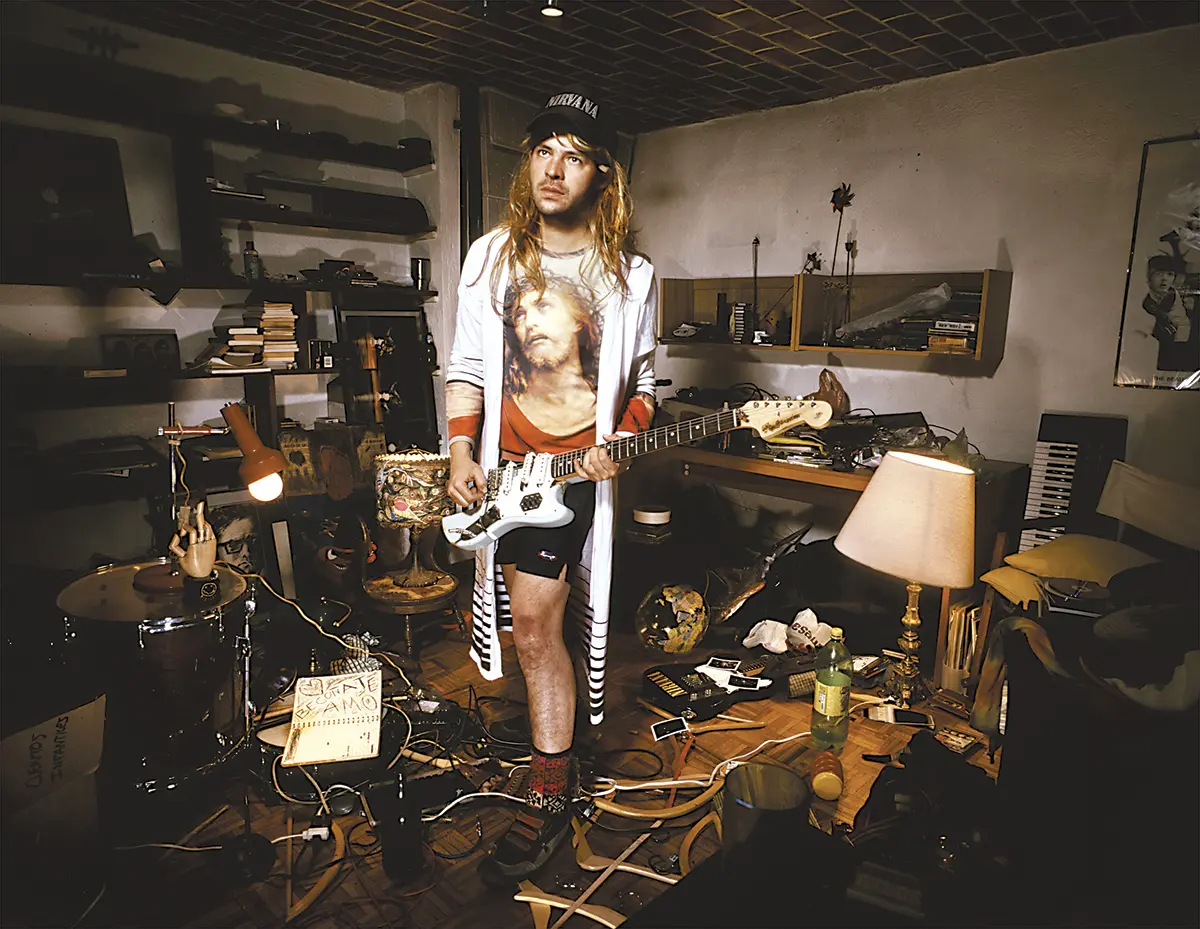
The photographs themselves do not seduce us, not only because of this exocentric, theatrical; all but mise en scène setting that portrays private worlds. They confront us with the doubt of the possible and imagined, exacerbated by the treatment of the dramatic illumination, akin to the cinematographic scenario of some production that pretends to be sophisticated, but that reveals the trickery of the exposed fake. Montiel-Klint exaggerates even more so the beauty of his product, with the tactile and attractive quality of the cinematographic take of the pose and the great format in counterpoint to the documentary photograph in which the “decisive” moment and the presence of few elements that are key to the meaning, predominate. Here, everything is saturation, baroque composition; thus, the artist does not disdain to resort to the use of design elements to emphasize to the photograph’s pictorial quality to a greater degree.
The absurd situation, almost unreal, of the individuals exposed here –all of them young and of a certain favored stratum of Mexican society– could remind us of the photographs by Daniela Rossell in Rich and famous series. In the empire of kitsch richness and the excess of the Mexican upper class that empowers the contrast between the disparate objects of these interiors engulfing the photographed person, including those in domestic service, and the obvious “exposure” to a certain fragility and solitude of the personage. Nonetheless, Montiel-Klint appeals more to irony, to the humor of the situation in which he contextualizes the subject, and of course, to the obvious theatricality, to imbue the image with another character who does not redound in the documentary theme. However, the personage loses, in favor of the scenery setting and seduction of the objects around the subject. The former alludes to icons of the popular culture assimilated by an “acculturated” elite who incorporate them as part of their consumption. The objects not only construct the image and the take but also characterize the subjects of the photographic take to the point of annulling and integrating them into their “fatal strategy” as only another part of the merchandise on exhibit.
DERMIS PÉREZ