
The recent exhibit by Fernando Uhía that occupied the top two floors at the Valenzuela Klenner Gallery bought together a large number of works from two groups: Technoesmaltes and Paraguernicas. Formally speaking, the two series appeared to have little in common. Thus, it was surprising to learn that they were executed at the same time. A closer look into both series revealed their shared preoccupation, one that has been part of Uhía’s entire artistic career: a persistent inquisitiveness regarding the globalized world and its effect upon not only art but also everyday life, in areas one would least expect, such as at the bike path (ciclovía) or on a bag of potato chips—spaces where city inhabitants go about their lives unaware of such an influence and, thus, are vulnerable.
In the Technoesmaltes series, Uhía employed oil paint purchased at home improvement stores and usually used on the doors of affordable housing units. The artist meticulously dripped paint onto the surfaces, resulting in combinations a resident of Bogotá would associate with colors they have seen on sportswear worn on any given Sunday at the ciclovía. It was not clear whether one might consider these works as abstractions like paintings by Barnett Newman or Mark Rothko; in the case of the Colombian artist, one could argue that, by dealing with something as pedestrian as the colors of Sunday sportswear, abstraction actually landed in the middle of Bogotá’s Carrera Séptima.
Aside from Uhía’s formal interest in color, it was possible to also infer the artist’s latent inquisitiveness concerning the relationships between painting and craft and between art and mass production. The Technoesmaltes had industrial-like surfaces, but at a closer distance, one could perceive the artist’s gesture, his control over the dripping paint, the layering of the several paints, and the surface movement. While the design of a sweatshirt or a pair of sneakers would yield a perfect delineation between one color and another, the colors were irregular in these paintings. It was a silent and subtle subversion, but a convincing one nonetheless. These were paintings that dealt with gravity: not only is it true that “gravity makes the painting,” as Uhía says, but gravity also dictates the theme, the dead weight of one culture over another—a weight carried for so long that it is no longer felt. These works succeeded in conveying that gravity.
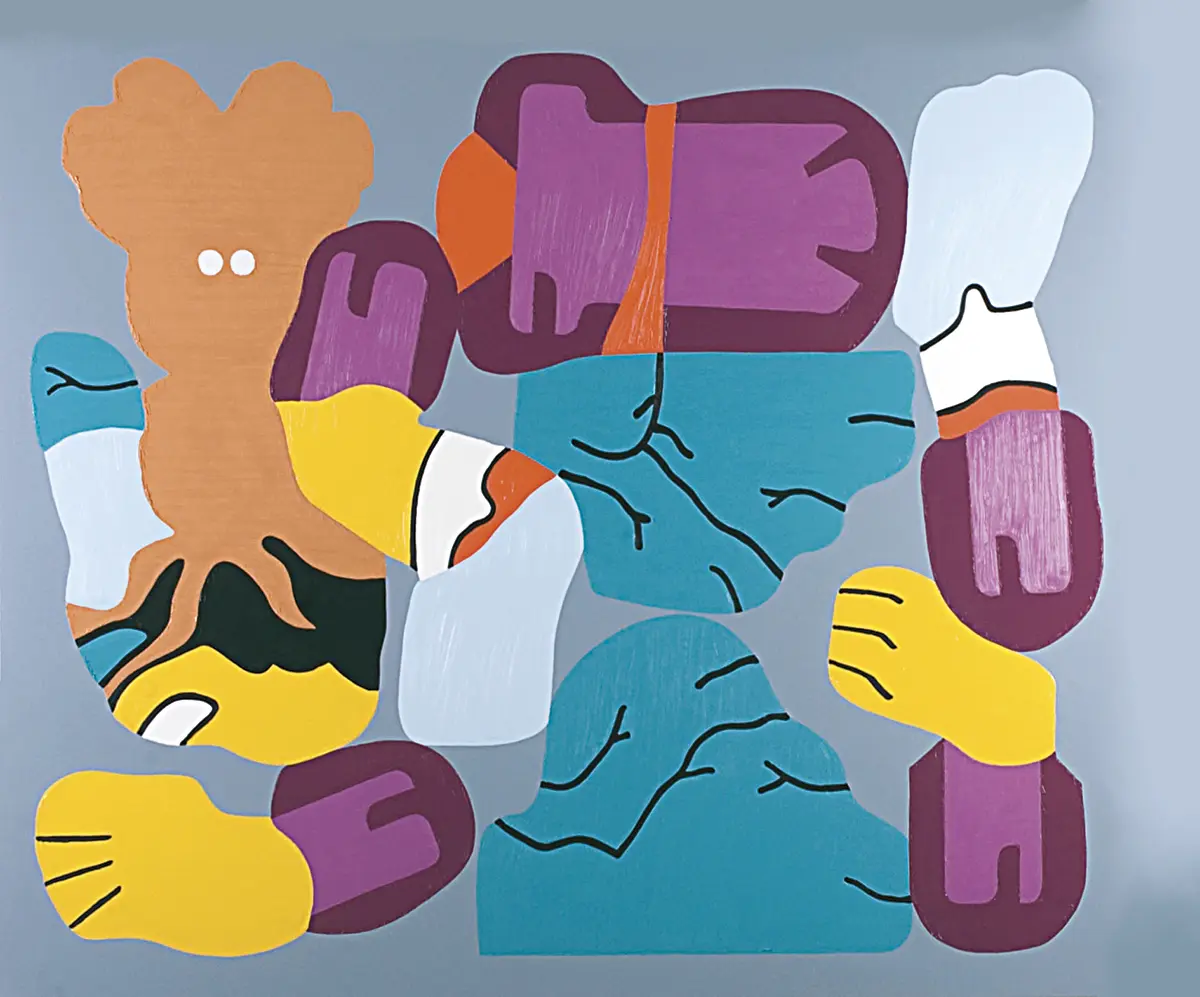
The other series in this exhibit was Paraguernicas. Unlike the works just discussed, these leaned away from formal abstraction and turned to a certain extent to figuration. In Paraguernicas, Uhía abandoned the traditional format and the materials that have characterized his works in recent years in order to explore textures and different ways of handling oil paint. Although the theme of this series also dealt with globalization, it was different. Here, Uhía turned his attention to an urgent concern in Colombian life: paramilitarism, its media coverage, and its effects.
In these works, Uhía demonstrated a surprising ability, combining his profound understanding of art history with current news images from Colombia, moving from the prosaic and satiric to the macabre and painful. Forms originally derived from The Simpsons TV characters—printed on bags of potato chips—were transformed before one’s eyes from cartoon characters to protagonists of terror. They were inciters of memories drawn from Picasso’s famous Guernica, from prints by the Colombian artist Luis ángel Rengifo concerning the period of bipartisan violence in Colombia, and finally from the images of mass graves revealed by the confessions of paramilitaries in connection with the disappearance of so many. For the viewer, little time was lost before the admiration of Uhía’s color in all its euphoric and deceptive beauty became a sorrowful contemplation of dismembered bodies, and in short time one came to realize how macabre the situation really is.
It could not be any different. Uhía’s paintings are like his theme: apparently uncomplicated, fun, vibrant, and seductive while simultaneously sinister, disheartening, and tragic at the core.
MARÍA CLARA BERNAL