
Through the use of unconventional materials, Francisco Bugallo explores the discursive possibilities of the great themes in Western painting. His most recent exhibit titled Al Final… el Juicio (At the End…The Judgment) at the Freites Gallery, between June 8 and July 27, collected together thirty-one medium-format works created by the artist during 2007 and 2008. Consistent with traditional disciplines, Bugallo nevertheless does not hesitate in experimenting with new elements: meaningful add-ons and supports that reveal the passing of time. This is the manner in which he insistently scrutinizes the models created by past masters and the symbolic and allegoric meanings that transcend the centuries. Notwithstanding these thematic references, his proposal is guided by a contemporary approach that assumes notions of appropriation and renovation, imitation, and invention that leads to a reflection on the icons constituting and shaping the collective memory. For this exhibit, Bugallo uses the characters painted by Michelangelo between 1534 and 1541 for The Last Judgment. Bugallo separates these from the group, de-contextualizing and isolating them; he studies their poses, expressions, volumes, and foreshortenings to then recreate these characters from a particular perspective; it is a cast that is not far from being “the sanctuary for the theology of the human body”, as Pope John Paul II suggested at an April 8, 1994 homily, during the Mass to celebrate the restoration of this portentous fresco that decorates the Sistine Chapel.
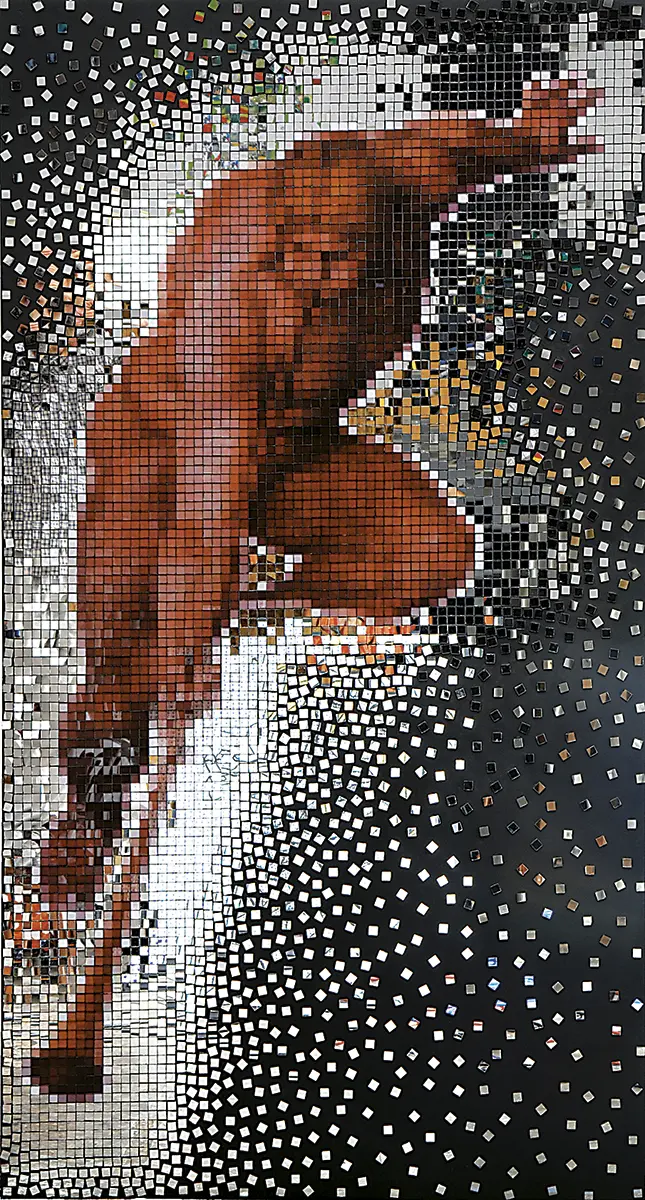
In this composition by Bugallo, the shapes are executed following a classic style –utilizing graphite, charcoal, and sanguine on posterboard– and other techniques involving steps such as juxtapositions and perforations with nails and other objects that cut; outlines and perforations that, in other times, were effected with a tracing template, used by earlier painters to transfer preliminary designs onto a wall. In other works, he applies different types of media, in which pictorial and extra-pictorial elements confer dimension and enrich the visual discourse: Natural and industrial materials such as silicone, bottles, knives, feathers, limestone, concrete, mirrors, and sequins, among other components. These transform Bugallo’s works into a back-and-forth game of diverse textures that distort the boundaries between two- and three-dimensional states. “This artist” – Federica Palomero, the exhibit’s curator, argues – “now wants to do away with the academicism in painting, the technical braggadochio, the purified execution that he achieved with such ease; was so easily able to achieve. In turn, he permits himself new liberties, even as he delves into a universe of uncertainties; no longer can even the materiality of the pigments, the thickness of his layers, afford him support. Certain elements from the artist’s earlier works remain, such as the fragmentation and deconstruction of the great apocalyptic tale held in such high regard by art historians …”
On seeing his work as a whole, one could argue that for Bugallo drawing –as an expressive and imitative discipline, as well as a way to represent reality– means different things depending on the instrument utilized and the way it is applied. According to what Paolo Pino wrote in Diálogo Sobre Pintura (Dialogue about painting), in 1548, we could say that drawing consists of tracing the figures that are part of any design; this is one of the stages that precede painting, and it is defined as “….shaping, outlining figures, and rendering all things in chiaroscuros, that which you call a sketch…”. This is how Bugallo – explains Federica Palomero – evokes The Martyrdom of Saint Sebastian, by perforating the surface instead of drawing arrows that pierce through the Saint’s body, as he is usually represented. On the other hand, the depiction of Saint Bartholomew – one of Jesus’ 12 Apostles, flayed alive for preaching the gospel – depicts him surrounded by a halo of sharp knives that allude to the torment through which he consecrated his faith. In including these elements, Bugallo counterpoises two fundamental aspects of the visual arts; namely, form and content, a relationship in which materials were required to be subordinate to the narrative function of art. In this exhibit, both elements stand face to face, they fight without one excluding the other, generate tensions that energize the intention of the discourse, which the spectator must perceive when attempting to visualize the artists purposefully. Bugallo emphasizes both theme and materials. This way, he can penetrate the hidden parts of our memory so accustomed to storing the typified images we grew up with and have shared for years. The encounter between past and present originates with the human figure, presented in its naked, fragile, and transformable corporeity. But it is also rendered as a noble, beautiful, and virtuous creature. This is a revelation that places human beings as the very sublimation of the creative act.
GLADYS YUNES