
From a panoramic perspective, Germán Venegas’ artistic trajectory is more a succession of determined leaps than a continuous progression. The revisionist retrospective of his work, curated by Patricia Sloane and currently on view at the Museum of Modern Art in Mexico City brings this artist full circle to his origins (akin to someone who has just been discovered). It presents where he started from and the transformations that followed (which may also be called reincarnations, given the inclination and central importance of Buddhist motifs on his imagery) in a compulsive need for reinvention.
Amid the several leaps and evolutions covered by the exhibition, time appears to stand still. The inclinations and possibilities that have defined moments in Venegas’ work appear almost too sudden. The artist’s career comprises only twenty-five years; between formal and political changes of heart, he has changed a sufficient number of times such that is not possible to speak of a single path traveled, nor even a half path, like what Dante announced immediately prior to the beginning of his Commedia.
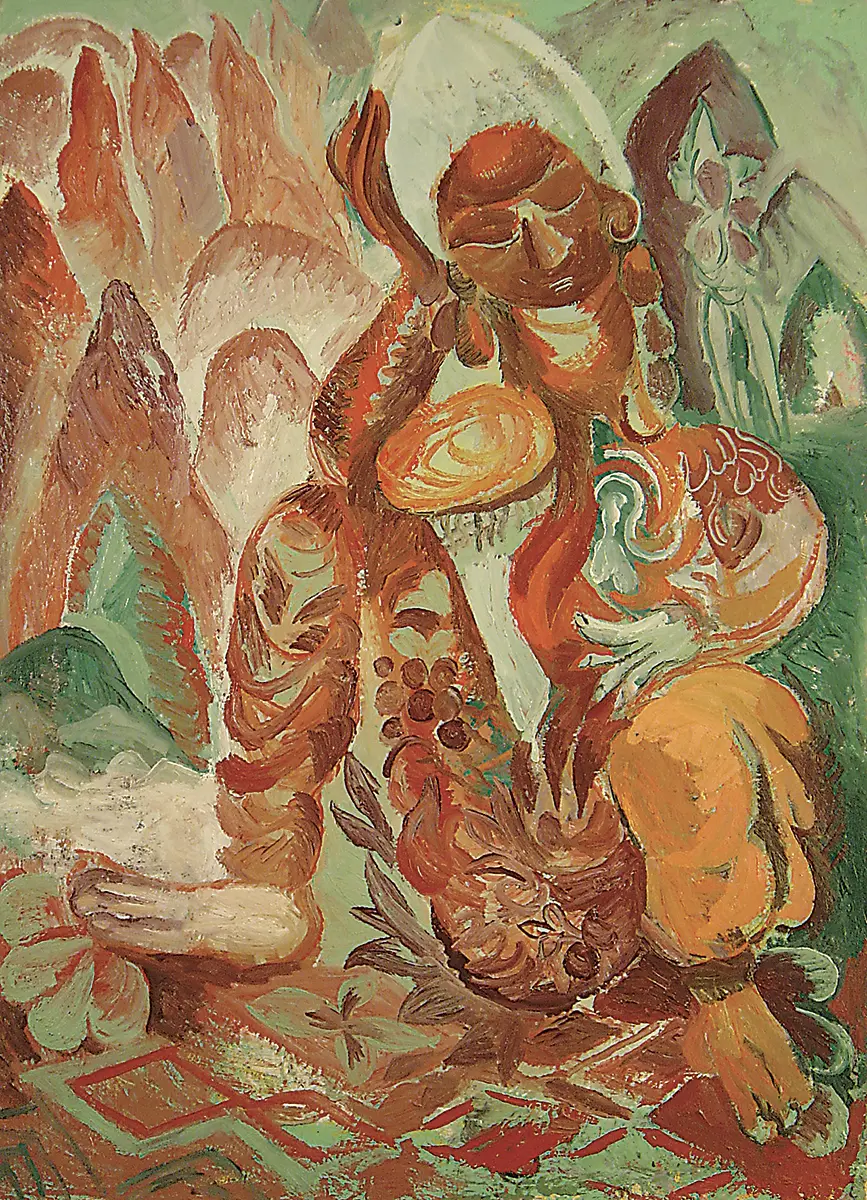
The body of work by Venegas can be appreciated through his renunciations. These appear in confrontations, juxtapositions, and insurrections as they work toward exhaustion. A farfetched paradox regards him as a tireless artist waging a war against himself (and sometimes against others), always vindicated through transformation. A lyrical creator, skillfully dedicated to the possibilities of wood carving, Venegas has found a way of dissembling folk themes and motifs that has always belonged to the world of craft, rescuing and transforming these into a sort of altarpiece in which folklore and postmodernity exist in a deceptive equilibrium.
There is a naturalness about Venegas. With visionary instinct, he captures the collage embodying virulent post-pop outbursts from the 1980s. These remain fresh, and their formal heroism can be observed in works that are surprising as choices for formal speculation: sufficiently disproportionate, austere, appealing to a large audience, and ridiculous in their solemnity.
But this place of transgressed materials and surfaces that foreshadow (and survive) a reading of glamorous monstrosities aimed at hybrid results is nothing but a point of departure to escape. Initially classified as a Neo-Mexicanist, then as a Neo-Expressionist, according to the needs of a phenomenological taxonomy, Venegas reacts time after time with a well-suited paranoia against these classifications. He does not fit into any particular label, and he is able (to date) to reinvent himself continuously.
Venegas has emphatically rejected each new label imposed upon him. In his work, he has searched for a place where he cannot be found. Defined by the particularities that have come to characterize his work, the artist hides by blending into the style of Orozco and proceeding beyond the multicolored and trans-cultural clamor (like a bodhisattva) in a vocation where feet cannot participate, which for him is concerned to a greater degree with signs than representation. One example is his self-portrait from the first Ascetas series. In his ability to synthesize materials and allusions, he has a supernatural instinct that mixes places, colors, forms, and figures with dexterity and intuition and an inconspicuous sense of composition that provokes the abyss (a Mexican style, if you will). Venegas knows nothing of serenity, as there is violence adorning his works that betrays his interest in Buddhism. A case in point is his painting Cabalgando Sobre El Tigre (which is also the title of the retrospective): while this work seems to present a vision of happiness filled with humor, both the story and the interplay among the figures unveil childish and avant-garde provocations.
The exhibit begins with altars with superimposed and brightly painted, carved figures—found in both Neo-Expressionism and Neo-Mexicanism—that exhibit a luminosity commonly found in traditional folk art. Subsequently, the viewer delves into Venegas’ Neo-Romantic period. In La Lección de los clásicos (The Lessons of the Classics), Venegas thematically and stylistically establishes a dialogue with Goya and José Clemente Orozco. This extreme, expressionistic predisposition is transfigured into baroque and grotesque wood carvings—defined in the exhibit as an “apotheosis” and a “fauvist” calling, an insolent appropriation of themes and styles by modern masters. Assuming this appropriation can be categorized as an assertion, it arrives at its coronation, which borders on the conceptual, with the series El violín y La flauta (The Violin And The Flute). Adorning one of the exhibit rooms, this commentary of “morbid” encyclopedic eagerness parodies The Flaying of Marsyas by Titian and exhausts its possibilities of repetition. Of course, there are also Buddhist and pre-Hispanic themes, a personal syncretism of ancient iconographies that recently have come to define both Venegas’ public and imaginary image.
RICARDO POHLENZ