
The works that Gonzalo Lebrija exhibited at the Laurent Godin Gallery in Paris titled Toaster R75/5 – originally created for the Carrillo Gil Museum in Mexico City – and the recent photograph series The Distance Between You and Me are both alternative approaches to rendering self-portraits. The function is to elevate the artist to the level of the myth of Prometheus, who no longer steals fire from the gods, but instead uses it to illuminate his way as he proceeds toward nature while in the midst of postmodernity.
Instead of perceiving the instrument (the bicycle, the camera, or the purloined fire) as a sign of the power of civilization, the artist incorporates it as part of his own body (indirect or metaphorical representation). By either exposing himself to extreme external physical conditions or by completely submerging himself into the environment, Lebrija is able to convey his own vulnerability, the fragility we share as human beings.
Lebrija’s aesthetic initiation took place during a visit to a luxury car show in Mexico City. There, he perceived the effects that the exhibited artifacts exerted on the space they occupied. In his Autopaisajes from the Nineties, the suggested presence of the artist’s moving body could already be observed: camera in hand, Lebrija would venture out into the streets on randomized walks, looking for reflections of the landscape on the finishes of cars. His Prometeo consisted of introducing a Ferrari into the interior of a museum in order to “steal” reflections from murals by José Clemente Orozco. In his work titled Entre la Vida y la Muerte (Breve Historia del Tiempo) (Between Life and Death [a Brief History of Time]), a black car steeply nosedives into a peaceful lake. This image conveys the beauty of an aesthetic experience that includes the components of the car that become part of the body of water, and even a metaphor on the dissolution of the self in immensity.
Lebrija’s presence is powerfully insinuated in the photographic series R-75 – named after a 1972 motorcycle model of the same name – like the year the model came out also happens to be the year of the artist’s birth. Lebrija never appears in the 66 photographs he took at the same number of stops during a busy day across Baja California State, where he took advantage of the mirror-like reflective quality the two-chromed panels on each side of the bike’s gas tank that had captured exterior spaces. The “Toaster” (another name for that motorcycle) really becomes an extension of the artist’s body: it is not just a tool or vehicle, but also a symbol of the body traveling through space under hazardous conditions on its way from Mexico City to San Diego. Thus, this action becomes a high-speed performance that tests the limits of the artist’s body, a vehicle for associations between mythic moments and the ephemeral nature of human gestures.
Notes on that trip —coordinates, temperature, distance covered to that point— are inscribed on frames containing the photos, and served as a chronologically ordered visual diary in which the author is replaced by the (vehicle) black-and-white portrait of the motorcycle taken at each stopping point. “I use it as I would a paintbrush”, affirms Lebrija. Nevertheless, imbrications can be even more intense: the bike serves as an extension of the artist’s body. Counteracting an initial, possible distant connection with the image due to this missing element (Lebrija) is the spectator’s compensating inclination to ponder the intense summer weather, to calculate the speed of the trajectories, to imagine the way in which time and distance between two points may have had to be overcome (nearly no stops, and no sleep), and to wonder at the natural desire prompting human beings to find their identity through difficult and risky actions, such as exploring a cavern or climbing a snowy mountain, in defiance of the mysteries of the natural world – but also of the labyrinths of civilizations. The combination between the motorcycle’s mechanical endurance – which required changing the shock absorbers halfway through – and the body’s limits of resistance are related to the ambiance in the film Easy Rider, or to Ahab’s obsession in hunting down Moby Dick. Also in this work are connections to performances by Bruce Nauman and Chris Burden. Lebrija does not inquire about the human condition from a comfortable conceptual distance, but instead, he puts on the line – under the pressure of the risk involved – what is most real of him: his own body.
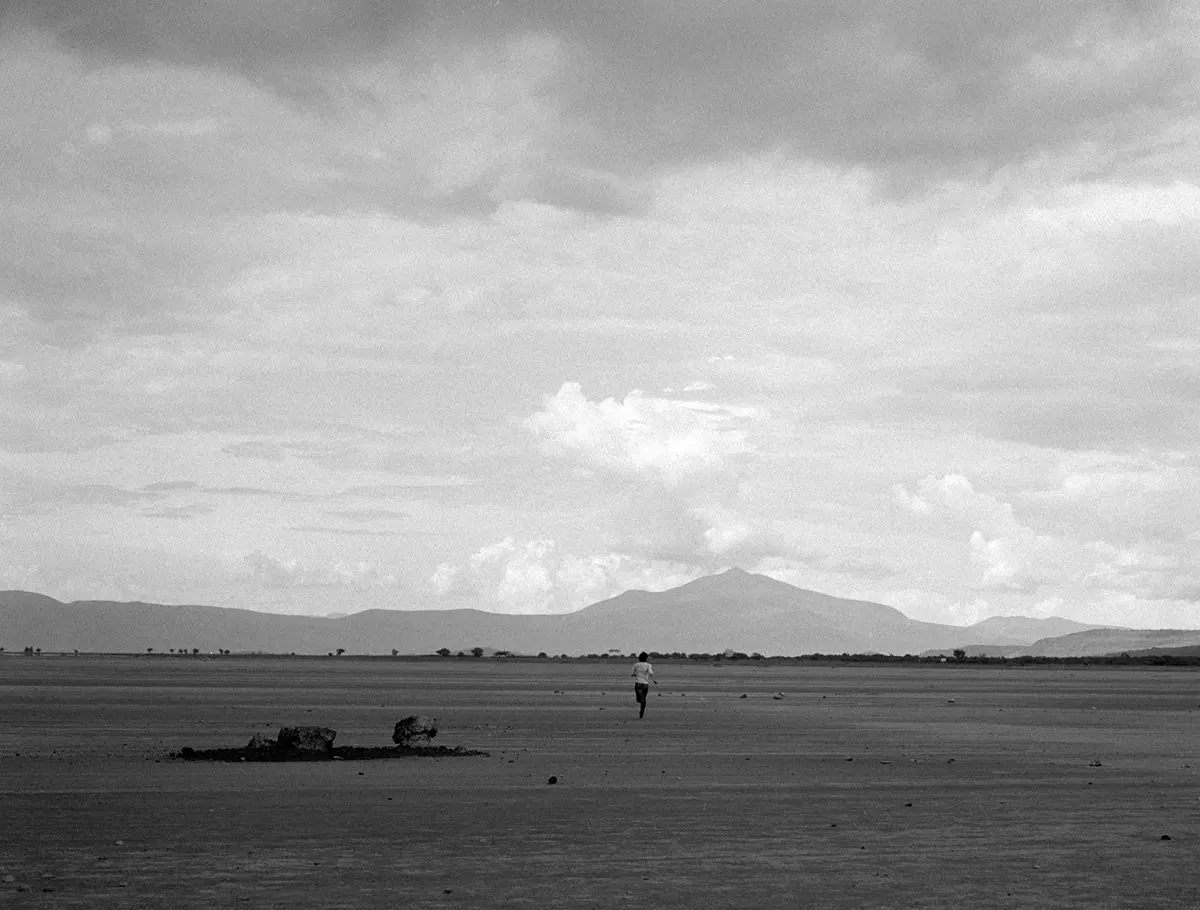
On one occasion, Lebrija changed one of his photographs into an English landscape from the Eighteen Century. He would have loved being inside the landscapes by José María Velasco or by Dr. Atl. In his analog photographic series The Distance Between You and Me, the artist focuses on landscapes he enjoys. He runs through the scene as the shutter is automatically activated, fixing his self-portrait in the middle of the highway. The timeless moment occurs at the point when the movement of the body and that of the programmed machine converge, when the distance among nature, the tools of civilization, and the artist’s gesture – forever freezing the image of his body immersed in the natural landscape – is erased. There is no other way back then through his work. The implicit recreational element is, like everything else, not only personal: it is an artistic solution that addresses the collective, the search for organic possibilities that do not subscribe to the logic of power while interacting with nature. The aesthetic act of allowing oneself to be absorbed by the living landscape also conveys the return to the human body as a place of truth in art.
ADRIANA HERRERA