
Reduced to the Maximum is not a minimalist proposal that contributes to the long career of Chilean artist Hugo Marín (1929). Contrariwise, such a title comprises a contradiction, considering that we are referring to Marín’s work. Given the precarious state of Chilean institutions, artists must put together exhibits with minimal budgets, and Marín’s response to that situation in this instance was to move his studio to the gallery. There, at the Roberto Matta Exhibit Room of the Museo Nacional de Bellas Artes in Santiago, the artist has settled in as if he was in his own home, and receives friends attends to the public and works with the help of an assistant.
He welcomes us at a high breakfast table, or invites us to sit in a small living room similar to the one at his home studio. His amazing sculptures of heads surround the space, some resting on rigid metal squares reminding us of candlestick props of saints, which disguised structures under their splendid clothes). Others are full-body sculptures that lie on the floor, such as the Chasqui (2007) (Messenger, 2007) animated in a running pose, and the Chasqui en Descanso (Chasqui at Rest, 2007), caught with his clay mouth open in surprise as he looks at the sky, revealing a dental prosthesis of human teeth.
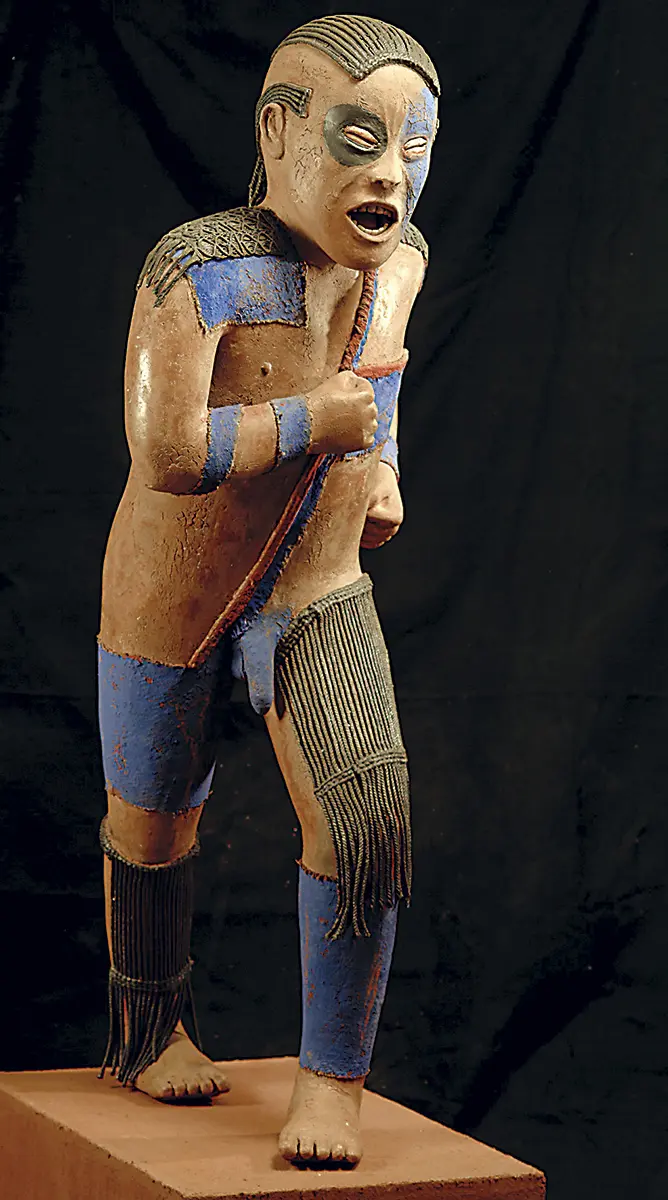
The titles of these works could erroneously be thought to point to an anthropological connection with the past, to singular beings lost in some bric-a-brac cabinet. On the contrary, Marín’s sculptures speak to us from an evocative and timeless time about our present and the convulsive human condition. The contemporary nature of his sculptures and the amazement they provoke, transcend the idea of the modern and the classic. They represent, within the Chilean context, one of the few artistic productions that truly interpret in a sophisticated and creative manner one of the pressing problems of today’s art: the tension between global and local, between identity and the deep reservoir of human knowledge.
On observing the sculptures in Marín’s studio at the gallery, I had the same sensation as when I first visited his actual workshop. As I entered the space, I felt surrounded by staring eyes, mouths, poses, and characters, inquisitive with the sound of their silence, producing a lively impression through their expressive power and frozen histrionic gestures – because Marín does not ascribe to the notion of silent matter. The color of the unbaked clay, the main material he uses to superimpose and assemble his works, identifies the Mestizo skin of the Andean land. The heart of the sculptures is the insulating material utilized as protection when packaged. There is here a mixture of natural and artificial elements, contrasts between the massive volume of these pieces and their lightweight, an adaptation and good use of precarious conditions and recycling. Shells, marble, vegetal fiber, jute, feathers, and other surplus materials are combined to create beauty and generate amazement. “Technologies” and creative approaches evoke and connect us with the memory of a past that belongs to us. It is the presence of a continuous cultural and material dialogue that we have incorporated into our present by means of continuous processes of transculturization and anthropophagi. To approach this exhibit, resorting to notions of the popular and pre-Columbian frames of reference is only to scratch the surface.
It is the materiality of sculpture-volume, shape, and color – that unifies the senses of touch and sight. The volumes created by the artist allow for the synthetization of painting as an expressive element, along with other materials that visually contribute to conveying the personality of the characters portrayed. Greeks painted their sculptures and temples; architecture was to them the highest expression for unifying diverse elements. The latter is what sculpture is to Marín.
Is his work suggestive of the return of a sacred, ancestral, and hidden place that returns to our consumer society in order to teach us something? Perhaps. Art continues to be a way of revealing the deepest truths about our reality, which herein hides underneath the “illusory maya veil” – according to Hindu tradition – that conceals the objects perceived with our senses that are distorted by the schizophrenia of the contaminating images in our society.
In Marín’s work, artifice overemphasizes the theatrical to salvage the mystery that has been lost in art. We simultaneously find authenticity and a synthesis achieved by rage in the cultural fusion that characterizes us. Why not grant sculpture an unbiased space where the human figure transcends mere narcissistic academic representation, and instead propose a look into who we really are? Hugo Marín presents us with keys to answer that question: does finding our potential and identity lies in our condition as Mestizos, and in the possibility of our establishing a connection between our past and future, through the common thread of our present, namely, an identity deeply rooted in this southern land with a history that began prior to the Spanish Conquest and that assists us in explaining the present.
DERMIS P. LEÓN