
I’ve always wondered why
a minimalized aesthetic has such staying power. The easy answer is that at the
core there remains an abstract vision and artists like Iran do Espírito Santo
consistently find formal issues —the perception of solid form and the concepts
of form— continuously fascinating.
In the USA that vision emerged out of Abstract Expressionism to unite what at first seemed complete opposites, Pop and Minimal art. In Brazil, it emerged within the Neoconcrete movement. The widened concerns of Ferreira Gullar were written from a phenomenological point of view and published in Brazil’s national newspaper by 1959. And just as Neoconcretism provided a briefly unified kernel applied by Brazilian artists in quite different directions, so too in the USA. A minimalized vision became another tool or strategy to reinvest old and new issues, as Espírito Santo has done over the years and continues within his current exhibition.
The exhibition title takes its name Deposition from two works, Deposition 1 and 2, and includes the far more spectacular wall installation in the rear room, En Passant 2. In each of two all-white rooms are propped against the rear wall one of two identical solid, two-inch-thick slabs of (more or less) black granite, five-by-seven feet. Because the only difference is their orientation, the horizontal and vertical axes change places. Each is carved the same, to look like large framed pictures with the mount, frame, and picture in the frame - or the "concept" of a picture in the frame - as one blank black unit.
What is a deposition? Clearly, it’s a verb, an action, now attached to two large objects. But is the root of the act to depose, i.e. to remove and/or declare, or is it to deposit, to put down, or entrust? If so, which? If deposed, what is removed or declared? Certainly, the picture and the idea of the picture; the press release refers to the Depositions as simulacra. If deposited, what is deposited aside from the two black slabs, and perhaps more relevantly, by whom: the artist, our speculations, natural sedimentation, the art handlers, or perhaps - to judge from past reviews of his work - art critics? Does it even matter?
I feel like I am looking at a list of the seven (or is it eight or nine?) basic plot lines for all novels, where you get to mix-and-match to create your own variations on well-known conventions. The feeling is the same, i.e., we’ve been here so many times we no longer need the art: minimal-expressive, presence-absence, solid-void, picture-object, body-mind, optic-haptic, architecture-sculpture-drawing, and even the return of the old modernist 2D-3D with edge to plane, etc. Such strategies seem dated since we are far removed from the formalist values at the heart of Greenberg’s modernism. Yet the game structure reminds us that meaning is not merely something assigned but a process more flexible and open to choice, one located in a public interface in the real world of objects. But beyond that, my question is what do or can we know here if the parameters of the game are formalist issues?
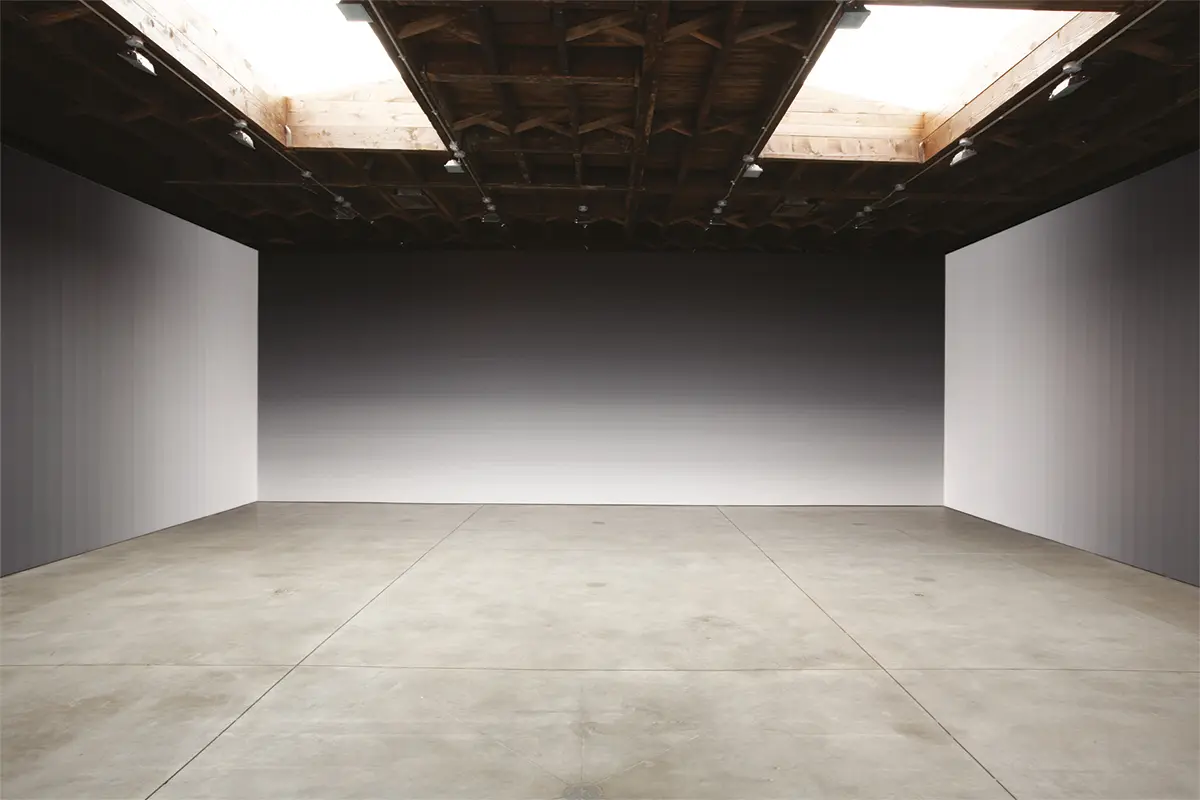
In the third and much larger room, whose two side walls are at first blocked from view by the door frame as you walk down the hall, sits a large rear wall (3.86 x 10.5 m) completely covered with painted horizontal stripes in gradations from pure white to pure black - the grayscale. Because of the gradations, the back wall projects the optical illusion, especially on approach from the hallway, of curving forward at the bottom. On entering, you see the side walls (ca. 11.3 m) painted with the same grayscale gradations but in vertical stripes with each wall identical. It may be called site-specific but the term implies a sense of locale, hence flexibility that is not present here. Rather, the grayscale, although it relates vaguely to Espírito Santo’s youthful experience in a photo lab, is a modernist, pre-established pattern that can be scaled. Which means the most: the "objective" illusion or the "subjective" dominance of the artist’s ego on the space?
Yet, this is more successful because the phenomenological experience of the embodied vision moving through space and time is more effective than the static and conceptual interplay of the Depositions. Here, in- or while passing En Passant reiterates the interplay between body and perception and opens more fundamentally the questionable state of how we know things in the real world.
RICHARD LESLIE