
Under the title El anima (The Ghost), Marcia Schvartz (Buenos Aires, 1955) presents a new exhibition with both historic works and her most recent production. Selected by Gabriel Levinas, her friend and a connoisseur of her work, Schvartz’s paintings, sculptures, and relieves connect with one another, avoiding the chronological corsets that often dominate this kind of show. The order established by Levinas to present the works is not strictly thematic, either; rather, it attempts to reveal clear connections within a vital and diverse visual production that jumps from portrait to landscape, from local color to surrealism, from charcoal on arpillera to polychrome ceramics or large-format canvas, with or without incrustations of small materials that turn painting into a collage.
Within its obvious multiplicity, Schvartz’s work has always been characterized by one feature: its edginess. In her violent, neo-expressionist brushstroke, and even in the small ceramic pieces that evoke the twisted shapes of the organic world —flowers, fruits, snails, cacti—, the artist generates levels of intensity that cannot be assuaged. Marcia Schvartz never attempted to lighten up, and perhaps because of that, her personal seal is so recognizable, so unique. Out of fashion more often than not —she never subscribed to conceptualism, minimalism, the photography boom, video, or the digital arts— she survives clinging to her undeniably skilled draftsmanship, her scant desires to please, and the fire-set rictus or her condition as a member of a generation that was disappeared, exiled, killed.
In her paintings of the 1980s —portraits of friends and street characters—, in the loving winks towards a mestizo America —her sensual nude Indian females of the early 1990s, the Paraguayan women and dark-haired men who come and go, traversing different periods—, or in her landscapes inspired on the wild, colorful flora of the provinces, Schvartz expresses a passion for the humble and the déclassé that links her to other great figures in Argentine art, such as Antonio Berni and, closer to her, Pablo Suárez. But while she inserts herself naturally into a saga of local artists enamored of the popular, she does so her own way: brilliant paintings like El ánima, from which the show takes its title, confirm her ability to allow herself the darkest fantasies in the hypothetical task of representing the real. El ánima (1994) appeared, in harmony with her fascination with the northern flora, under the shape of a woman-cactus, covered in thorns, painted in green oil, a monster with her mane floating in the wind, white teeth and slanted eyes that crops her figure in the foreground against a sky where an orange sun shines brightly.
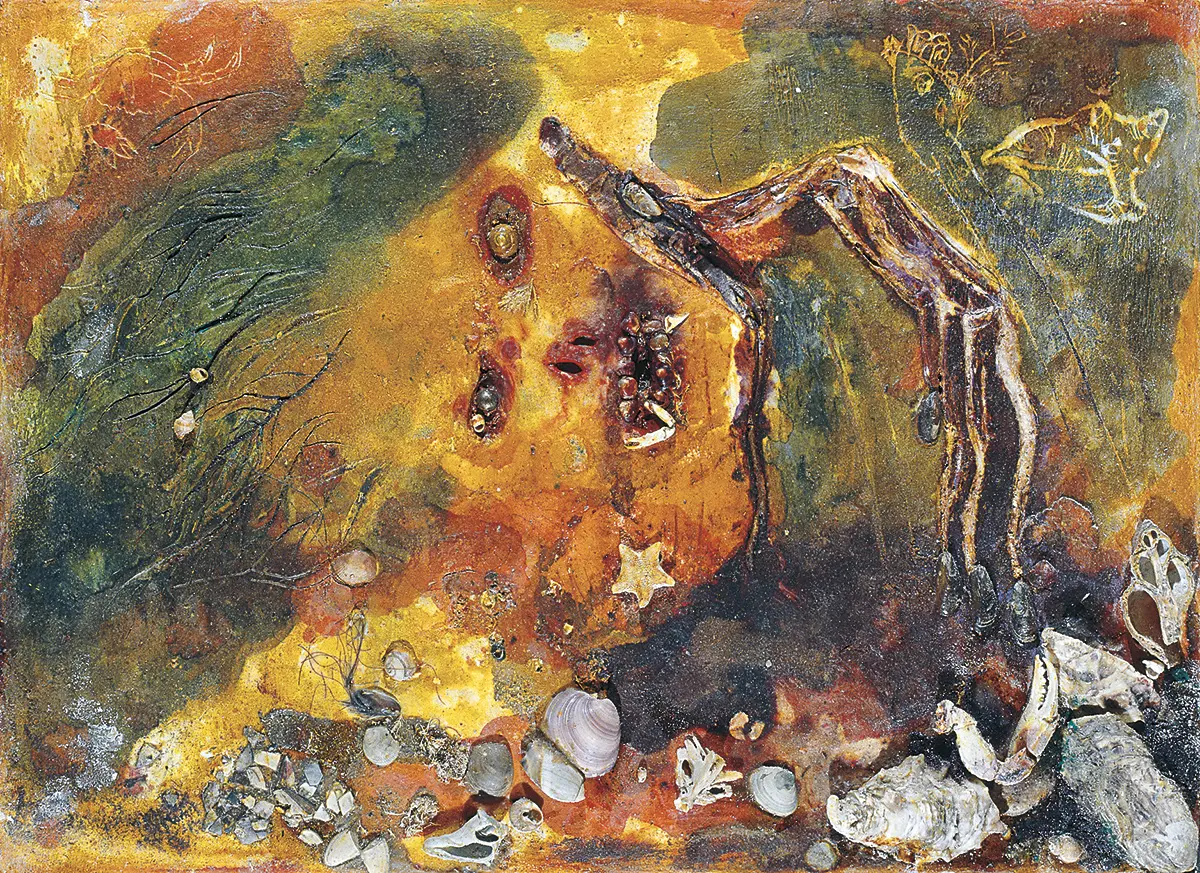
The show covers the entire spectrum of her oeuvre, including the most recent works, grouped under the name of Fondo. These are literal bottoms, bottoms of the sea and of rivers resolves as relieves or collages, but also symbolic ones, viscous and barely complacent. La zanja (The Ditch), an outsize canvas with a variety of encrustations at its center are undoubtedly one of her masterworks, and if there were something like pictorial justice, it would also be a landmark in the history of Argentine art. Detritus, rocks, and bones —chill-inducing bones— fuse in those bottoms that display Marcia Schvartz’s talent to unfurl her materials and her ideas with uncommon freedom, with a style accustomed to fearlessly approach the most fearsome topics.
EVA GRINSTEIN