
Mimicry is the current solo exhibition of Colombian-born, Australian-based artist Maria Fernanda Cardoso, at Bernice Steinbaum Gallery. The show addresses an inevitable phenomenon in the animal world, the physical adaptation of a species into its surrounding as a survival mechanism. This is Maria Fernanda’s underlying intention in the presentation of this body of work.
It is not the first time that animal elements appear in her work. In the past, she has used dissected frogs, piranhas, and starfishes as part of her pieces. Perhaps her most recognized work is her flea circuses, for which she raised and trained fleas in the same fashion as it was done in the 1930s when it was a popular attraction. The connection between her past and latest work is particularly established by three pieces currently on exhibition: A Garden of Insects that look like Plants (2006) —a sort of fish tank with insects—; and two videos: Stick insects on the branch (2004-2008) and Stick insects swaying on metal rod (2004-2008). The pieces document insects blending with nature, showing how they engage in a mimicking process with things such as branches. Maria Fernanda also uses these pieces to bring to our consideration the beauty of the mimicry phenomenon exactly as it happens in nature.
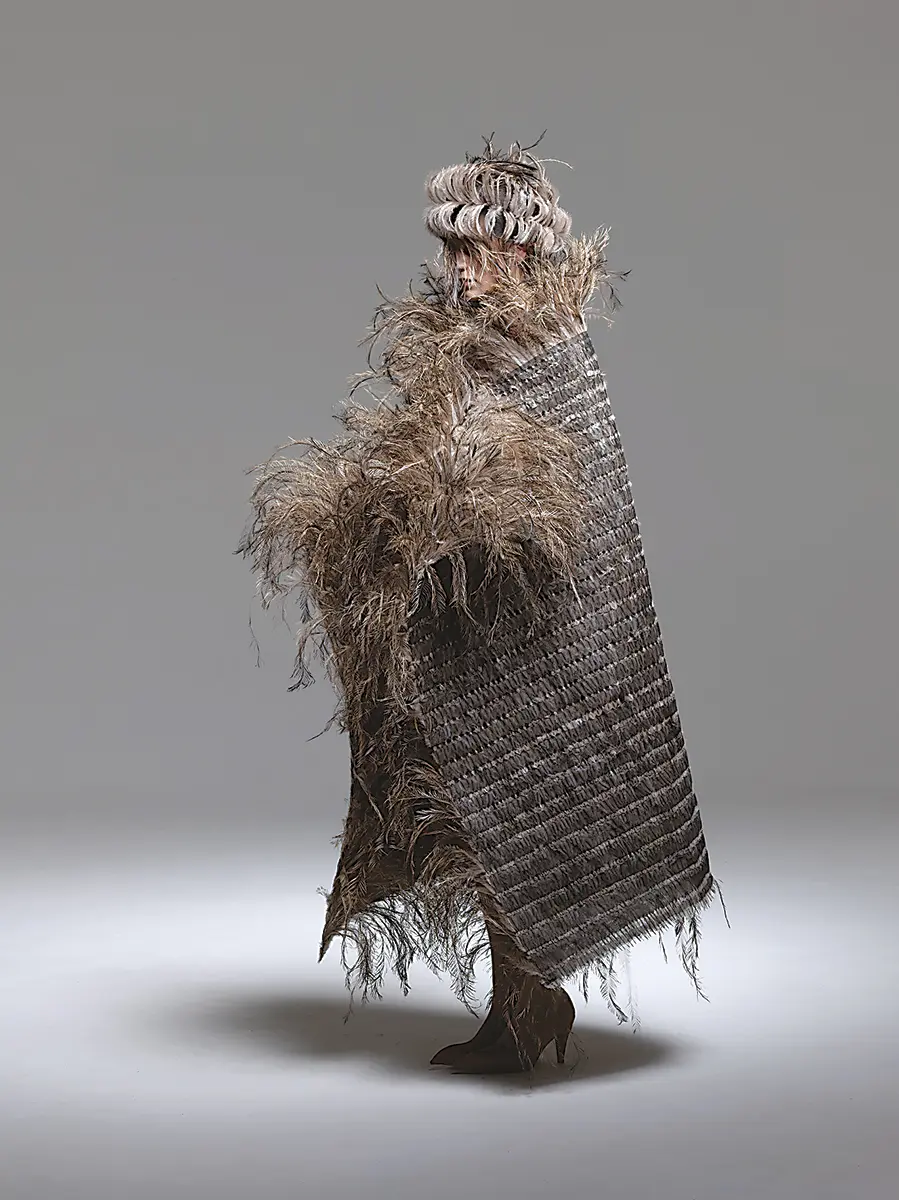
The main focus of the exhibition is her most recent work, based on the national bird of her adoptive country, the emu. The central pieces are four dresses and hats. They are exquisite pieces entirely made of emu feathers and skin, skillfully woven into fiberglass nets. Although each dress is very different from the other, the forms are distinctly and intentionally made to resemble the emu birds.
The dresses are exhibited as objects, as hanging sculptures, with photographs alongside showing how they look when worn. Emu Rectangle is perhaps one of the pieces where the object-dress dichotomy is more evident. The work in its raw form is a rectangle made of feathers. The brown-black colors of the feathers create an abstract image that replicates the same color and texture typical of the grasslands in Australian landscapes. This structure can be turned into two different dresses, suggesting a dual camouflage. Depending on which side of the garment is on the exterior the dress either exhibits the feathers or the fiberglass netting, suggesting different stages of disguise.
Rauna is another work that hangs by itself as a sculptural object but once worn by a model the piece becomes alive and takes the form of a giant brown bird. The final effect is undoubtedly reinforced by the hat, a triangular form meant to cover the entire face. The hat gives the impression of a bird beak, uniting the feathers of the dress with those of the hat. The person underneath the attire becomes invisible. In a projection on a loop sequence at the entrance of the gallery a model wearing the Rauna dress is shown making movements analogous to a bird ready to take flight. The depiction of the woman-bird represents the idea of becoming the animal through a mimicry method and can be considered as a vestige of pre-Columbian cultures. Evoking the spirit of an animal is intrinsic to shamanic religions. A ceremony brings the spirit of the animal alive and allows the person partaking to unite with their ancestor which they believe to be the animal. Therefore this animal-person relationship becomes a sacrament of direct dependency and survival. This totemic approach to life is the foundation of Maria Fernanda’s pieces, in a sense, she is documenting her transgression from her human appearance to an emu, which for her is the ultimate step in her transformation as an Australian native. Her work has a ritual quality that involves the objects made by the artist (dresses and hats) and the person wearing them. More than mere disguises they are attempts to turn into the animal, to acquire those characteristics that define its nativity.
At first glance, one could think that María Fernanda’s intention was to make couture dresses. Although it can be interpreted as that, fashion is not precisely her main concern; her statement goes beyond that. Made with infinitesimal patience and skilled crafting these dresses and hats are unique creations. Her respect for the material is almost ritualistic; she imitates the animalistic qualities with reverence, taking the feathers and skin and literally wearing them. Maria Fernanda’s work speaks of self-adjustment, of the ability to become something or somebody else under given circumstances. In a way, her work becomes a metaphor par excellence of her adaptation process in Australia. She is ‘mimicking’ this otherwise ordinary process and successfully blending into her new environment by transforming herself into an integral component of the local fauna: the emu. By visually registering this progression she is alluding to the human equivalent of the mimicry practice, recreated in a certain manner when we attempt to integrate ourselves into a new culture or try to adopt new traditions.
IRINA LEYVA